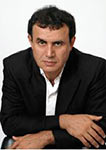
Nouriel Roubini, the once-obscure economist who gained celebrity and the title “Dr. Doom” after correctly forecasting the financial crisis, believes that current Fed policies are destabilizing the markets and pushing the economy toward another collapse.
Roubini sounded the alarm while delivering the keynote address at the Index Universe Inside Commodities conference last week in New York.
As a consequence of Fed policy, Roubini said, investors should prepare for an anemic U-shaped recovery and avoid risky assets “across the board.”
Oil prices are the tipping point
The current recession was not triggered by subprime lending, a housing bubble, or the collapse of Lehman; according to Roubini, it was brought on by a global trade shock –oil prices rising to $145/barrel – that crippled the US, European, Chinese, Indian, Japanese and other major commodity-importing economies.
The recent rise in oil prices from $30 to $80/barrel is very hard to justify based on fundamentals. With global demand for oil at 2005 levels and inventories at all-time highs, Roubini believes oil prices have formed a bubble.
The danger today is precariously high oil prices, which he said are driven by speculators and option traders. “If oil reaches $100 – not based on fundamentals – it will have the same impact on the global economy as oil did at $140 last year,” he said. Global economies are just getting back on their feet, and oil at $100, if driven by speculative factors, would be highly destabilizing, Roubini believes.
Although he generally does not favor such regulation, Roubini recommends market controls for the oil futures markets to limit price movements caused by speculative trading.
The dangers of the dollar carry trade
While oil prices pose the greatest threat to economic growth, Roubini said, the dollar carry trade imperils the stability of financial markets.
Hedge funds, banks, private equity firms and other institutional investors have been able to borrow at near-zero interest rates in US dollars and take long positions in risky assets, including those denominated in other currencies. Those risky assets include global equities, commodities, and bonds. Because the dollar has depreciated at an annualized rate of 20% over the last six months, he said, “the game is obvious” and “every investor looks like a genius.”
“Global liquidity is climbing a wall of worry and is pushing asset prices higher, driven by the global carry trade,” he said.
The carry trade has caused all asset classes to be highly correlated. Even trades that appear to be different are really the same, Roubini said.
What matters more than correlation, however, is artificially low volatility in the markets. By buying assets (mortgaged-backed debt, for instance) at the long end of the market, he said, the Fed is reducing volatility and “making the world safe for the time being for this carry trade.”
“This carry trade cannot go on forever. Eventually it will unravel, and when it unravels it will get ugly,” Roubini said. If the dollar reverses, everyone will try to exit and “the mother of all asset bubbles will become the mother of all asset busts.” Everyone thinks they can get out, Roubini said, but “there will be a stampede, and 95% of the people will be crushed.”
Roubini cited a number of reasons that the carry trade must end. The dollar cannot fall forever, he said, and it will eventually stabilize. Similarly, the Fed cannot reduce volatility forever, and the current plan to purchase assets is scheduled to end in March. That will result in large budget deficits and a lack of buyers for mortgage-backed securities, causing spreads and volatility to rise. If there is a V-shaped recovery, the Fed will abandon monetary easing, and interest rates will rise, triggering a reversal of the dollar. Lastly, if there is a U-shaped recovery with a risk of double-dip recession, investors will become risk-averse and seek the safety of the dollar, as they did last year. This, too, will cause the dollar to rise.
The end of the carry trade will trigger a market crash, Roubini said, and “the global economic consequences will be more severe than the bursting of the housing bubble.”
Equities now overvalued
“The increase in equity prices is too much, too soon, and too fast and cannot be justified by the improvement in fundamentals,” Roubini said. The economy has bottomed out and started a gradual recovery, he added, but asset prices have “gone through the roof.”
Those fundamentals justify only some of the market rally that began in March, he said. Back then, the market was not just pricing in a recession; it was pricing in an L-shaped depression, with major economies being taken over by their respective governments, he said. Government action has averted depression by minimizing the “tail risk,” Roubini said. “Given that risk is lower, asset prices should be higher,” he said.
Regardless of shape of recovery, Roubini said there is light at the end of the tunnel, and asset prices are anticipating a recovery. Risk-aversion is on the decline, he added. “We have avoided Armageddon, and investors have moved to riskier assets.”
Indeed, if the global economic recovery turns out to be V-shaped, Roubini said, prices would be justified and could rise further.
Roubini, however, forecasts a U-shaped recovery for the US, Europe and Japan that, at some point, will cause asset prices to “move sideways and correct.” His forecast is similar to those of the IMF and of PIMCO’s “New Normal.”
The case for the U-shaped recovery
The horrible state of the labor markets in the US and other advanced economies will depress consumption and serve as the underlying driver of a U-shaped, rather than a V-shaped, recovery. Roubini pointed to a reduction in the average work week to 33 hours, which he said equates to another three million job losses on top of the 7.2 million already lost during this recession.
The crisis was brought on by excess leverage in the financial services, corporate and household sectors, and while debt ratios have stabilized, they are not falling. In addition, Roubini said, the public sector has undergone “massive leveraging,” and solvency issues will impede economic recovery.
In addition to the US, other overspending countries – like the UK, Spain, Australia, New Zealand, and the Baltic states – must overcome the same issues in their labor markets and reduce personal leverage in order to increase consumption and grow their economies.
In a typical V-shaped recovery, Roubini said, capital expenditures rise sharply and catalyze growth. But capacity utilization in the US and Europe is at 70%, and he does not expect capital expenditures to grow until utilization reaches 80%.
What’s more, damage to the financial system has not been repaired, and Roubini said solvency problems and contraction in the commercial banking, mortgage banking, hedge fund and private equity industries will impede credit growth – and therefore recovery. Even when credit growth turns positive, he said, it will not be “perky and bubbly” like it was during the credit boom.
Unless there is a rapid recovery by the second quarter of next year, Roubini said, the fiscal stimulus will turn into a fiscal drag. “Eventually, the bond market vigilantes will force rates higher,” he said, and with that will come higher expected inflation. “It doesn’t take much more than higher expected inflation to drive a recession or stagflation,” he said.
Roubini is more bullish on the emerging markets than he is on the US and developed economies, because they do not have high leverage in their household and financial sectors. Their flexibility to use monetary and fiscal policies could accelerate their recoveries.
China, however, will not be the major engine of global growth that many hope it will be. “The numbers just don’t add up,” Roubini said. China’s GDP is $3 trillion compared to $15 trillion for the US. In the US, 300 million people represent $10 trillion of consumption, but 1.3 billion Chinese consume only $1 trillion worth of goods. Maybe in 30 years, China can drive global growth, but Roubini said that day will not come soon enough to make a difference in the current economic cycle.
Is there a solution?
“By trying to avoid deflation and create growth, the Fed is creating the mother of all asset bubbles. It will destabilize the financial system, creating a credit bubble which will come down crashing very severely unless you take a different type of action sooner rather than later,” Roubini said.
Roubini called the Fed’s policies “reckless” and said that those policies are being exported for reluctant adoption by other countries. “The consequences of easy money are that the dollar falls and all other currencies appreciate, especially in Asia and Latin America,” he said.
Currency appreciation is a huge concern for export-dependent countries, and many are intervening in the markets to devalue their currencies. Korea, Indonesia, Thailand, and other Asian and Latin American countries are intervening and only partially sterilizing (i.e., selling bonds), Roubini said, and this is causing growth in their money supply. Intervening without sterilizing at all creates even greater growth in the money supply.
The central problem, Roubini said, is that the Fed is trying to achieve two policy objectives – economic growth and financial stability – with a single policy instrument, the Fed funds rate. Instead, he said, they should be using credit policy to regulate the financial system, and he recommended increasing margin requirements as a way to decrease leverage. “But they must be selective to avoid creating a credit crunch on the real economy,” he added.
Investors should prepare for deflation through at least 2011 and possibly 2012. By then, large budget deficits will cause inflation, he said. Inflation will also be driven by increases in commodity prices, which will come from a weak dollar and from global liquidity and the carry trade funneling money into commodity-based investments.
The government is running out of “policy bullets,” Roubini said. If oil goes above $100 and there is a policy mistake pushing the economy into a W-shaped double-dip recession, “that would be a disaster.” Roubini assigned a 25% probability to that scenario.
Roubini recommended being risk-averse across the board for risky assets. Investors will know in six months if there has been a V-shaped recovery, in which case there will be many years ahead for double-digit returns on equities. If, on the other hand, we face a U-shaped recovery, then there will be a massive correction. Investors should be “better safe than sorry,” Roubini said.
Read more articles by Robert Huebscher