The following is in response to our article, Debunking Ken Fisher, which appeared two weeks ago:
Dear Editor:
It took leaving the country to get off his marketing lists. His marketing staff does quite well financially. However, I could not find a single investor that could substantiate making a profitable long-term investment with him, earning more than that of a Vanguard fund. His fees were outlandish, and I have no idea as to the churning costs he incurs, and the stocks given me by him to follow did no better than a global fund index at lesser fees and greater liquidity. I could find no one to substantiate how costly it would be to leave his fund during the last downturn when he was advocating buy-and-hold. Throw in tax consequences, and I could not in good conscience use his services.
All funds are Ponzi-esque. When Fisher discusses the obvious, casting the Ponzi mantra at others, he is preaching to his choir and sucking in newbie investors. I have yet to see the net-net 'provable' financial results from Fisher.
Happy New Year,
Joel-Geri Dee
Berlin, Germany
The following is in response to the article,Return Distributions and the Shiller P/E Ratio, by Keith C. Goddard, which originally appeared on February 2, 2010 and was contained in your section The Ten Best Articles You Probably Missed on December 28.
Dear Editor:
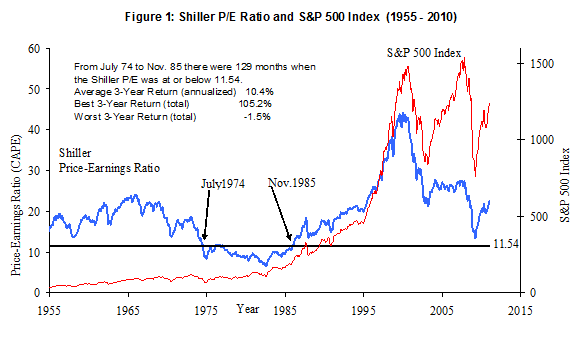
This article makes the point that one should time one’s investment in the market depending on the level of the Shiller P/E Ratio. The article shows that when the P/E Ratio is at 11.54 or less the returns are superior to what one would achieve if one invested when the P/E Ratio is higher.
Although this advice is theoretically correct it is not practical. If one has to wait until the Shiller P/E Ratio is below 11.54 before investing in the market, then one may have to wait for a long time. The last time when the Shiller P/E Ratio was at or below this level was between 1974 and 1985. See figure 1 for details.
More recently, during March 2009, the Shiller P/E Ratio was at 13.32 and provided a good signal for entering the market. This was 24 years after the 1985 signal. Given this history, the next low of the Shiller P/E Ratio might not be for another 20 or more years. Investors relying on this signal will have to be very patient.
Sincerely,
Georg Vrba