Advisor Perspectives welcomes guest contributions. The views presented here do not necessarily represent those of Advisor Perspectives.
Investors face the challenge of funding decades of retirement in an environment of low interest rates and lackluster stock valuations. For many, earning market returns alone will not suffice. Hence, thoughtful portfolio construction needs to incorporate asset classes that have higher long-term expected returns. In this regard, small company or small-cap value stocks – the stocks of smaller companies that are low priced in relation to earnings, dividends and book value – have a critical role.
Based on long-term historic indices, small-company value stocks have returned a significant premium to the overall market as well as to small-company growth and large-company growth and value stocks. This premium is illustrated in the following graph which illustrates the growth of $1.00 U.S. invested in small cap value stocks (in red) compared to the other indices from July 1927 to December 2010.
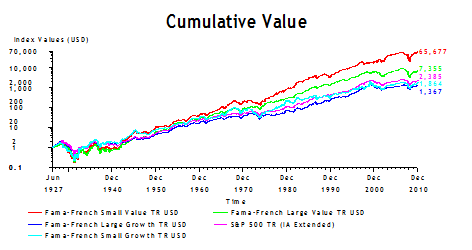
The investment in small company value stocks grew to $65,677 – nearly 28 times the $2,385 of the S&P 500 and nearly nine times the $7,355 of large-company value stocks. Contrary to the popular conception that growth is the place to be, growth stocks, both large and small, lagged their value counterparts.
The historic outperformance of value stocks in general is a well-documented global phenomenon1. Until recently, however, research on small-cap value stocks has tended to focus on performance in individual countries. For example, the small-cap value premium has been found not only in the U.S. but the U.K.2 A comprehensive analysis on the performance of small-company value stocks globally has been lacking until the recent publication of sweeping study3 by Professors Fama and French. Encompassing 23 countries for the period November 1989 to September 2010, they found that the value premium is larger for the stocks of small companies versus large companies in North America, Europe and Asia Pacific. Only Japan was the exception.
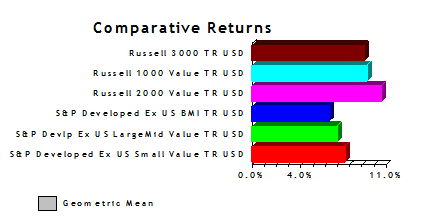
These findings are consistent with a review of major indices for the period July 1989 through January 2011. As illustrated in the following graph, small-cap value stocks in the U.S. (in pink) outperformed large cap value stocks (in light blue) and the market overall (in brown). In the balance of the developed world markets, small value (in red) also outperformed large and mid cap value (in green) and the total market (in dark blue).
1. See, for example, Fama, E.F. and K.R. French, 1992, “The cross-section of expected stock returns”, Journal of Finance, Vol. 47, Issue 2, pp. 427-65 as well as Fama, E. F. and K. R. French, 1998, “Value versus growth: the international evidence,” Journal of Finance, Vol. 53, No. 6, pp. 1975-1999.
2. See Dhatt, M.S., Y.H. Kim, S. Mukherji, 1999, "The value premium for small-capitalization stocks," Financial Analysts Journal, Vol. 55, pp. 60-68, and Dimson, E., S. Nagel and G. Quigley, 2003, “Capturing the value premium in the United. Kingdom”, Financial Analysts Journal, Vol. 59, pp. 35-45.
3. Fama, E. F. and K. R. French. “Size, value, and momentum in international stock returns” (January 15, 2011). CRSP Working Paper. Available at SSRN: http://ssrn.com/abstract=1720139