Advisor Perspectives welcomes guest contributions. The views presented here do not necessarily represent those of Advisor Perspectives.
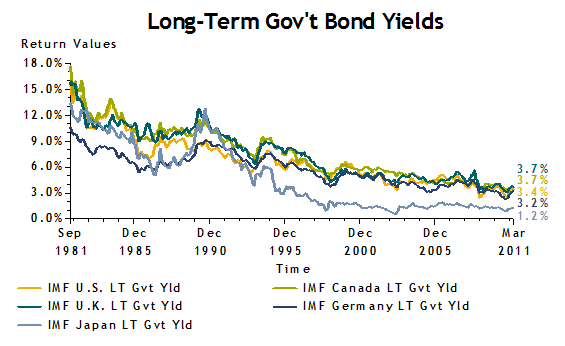
Since peaking in 1981, yields on the government bonds of most developed nations have fallen almost continuously, as illustrated in the following graph.

This decline is due, in large measure, to the success of central bankers in reigning in inflation from the heated double-digit numbers of three decades ago. Also, oil prices fell precipitously in the 1980s while deregulation and globalization fuelled competition and exerted downward pressure on prices.
Recent research has highlighted other causes. A McKinsey Global Institute study1 found that a dramatic fall-off in the level of global investment in physical assets such as infrastructure, plant and equipment since 1980 reduced the demand for capital relative to previous decades and hence, depressed interest rates. Some economists including Fed Chairman Bernanke2 have suggested that a worldwide shortage of safe assets, particularly in the emerging markets, reduced Treasury yields over the past decade. According to this view, this shortage has been exacerbated by the recent financial crisis.
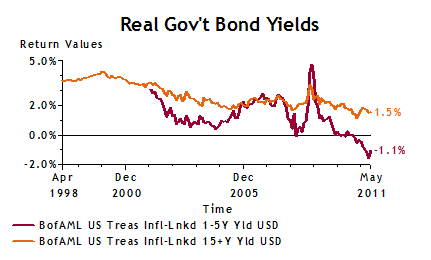
Although many investors are aware of the challenge lower bond yields present to achieving adequate long-term portfolio returns, a focus on nominal yields (which include both a real and an expected inflation component3) conceals the scope of the problem. For investors, it is real (i.e., net of inflation) bond yields that matter. The inflationary component of bond yields only offsets expected price increases. As illustrated in the following graph, real government bond yields on both short-term (in dark) and long-term (in light) Treasury Inflation Protected Securities (TIPS), the principal value of which increases with inflation, have also fallen precipitously.
1. McKinsey Global Institute, Farewell to cheap capital? The implications of long-term shifts in global investment and saving, December, 2010.
2. Bernanke, Ben S., Carol Bertaut, Laurie DeMarco, Steven Kamin, “International Capital Flows and the returns to safe assets in the United States 2003- 2007”, Banque de France Financial Stability Review, No. 15, February 2011.
3. The yield of bond actually incorporates four elements: 1) a real return component for deferring consumption and assuming the risk of investment; b) an expected inflation premium; 3) an inflation uncertainty premium for the risk of changing inflation rates; and 4) a term premium for the risk of extending the investment horizon. For brevity sake, we have simplified this into a real return and an expected inflation component. We have also ignored any liquidity premium.
Interest rates today are so depressed by the Fed’s monetary policy that investors now receive a negative real yield on short-term TIPS. Like fearful savers in the Middle Ages who paid goldsmiths to safeguard their gold, anxious investors today are prepared to pay in the form of certain real losses4 for the perceived safety of short-term TIPS. Meanwhile, investors in long-term TIPS who earned real returns in excess of 4% per annum just a decade ago now accept a modest real annual yield in the 1.5% range5.
Is this adequate compensation for the risk of investing in U.S. government bonds? History might provide some insights. Unfortunately, TIPS have only been issued in the U.S. since the late 1990’s. Even the U.K., which was the first issuer of inflation-linked bonds, only has data starting in 1981.
However, we can gain insight from what the real rates-of-return on traditional “nominal” government bonds have been over a much longer time frame. Since 1926, intermediate-term U.S. government bonds have earned an annual real return of 2.3%. By this standard, today’s negative real short-term yields are clearly a result of the Fed’s massive monetary easing. We therefore expect short-term rates to rise materially when Fed policy becomes more restrictive as the economy improves.
Long-term U.S. government bonds earned a marginally higher real return of 2.4% per annum since 1926. This is nearly a percentage point higher than the 1.5% real annual yield of 20-year TIPS today. Allowing for the fact that “nominal” bonds, unlike TIPS, face future inflation uncertainties and need to offer incremental compensation for this risk6, we estimate that long-term real annual yields today are about 0.5% lower than the historical average.
Although a subpar economy has and will continue to act as drag on real yields over the next few years, other forces are at work to increase long-term rates. McKinsey concluded that a forthcoming investment boom in physical assets in emerging markets combined with declining savings rates from an aging global population will gradually place upwards pressures on real interest rates. Chronic government deficits are also a factor. A substantial body of research7 has found that in general higher deficits and public debt lead to an increase in long-term interest rates.
In particular, real yields also need to compensate investors for the ever-growing credit risk associated with U.S. government bonds. The U.S. is incurring deficits that are the highest as a percentage of GDP since 1945 and faces structural shortfalls in funding its current health care programs and Social Security. Standard & Poor’s in April placed a negative outlook on the U.S.’s AAA rating and stated there's at least a one-in-three chance that the rating could be lowered in the next two years.
We believe today’s low government bond yields don’t offer an adequate potential real return to properly compensate investors for the associated risks. This is particularly true for long-term bonds which are more susceptible to losses when interest rates rise. Government bonds have an important portfolio role as a hedge against deflation, but beyond that thoughtful investors should look elsewhere for real return opportunities.
Tacita Capital Inc. is based in Toronto, Canada and is a private, independent family office and investment counselling firm that specializes in providing integrated wealth advisory and portfolio management services to families of affluence. We understand the challenges of affluence and apply the leading research and best practices of top financial academics and industry practitioners in assisting our clients to reach their goals.
7. See, for example, Baldacci, Emanuele, Manmohan S. Kumar, Fiscal Deficits, Public Debt, and Sovereign Bond Yields, IMF WP10/184, August 2010.
Read more articles by Michael Nairne