The following are in response to our article, Can Krugman Fix Our Economy?, which appeared last week:
Dear Editor,
Can Krugman fix our economy? Not in a million years.
Joe French III
First Vice President, Financial Advisor
Dear Editor,
No, Krugman cannot!
He is a central planning socialist, advocating Keynesian policies which have been proven wrong by von Mises, Hayek, Friedman, Kemp and Reagan. Government is not productive, therefore, all government spending is waste. Less waste would be more productive, so cutting government spending is the smartest thing.
Written to you, by a man who has been told by Mensa that his I.Q. is in the top 3% and who has been an investment broker since 1969.
I know “stuff.”
Frank Gildner
Dear Editor,
Well-reasoned, fair, and balanced. Excellent job!
Mark A. Carlton
Dear Editor,
I agree entirely with your analysis of Krugman's book. As you point out, Krugman's warped worldview arises not from his considerable powers of diagnosis, but from his lack of any apparent power of prescription. It seems as if most saltwater economists are born without a "connectivity gene;" that is, they aren't able to connect some very important dots in the economy.
They refuse to believe, for example, in the Laffer Curve. They believe that government spending, no matter how badly it is allocated, has a multiplier much greater that one. And, as you have documented, they believe that government debt can be greatly increased without damage to the general economy or the currency. In other words, they believe that there will be no reactions to any of their actions.
They cannot be made to see that we live in an information economy, not an industrial one, where the primary resource is brainpower and training, not highly restrictive work rules and rigid seniority. They have no appreciation for financial risk or entrepreneurship. If those who undertake heavy financial risk are successful, they believe that somehow those gains were stolen from "labor," whom they pretend to revere, but honestly believe them to be only knuckle-dragging Neanderthals, who must be forcefully led by strong unions and made to vote through Chicago-style political machines.
And they will not improve. As Herbert Spencer famously said, "There is a principle which is a bar against all information, which is proof against all arguments and which cannot fail to keep a person in everlasting ignorance – that principle is contempt prior to investigation." Further, academia itself, from which Krugman springs, is the victim of its own insularity which predates even the Industrial Revolution.
“In times of drastic change, it is the learners who inherit the future. The learned usually find themselves equipped to live in a world that no longer exists.” Unknown author
Kimble M. Johnson
Registered Principal
Dear Editor,
Paul Krugman has no idea how to fix our economy. In fact, his “solutions” are the reason the economy is stuck in a ditch.
For starters, he doesn’t believe in free markets. All Keynesians are interventionists, meaning they (not the market mechanisms that naturally work as a result of collective human action) think they know how resources should be most efficiently allocated within the economy.
Unfortunately, each week the New York Times wastes far too much paper, ink and bandwidth to publish Krugman’s best guesses about how the U.S. government should centrally manage an economy of 300 million freedom-loving people. What’s more unfortunate is that his readers, which include policy-makers, educators and many people in our industry, dutifully hang on his every word.
Forget all the boogie-man propaganda you’ve heard about the failures of the free market. Very simply, a free market is a system of social cooperation whereby the participants are bound by private property rights, engage in voluntary transactions with each other and are prevented from trespassing upon other people’s rights to life and property. End of definition. Scary, right?
The power of free markets are price signals, competition and the specialization and division of labor, which work together continuously to achieve the highest quality goods and services at the lowest possible cost. As Adam Smith wrote in The Wealth of Nations, “It is not from the benevolence of the butcher, the brewer or the baker, that we expect our dinner, but from their regard to their own interest. We address ourselves, not to their humanity but to their self-love, and never talk to them of our own necessities but of their advantages.”
In a free market, we work for ourselves and our families, all the while meeting the demands of our customers in our communities, our states, our country and around the world. Can you imagine a more beautiful market system?
Paul Krugman can and he’s trying to force it down your throat.
This brings us to the matter at hand: His easy fix for the sluggish economy. He says our economy is “suffering from a severe lack of demand” and that the solution is “simple.” If you think our economic troubles have deep roots, Krugman says, you’re “utterly wrong.”
A Keynesian hangover
The truth is Krugman is utterly wrong. He says that businesses and consumers are not spending enough and thus holding the economy back. “There isn’t enough spending. It’s really that simple,” he said in a Rolling Stone interview last month. He says that government must intervene, borrow hundreds of billions of dollars and spend to spur demand and to get the economy back on the road to full employment. Didn’t they try that already?
Stop for a moment and think about what “lack of demand” means.
Krugman says that businesses and individuals are not demanding (spending) enough goods and services from the butcher, the brewer and the baker. Our problem isn’t that land, labor and capital needs to adjust—a natural market force (like the physical law of gravity) which he notoriously fights—it’s that businesses and individuals need to act differently.
After decades of massive credit expansion, a sub-prime mortgage crisis, a real estate bubble and an overheated stock market, markets don’t need to cool down—they’re fine! Individuals and businesses just need to spend more. “It’s really that simple. There isn’t enough spending,” he says. If all of this sounds crazy to you, it’s because it is.
What about corporate balance sheets? They are flush with cash. Aren’t the banks ready to loan to credit worthy businesses and individuals at historically low interest rates? Individuals have even decreased their household debt. There’s plenty of opportunity for more spending.
Never mind that, Krugman says. Companies and consumers need to spend more. And if they won’t government will force it on us. If it weren’t so destructive, it would be laughable.
When justifying his position, Krugman puts some fancy words around, creating an intellectual fog that causes people to glaze-over. In the end, what he’s saying is this: You and I (the market) are the reason the economy is in the ditch. And if we would just borrow a gazillion dollars and give it to our overloads in government to spend for us, we’ll be fine. “It’s really that simple,” he says.
Markets aren’t perfect, of course. And, contrary to mainstream propaganda, every free market economist will tell you so. There can be no perfect economic system. The question we need to ask ourselves is which economic system is most efficient? In other words, which mechanisms can most efficiently allocate land, labor and capital throughout the economy and thereby help us improve our quality of life and maintain the most stability? Are market systems or government systems better suited to the task? That’s the question.
By the way, the answer cannot be both—that’s a recipe for disaster because human beings have no good way of knowing when to turn on or off the market system. Besides we all have our own biases. We’d be flying by the seat of our pants. In fact, this is precisely what we’ve been doing for the last several decades! It has driven the economy into the ground.
As a side, if you’re not convinced of the superiority of market systems to government systems when it comes to managing the economy, consider how the market works to produce the pencil on your desk. Then think about how government would produce it. Google “I Pencil” by Leonard Read or listen to it here: http://youtu.be/ggJ3qrGwpu4.
Crony capitalism
If Keynesianism is best described as crony capitalism, what would you call it? Fascism is probably too strong – and to politically charged – but that’s where we’re headed if place our trust in Keynesians. It was Benito Mussolini who said, “Fascism should more appropriately be called Corporatism because it is a merger of state and corporate power.”
There’s surely plenty of Corporatism in America these days. One way to stop it cold in its tracks is to recommit to a true free market system.
Krugman may give lip service to the concept of a free market, but his policies that have nothing to do with free markets. He supports a centrally planned, government sanctioned monopoly to arbitrarily control the production of money and its rate of interest. Keynesian policies siphon money directly from the pockets of working class citizens (and their children and grandchildren) and place it under the control of government agencies, politicians and their cronies who are expected to “invest” it for the “common good.” If all of this sounds like socialism or communism to you, that’s because it is.
Krugman’s solution to his lack of spending problem is massive government spending to make up for the slack in demand. The massive growth we’ve seen in our supposedly constitutionally “limited government” in recent decades isn’t enough. The trillion-dollar stimulus spending and bail outs of Wall Street banks aren’t enough.
Krugman wants more government spending – more government intervention. He’s solution to a massive increase in debt and overspending is to assume more debt. His solution to a government that invites corporations to treat elected officials like whores is to borrow money from the working class so that government can build a bigger brothel.
In this review of Krugman’s recent book, Robert Huebscher, points out that, “Only on page 215 is there a brief discussion of how that money should be spent, and Krugman does not offer any framework or criteria for deciding which projects should be funded.”
Unbelievable! How can people take this guy seriously? The idea that he can propose such draconian measure and then gloss over how those measures should be implemented is... well, it’s irresponsible, short-sighted and childish. As a free people, we all should be insulted.
The government already controls our money and has a strangle-hold on vast markets in education, health care and transportation. It disregards the Constitution, tramples on State’s rights and seeks everyday to regulate more our food, the goods we manufacture and services we seek to provide to each other. (Is it any wonder companies are “shipping jobs overseas?” We must punish them by taking away their tax breaks! Yeah, that’ll teach those evil corportations!)
I find it interesting that Krugman recommends policies that appeal to the most self-serving interests of politicians. Meanwhile, he personally enjoys all the privileges of sitting at the top of the financial elite. He works hard to maintain the status quo and intellectual fog that surround Keynesian Economics and protect crony capitalism.
The solution
The economy is actually suffering from a hangover thanks to Krugman and his fellow Keynesians, Alan “The Maestro” Greenspan, Ben Bernanke and the rest of the central planners at the Federal Reserve.
These market interventionists have been arbitrarily managing the supply and the price of money for decades. Since the Fed was formed, boom and bust cycles in the economy have doubled in frequency and their effects have been magnified. The propaganda you hear about the Fed being a great stabilizer is baloney.
Decades of artificially low interest rates have caused a dangerous and steady inflation creep. John Maynard Keynes himself warned against the dangers of this when he said, “By a continuing process of inflation, governments can confiscate, secretly and unobserved, an important part of the wealth of their citizens.”
By not allowing market mechanisms to control the supply and price of money, government has been incentivizing market participants to allocate resources in inefficient and thus creating gross misallocations of land, labor and capital throughout the economy. The interventionist policies of the Fed and the government are the problem, not the solution. To cure the hangover, they need to stop serving free drinks. Only then will our hangover be cured.
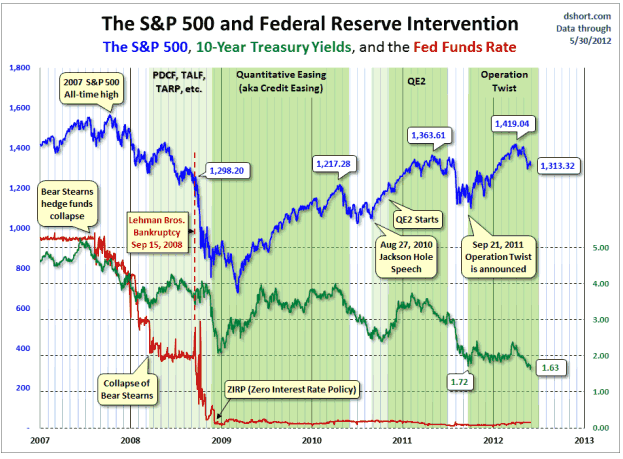
Krugman disagrees. He wants us to guzzle another bottle of wine, which would make us feel better in the short run, of course. But in the long run it will only make things worse. Consider the chart below which shows how one market—the market for stocks has responded after each round of free drinks from the Fed since the Financial Crisis.

Guided by Keynesians, government and Federal Reserve interventionists are what drove the economy into the ditch. And they are making the ditch deeper right now by continuing to intervene when they economy just needs to be left along to recalibrate. Land, labor and capital need to adjust.
They best way to deal with a hangover is to take some medicine with a glass of water and let your body work through the pain.
To quote the great Austrian economist, Ludwig von Mises: “There is no means of avoiding the final collapse of a boom brought about by credit expansion. The alternative is only whether the crisis should come sooner as the result of a voluntary abandonment of further credit expansion, or later as a final and total catastrophe of the currency system involved.”
Brian Schreiner
Vice President
Schreiner Capital Management, Inc.
Read more articles by Various