The Rules of Growth: Organisms, Cities and Companies
Membership required
Membership is now required to use this feature. To learn more:
View Membership BenefitsWhat do living organisms, cities and businesses have in common? They all have organic characteristics: they’re born, grow, sometimes shrink and usually die. They all require energy to maintain and grow, and they all must deal with the sometimes undesirable byproducts of their existence.1
Do these wide-ranging behaviors follow simple laws that have explanatory and predictive value? Geoffrey West, a physicist and past president of the multidisciplinary Santa Fe Institute, says “yes…and they are laws of scale.” Such rules “quantitatively describe how almost any measurable characteristic of animals, plants, ecosystems, cities, and companies scales with size.”
The biology and physics that underpin these scaling relationships explain why it is unlikely we will ever discover a land mammal much larger than an elephant or much smaller than a mouse, and never the mythical Godzilla of motion picture fame. Weight rises with the cube of length or height, so that, in order to move, hunt, forage or fight, a creature much larger than an elephant would need muscles bigger than the creature. On the small side, a creature much smaller than a mouse could not exist because its heart could not pump blood through its capillaries. It would need a completely different body plan, such as that of an insect.
Likewise, through the lens of scaling, we can understand why, despite life expectancy increasing by leaps and bounds in the modern era, we should not expect to live beyond age 125. People wear out not because they are overworked, but because their cells are. Metabolism, the internal engine or “fire” of life, damages cells at predictable rates and that process puts a limit on how long we can live, even if all diseases become curable or preventable.
We can also find, in the vocabulary of scale, reasons why cities grow to mammoth size – several metropolitan areas now house 40 million people – even though common sense suggests that smaller units might be more efficient and pleasant. Some of these megacities are evolved versions of settlements that were established millennia ago by people seeking the same kinds of business and social connections that people moving to cities in contemporary society pursue now.
Businesses, which are superficially like cities in that they are aggregations of people pursuing some activity in common – reach their scale-driven size limits fairly quickly and have surprisingly short lives, although with a long tail: one Japanese business, a builder of Buddhist temples called Kongō Gumi, “lived” for over 1,400 years.
Scale, argues West, explains all of these phenomena.
West makes a valuable contribution to one of the overarching challenges of our times: how to expand the benefits of economic growth experienced by the developed world to billions living in poverty in the developing world while at the same time dealing with twin environmental challenges of pollution and changes to global temperatures. His contribution is the “scaling toolkit,” which helps us better understand the resource dynamics of human interaction, people, cities, countries and the world.
An author who reaches this broadly is bound to overstep. The usual rule applies: anyone who thinks they have found a single explanation for everything, hasn’t. There are limits to what can be explained by scaling factors.
West calls for a “Manhattan-style project or Apollo-style program” in pursuit of a “grand unified theory of sustainability,” based on his concern that matters of scale could someday threaten the existence of the human race. I suspect he’s talking his book. West’s institute and career would benefit immensely from such an effort. Or it could be just what the world needs. We don’t know. However, for the non-scientist, West’s story of scaling opens a window to the hows and whys of resource dynamics in a growing world economy.
Some basics
It is well known that there are some basic mathematical relationships between the size and the functional characteristics (say, speed or longevity) of anything. Science writers across the generations, from D’Arcy Thompson (On Growth and Form, 1917) to Stephen Jay Gould to Matt Ridley, have emphasized this fact.
The relationship usually takes the form of a power law. Here is one that is familiar to athletes: The strength of a muscle increases with the area of its cross-section, which is proportional to the square of the muscle’s thickness; but the weight of the muscle is proportional to the cube of its thickness. Thus the strongest athletes, per pound of body weight (not in absolute terms), are the little guys, not the big ones.
This principle applies in shipbuilding, too, and in just about everything else. The grand engineer Isambard Kingdom Brunel, who built Britain’s Great Western Railway in 1838, also built a Great Western steamship – the first modern steamship – for travel to North America. This venture succeeded, so he built a second ship, the Great Eastern, much larger so it could power around the Cape of Good Hope to the Far East.
But it was too big!
How can a ship be too big? The energy it uses is proportional not to its length, but to the weight of the water it displaces, which varies as the cube of the ship’s length. So the Great Eastern lost boatloads of money and was eventually disassembled for parts. Her top mast still stands at the Liverpool Football Club’s stadium, a monument to scaling gone awry.2
The power law for organisms
In biology, West argues, a ¾ power law is particularly widespread. Let’s look at the metabolic rate, which is centrally important because it is the internal engine of all living things, the rate at which an organism converts inputs (food) to outputs (work):
Elephants are roughly 10,000 times (four orders of magnitude, 104) heavier than rats; consequently they have roughly 10,000 times as many cells. The ¾ power scaling law says that, despite having 10,000 times as many cells to support, the metabolic rate of an elephant (that is, the amount of energy needed to keep it alive) is only 1000 times (three orders of magnitude, 103) larger than a rat’s; note the ratio of 3:4 in the powers of ten. This represents an extraordinary economy of scale [in the use of resources] as size increases.
Figure 1 shows this relationship, which also explains the relentless march toward larger size as evolution proceeds: small reptile to dinosaur, eohippus (an early horse about the size of a fox terrier) to modern horse, small sea mammal to whale.3 Yet, as we saw at the outset, scaling factors also impose limits to size, as the organism encounters tradeoffs between the efficiency of larger size and the handicaps that large size inflicts.
Figure 1
Relation between Size (Body Mass) and Metabolic Rate of Animals
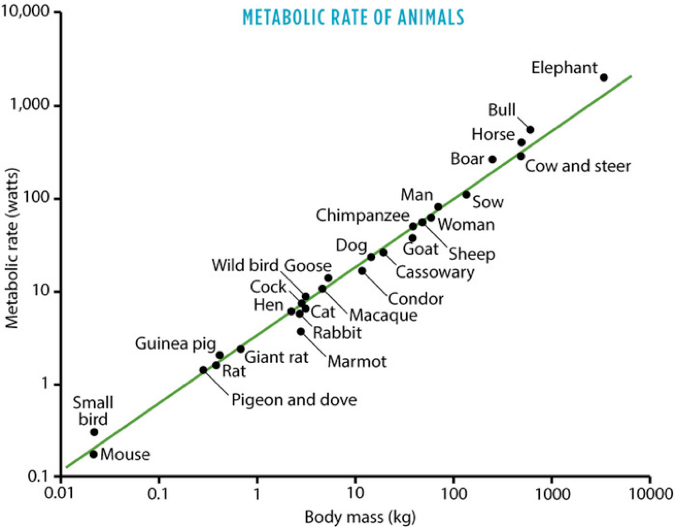
Source: Mann, Charles C. “How Nature Scales Up” (review of Scale by Geoffrey West). Wall Street Journal, June 23, 2017. After West [2017], Figure 1 on page 3.
Scale for schoolchildren
Children learn about scaling early on, not just in the pecking order of the schoolyard but by repeating Jonathan Swift’s rhyme from 1733:
So, naturalists observe, a flea
Hath smaller fleas that on him prey
And these have smaller still to bite ’em
And so proceed ad infinitum.4
Packed into those four lines intended for six-year-olds are the concepts of scale, self-similarity and fractals, the building blocks of West’s book and of much of biology, much of urban economics, and – as we will discover – something about the life and death of business corporations too. (Yes, there was a time when six-year-olds could puzzle out “ad infinitum.”)
Cities
Cities connect two power laws: (1) The sublinear ¾ power law for the inputs of energy and other services needed as city size increases (metabolism) and (2) the superlinear 1.15 power law as human connections grow 15% faster than city size due to proximity.
The second power law indicates that each doubling in the size of a city results in a 115% increase in each of the key economic variables such as wages, patents and industries. Because commerce is transacted more rapidly, per capita GDP is higher in larger cities: Los Angeles is richer than Tulsa, which is richer than a typical rural town. The relationship is causal, not coincidental – the connections made possible by the larger city’s size created the additional wealth.
If cities consume (relatively) less and produce more as they become larger, no wonder they grow so quickly! And they will continue to do so, adding to the stresses associated with rapid urbanization, especially in developing countries.
Wealth creation has thus proceeded hand-in-hand with the emergence of large cities, always and everywhere: in ancient times, in the last two centuries in what we now call the developed countries, and more recently in the developing ones. While it sometimes seems as though large cities have inordinate numbers of poor people, that is generally because they have migrated there in the hope of ending their poverty quickly – and, more often than not, they do.5
Exhibit 2 shows the relationship between city size and several attributes of cities: GDP, income, crime, and number of patents created. The slope of all of the relationships is 1.15; that is, the 15% rule applies to each of the attributes. Note that bad attributes (crime) follow the same power law as good ones.
Exhibit 2
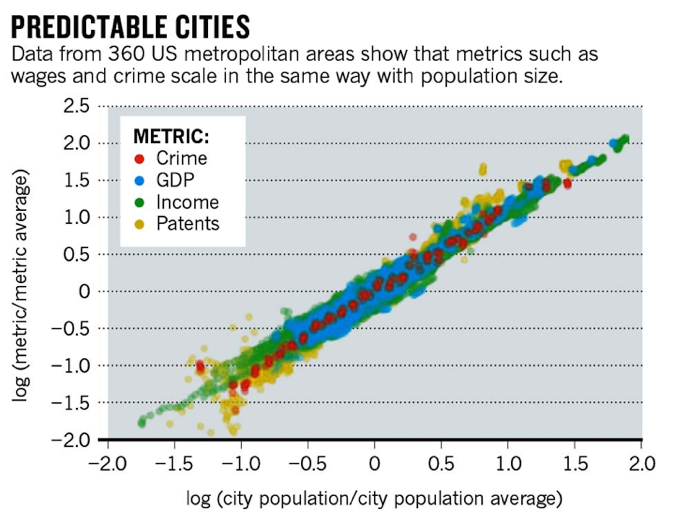
Source. Drawn by Michael E. Smith after Figure 44 on p. 343 of West [2017]. Professor Smith is a colleague of Geoffrey West at Santa Fe Institute.
West’s investigation of the characteristics of cities is extensive and sophisticated. He is well read on the topic, having consumed not just the works of Jane Jacobs and Lewis Mumford (familiar to beginners in urban geography) but also the more academic contributions of Walter Christaller and Michael Batty. The lengthy section on cities was the most valuable part of Scale.6
Businesses
West originally set out to extend his research on scale to businesses, but turned to cities because he couldn’t, at first, get the business data. It’s just as well he turned his attention to cities, because business didn’t turn out to be as fruitful a field. Still, in the business world, West found some regularities worth noting.
Companies look superficially a lot like cities: both are voluntary aggregations of people, assembled to pursue a common goal. Both produce and consume resources, compete with other cities or companies and seek to grow. Both start from essentially nothing and can become very large. However, cities tend to stay in one place, growing amoeba-like into new territory only over decades, while companies can pick up and move quickly and be acquired or dissolved with the stroke of a pen. Moreover, while cities almost never die completely, companies generally do.
West’s key findings are: (1) Company sizes follow a Zipf distribution, like cities; and (2) The efficiency of companies – measured, say, by sales or profits per employee – scales sublinearly (that is, at a slower rate than a linear relationship) like organisms. What an odd beast we have created!
George K. Zipf, a linguist, discovered in the late 1920s that word use in languages follows a power law in which (taking English as the example) the most frequently used word, “the,” occurs twice as often as the second most frequent word, “of,” and three times as often as the third most frequent word – and so on down to rare words.7 This power law is observed in many contexts including the populations of cities (New York, 8.5 million; Los Angeles, about half that or 4.2 million; Chicago, about a third that of New York or 2.7 million) and the sizes of companies as measured by profits or sales. The ranking of company sizes is, of course, much more fluid than that of cities – the top-ranked company rarely repeats from one decade to another.
West’s scaling analysis for the efficiency of companies is summarized in Exhibit 3. Each “cloud” represents, respectively, “income, profits, assets, and sales for all 28,853 companies in the United States from 1950 to 2009 plotted logarithmically against their number of employees, showing sublinear scaling with a substantial variance.” Data for Chinese companies over a shorter period shows a similar relation, not shown in the exhibit. Thus, in two very different economies, adding more employees does not add to sales or profits at a commensurate rate.
Exhibit 3
Income, profits, assets, and sales of U.S. companies plotted against number of employees, 28,853 companies, 1950-2009
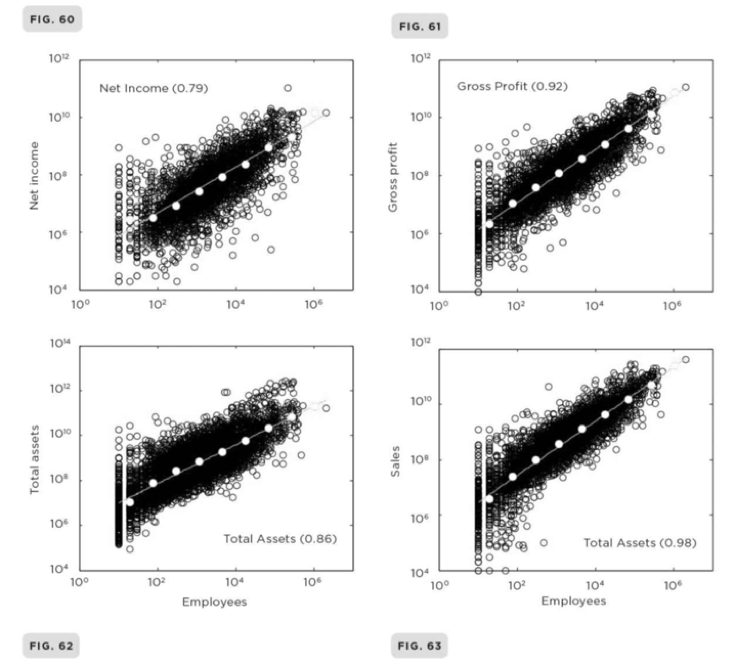
Source: West [2017], p. 388.
“This suggests,” West writes,
that companies are more like organisms than cities and are dominated by a version of economies of scale rather than by increasing returns and innovation. This has profound implications for their…growth and mortality. …[S]ublinear scaling in biology leads to bounded growth and a finite life span, whereas…the superlinear scaling of cities (and of economies) leads to open-ended growth.
Note that, in Exhibit 3, sales do scale almost linearly with number of employees (the slope is 0.98), but net income grows significantly less quickly (the slope is 0.79). This means that costs grow superlinearly with company size, something that almost any corporate employee or manager would have expected.
West also studies company mortality but the results are colored by the fact that companies rarely die completely – they are merged or acquired, or their assets are sold to other companies. Thus the analogy with organisms is incomplete.
Sustainability
In the provocatively named subchapter, “Global Warming, the Exponential Scaling of Temperature, and the Metabolic Theory of Ecology,” West issues a call for a new science of ecology or sustainability based on his observations about scale, metabolism and entropy.
I am a little disappointed that this book, with its valuable contribution to understanding how organisms and organizations grow, starts to slip into just another piece of climate-change advocacy – one calling for a sustainability Manhattan Project involving the extensive and expensive involvement of scientists much like the author himself. While West’s basic take on climate change is not very different from that of most scientists, his angle of attack feels a little contrived: If melting ice packs, rising sea levels, steaming hot jungles and deserts, and dangerous weather aren’t convincing enough, let’s try metabolism. Let’s try entropy.
All other things equal, metabolism accelerates exponentially with absolute (Kelvin) temperature, at a rate such that it doubles with each 10°C rise. Fair enough, although I haven’t observed tropical human populations metabolizing at double the rate of polar ones so I’m not sure how to apply this principle.
But entropy? West is absolutely correct in saying that, merely by having been alive, an organism leaves the Earth a slightly warmer place, for reasons directly related to the theory of entropy (the second law of thermodynamics). An animal (for example) is a machine for converting fuel to work, but it is not completely efficient at doing that. It gives off some heat as a waste by-product; that is why animals feel warm to the touch. If it were a perfectly efficient machine, its internal fires – its metabolism – could burn at a high temperature but no heat would leak through to the outside, and it would be cold to the touch.
But this process has been going on for much longer than humans have been alive, and the nonhuman biomass on the planet vastly exceeds the human. The resulting heat production has had no measurable effect on anything, with global temperatures affected on a many times larger scale by geological heating and cooling. Between “the Eocene Optimum, 55-45 million years ago, [and]… the [last] Ice Age, which ended just 20,000 years ago….[t]he overall range in temperature was enormous, about 35°F,” writes William Menke, a Columbia University geology professor who is as mainstream as you get.
Even if the “social metabolism” of the human race – its energy use from fossil fuels and other technologies – is 100 times its animal metabolism, as West estimates, geological climate change is going to overwhelm metabolic climate change in the long run. Moreover, most scientists believe that the greatest threat to climate stability is the greenhouse effect of CO2 emissions, not energy use per se (which leaks heat into the environment because the conversion of fuel to work is not completely efficient).8
Finally, people won’t just stay put and watch their environment become unlivable. They will migrate to more comfortable climates. This has happened before, and it has a downside as well as an upside. The downside is the wars, famines and epidemics that have accompanied climate-motivated mass migrations in the past. The upside is the discovery and settlement of new territories with new resources. We are about out of territories, so mass migration in the future will mostly involve downsides, but, because of technology and civilization, the pain involved will be less than it was in previous episodes.
And there have been previous episodes. We have had warm periods before, recently enough to be documented by those living through it, in the Minoan, Roman and Medieval warming episodes. The last two were warm enough to convert northern England to a wine-growing region. The rest of history consists of cold periods.
People, then, adapt to their environment, and they adapt their environment to their needs. I am not saying global warming isn’t a potentially serious problem – patterns of human settlement are already more or less optimized around the existing climate, so any climate change (warmer or cooler) is disruptive and costly, and can be fatal to populations that are not technologically advanced enough or wealthy enough to adapt or move. Assuming no adaptation, however, is the wrong way to assess the danger.
An older, better Grand Unified Theory of sustainability: Economics
West calls for a grand unified theory of sustainability, based on scale, but we already have one based on incentives, tradeoffs, and opportunity costs: it’s called economics. When a resource starts to be scarce, it becomes expensive, so we use less of it. We are also incentivized by its high price to make more of it, or to find substitutes. Thus a “tin” can is made of aluminum and a “silver” photographic plate is made of silicon. We burn natural gas in “wood” stoves and we are about to put robotic “drivers” behind the “wheel” of automobiles.
There is literally no resource that we have run short of without finding either a way to make more of it or an acceptable substitute for it. This process, basic to Adam Smith’s vision of a market economy and probably discoverable in the writings of the ancients, is no mystery. It describes how man has adapted to the changing supply of resources and has created a versatile economy that fulfills people’s needs even as external circumstances undergo great change.
Having shaped the environment to our advantage in countless ways, we have also depleted or damaged it in others. But, where necessary, we can reverse the process. In a generation, many of our polluted waterways are once again sparkling rivers, fit for drinking. We are extracting energy from the wind and sun, at first haltingly but now with increasing efficiency. We are even finding ways to remove carbon dioxide from the atmosphere.
Conclusion
Scale is a mix of wonders and disappointments. Its value is in broadening our intellectual base as we confront the economic and policy decisions we must make, individually and collectively, to adapt as both population and economic output grow. West’s work on organisms and especially on cities is compelling. His extension of the concepts of scale to environmental issues is provocative although more speculative.
West’s attempt to extend his methods to businesses, however, runs into difficulties caused by the very nature of businesses – unlike organisms, they change ownership, operate under a variety of names and corporate structures, become parts of other businesses and are nationalized by governments.9 Are all of the U.S. railroads and airlines that went bankrupt really dead? No, the assets they owned have been redeployed, moving more people and freight more safely using less energy (sublinear scaling!). Even truly dying businesses, like typewriters, leave behind “spare parts” that are often used to build new businesses.10
Thus, for investors, the seemingly immutable laws of scale that apply to organisms and cities apply less directly to the understanding of companies’ life cycles and prospects. But in this era of superlinear scaling by likes of Google, Facebook, and Amazon, West gives us a framework for thinking about growth and its limits.
So investors will have to look beyond power laws and Zipf distributions to assess the health and longevity of the businesses they are evaluating. They will have to focus on fundamentals – the cost of labor and materials, the demand for the company’s service or product, the competitive environment. Active management has not yet been turned into a science, nor do I believe it ever will be.
Laurence B. Siegel is the Gary P. Brinson director of research at the CFA Institute Research Foundation and an independent consultant. He may be reached at [email protected]. The author thanks Steve Sexauer (CIO of San Diego County Employees Retirement Association) for extensive comments and assistance.
1 Scale has the remarkable subtitle, “The Universal Laws of Growth, Innovation, Sustainability, and the Pace of Life in Organisms, Cities, Economies, and Companies.” The author (or his publisher) does not appear burdened by an excess of modesty.
2 In a 2002 BBC poll, the British public voted Brunel the second greatest Englishman in history, after Churchill but ahead of Darwin, Shakespeare, Newton, and all of the royals. See http://news.bbc.co.uk/2/hi/entertainment/2509465.stm. Brunel is almost completely unknown outside Britain.
3 We are now supposed to call eohippus (“dawn horse”) hyracotherium. Almost no one does, eohippus being much more melodious; and, while the comparison of eohippus to fox terrier is copied from textbook to magazine article to this essay, few people know what a fox terrier is, much less how big one is. Gould [1991] documents the spread of this silly meme. Gould, Stephen Jay. 1991. “The Case of the Creeping Fox Terrier Clone,” in Bully for Brontosaurus, W. W. Norton & Co.
4 Swift, Jonathan, 1733. “On Poetry: a Rhapsody.” In 1922, the British mathematician and meteorologist Lewis F. Richardson adapted the poem to self-similarity in fluid dynamics: “Big whorls have little whorls/ Which feed on their velocity/ And little whorls have lesser whorls/ And so on to viscosity.” This line of thinking led to Benoit Mandelbrot’s (1967) discovery of fractals.
5 The persistence of relative poverty in minority districts of large U.S. cities can probably be explained by history (slavery) and poorly conceived social policies. In the U.S., poor urban immigrant communities typically do not stay poor for long, following the pattern seen in other countries. In developing countries, progress from extreme poverty to “ordinary” poverty and, then sometimes, to non-poverty takes place very quickly in cities, but U.S.-based observers may have difficulty recognizing the fact that ordinary poverty is a huge step up.
6 This is familiar and friendly territory. Before I studied finance, I studied urban geography at the University of Chicago.
7 Zipf wrote up his “law” with regard to the frequency of words in a language in Selected Studies of the Principle of Relative Frequency in Language, Cambridge, MA: Harvard University Press, 1932, and extended it more broadly in Human Behavior and the Principle of Least Effort: An Introduction to Human Ecology, Reading, MA: Addison-Wesley, 1949. Zipf’s Law is closely related to the Pareto distribution for incomes, discovered by the Italian economist Vilfredo Pareto in the 1890s (see Hardy [2010]). Hardy, Michael. 2010. “Pareto’s Law,” The Mathematical Intelligencer, Volume 32, Issue 3 (September), pp. 38–43,
https://link.springer.com/article/10.1007%2Fs00283-010-9159-2.
8 From this vantage point, nuclear energy is “clean,” even if it is not completely efficient and produces waste heat, because it does not generate CO2. So are wind, solar, geothermal, and so forth.
9 The same ambiguity applies to cities – is Brooklyn a going concern, or did it die when it was merged into New York in 1898? How about Jersey City, which never officially merged but might as well have?
10 In a New York Times review of Scale, Jonathan Knee writes:
Furthermore, the consistent “decay” rates of corporations identified by Mr. West — calculated by the longevity of independent public corporations over time — does not correspond to any consistent change in underlying activity analogous to “death” in living organisms. Even in the context of bankruptcy, which Mr. West looks at separately from corporate “death” from mergers and acquisitions, good businesses with bad capital structures often continue “life” under new corporate form. It is not evident how meaningful mathematical calculations could be that treat such situations the same as failed businesses that are simply liquidated in bankruptcy for scrap value.
Membership required
Membership is now required to use this feature. To learn more:
View Membership BenefitsSponsored Content
Upcoming Virtual Events View All












