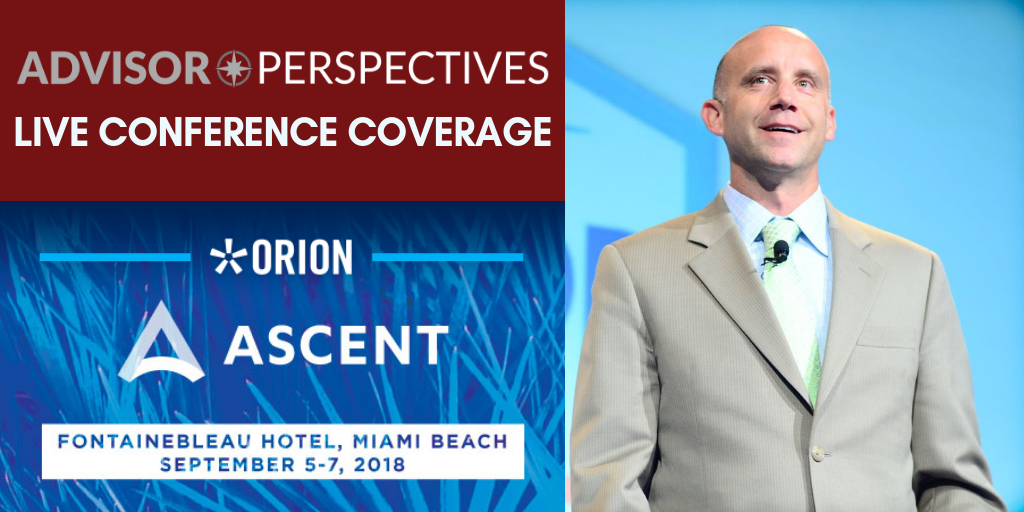
Eric Clarke is the founder and chief executive officer of Orion Advisor Services, a premier portfolio accounting platform for advisors. While working at Orion’s sister company, Mr. Clarke helped create Orion’s system from scratch when the off-the-shelf solutions available couldn’t handle their needs.
Prior to starting Orion, Mr. Clarke served as chief operations officer for CLS Investments, LLC, an SEC–registered investment adviser. As an industry recognized expert in portfolio accounting, Mr. Clarke has written articles that have appeared in a number of publications. He earned a bachelor’s degree in accounting from Brigham Young University and a master of business administration degree from the University of Utah.
I interviewed Eric at the Orion Ascent National Conference in Miami on September 7. This year, Orion’s Ascent user training conference was combined with their FUSE financial services technology gathering.
As background for our readers, please describe Orion’s strategic positioning in the advisor-technology marketplace and its unique, competitive differentiators.
We're the nation's largest privately-owned portfolio accounting provider. Underneath portfolio accounting, there's three main things that we do for firms. We help them with reporting, billing and trading. There are different things that fall underneath that, but those are the three areas of focus that we help firms with.
We service just over 1,700 firms, and provide our technology service to just over $700 billion of client assets. We have a significant amount of scale that we provide to advisors.
When we look at how we are helping advisors, or what group of advisors are in our target market, we serve independent fiduciaries. We serve, typically, independent investment advisors that have left a large wirehouse and gone out on their own, or some of the nation's largest independent firms. We service just over 100 firms that have over $1 billion in assets. But typically, we'll service firms at $200 million to $250 million and up in assets.
When we look at what makes us unique in the marketplace, we have a firm belief that the technology should be customized and configured for the specific niche that the advisor is in. It's not a one size fits all for reporting capabilities, or the other integrations that the advisor needs to be efficient. We like to use technology to provide things that would normally only be available to institutions, and help our advisors simplify those institutional-level technologies, and help them be innovative in their client relationships.
But at the end of the day, the technology always has two focuses. It's creating the operational efficiency for our advisors. Think of scale, being able to provide them additional capacities. Or we help them create a great client experience in their interactions with their clients, to make sure that those are positive.
Orion announced a couple of partnerships last week, one with Asset-Map and another with FinMason. Why are these partnerships unique & what do they allow advisors to do that they weren't able to before? How do they further Orion's vision of its future?
FinMason has great institutional-grade analytics. It provides the different statistics that happen within investment portfolios and client holdings, FinMason does a phenomenal job of gathering all that data, and helping the advisor make great data-driven decisions.
As we looked at what they're doing, they had come out with a way to take investment portfolios and project probabilities as far as future valuations on those portfolios. Advisors could do that with certain predictive constraints and inputs – things like, “Hey, my client's portfolio is worth X today, but we're going to save $1000 a month, what's the probability of assuming a 7% increase? What will this be worth in the future?” They could also run different Monte Carlo projections on it.
It helps people decide. You basically take that institutional-grade analytics and FinMason helps people decide the probability of being able to retire on time. It's a very lightweight financial planning tool, but it allows the advisor to quickly answer client questions, things that they had on their mind. It is very practical and has a great use-case.
Asset-Map is a totally different tool in a sense that it's underneath the reporting category in terms of mind mapping. Asset-Map is essentially a mind-mapping tool for financial advisors to use with their clients to help them track their holdings and things like estate planning, trusts and documents. Asset-Map integrates that into our client presentation tools, and really allows the advisor to have visualization of what's going on in that client's household.
What should advisors look for when choosing technology? What holds advisors back from adopting new technology solutions?
The technology provider needs to be an open architecture system. Meaning that they've got to have open API capabilities to integrate, not just with the technology that an advisor's using today, but the technology that they might want to be using in five to 10 years from now. Something new might come out and they need to know that the core systems that they use will still play nice and interact with those new technologies that are yet to come on the market.
The biggest unexpected hurdle advisors experience when they're implementing new technology is how they are going to train their staff. How am I going to train my team to implement this tech? How are we going to get the most return out of our investment that we're making?
It's a good rule of thumb to allocate at least a third of the purchase price to training. That’s not in hard dollars that you're going to spend training your staff, but in allowing your staff to take some time out of their day to become familiar with and being able to make the most out of the investment that you're making in technology.
Training is huge. Without training, you won't get to where you need to, and that's what this conference is all about, it's a conference that brings our advisors together to make sure that they are trained, proficient and knowledgeable about how to use our systems and technology.
What features are advisors asking for? Where do you see your offering and services moving in the coming year or two?
We're focused on three things based on advisor feedback.
With reporting technology, we've got event-driven notifications – being able to take data points from our system and automate client communication that creates scale. Instead of servicing 150 households, we're hoping our advisors could serve 175 households by reducing the amount of time that they're spending crafting emails about rebalancing the client's portfolio, or if an RMD is on track, or even something as simple as client birthdays or achieving goals with regard to portfolio value.
Maybe a client comes in, says, "Hey, I'd really like to get my portfolio to $250,000 or $0.5 million." We want to automate the communication when those types of goals are reached and accomplished.
We feel like it'll give the advisors back a couple hours of their day, and we're hoping that they can then deploy that towards growing, scaling out and handling more households.
The second thing we're focused on are the training tools – creating operational efficiency for our advisors.
The third is being able to help our advisors on the compliance front.
Chief compliance officers (CCOs) have been neglected with to regard technology, and we're just seeing huge operational efficiencies that CCOs are gaining by being able to proactively audit the data. We want to make sure that they're prepared for an audit, and then when they do have an audit, automate those workflows associated with it.
What advice do you have for advisors choosing technology for their business? What is the ownership model and how important is it in a potential partner in that decision?
That's a very good question. Data ownership is critical. Advisors want to make sure that they own their client data, and that at any point they can get that data out and use it in other systems.
Advisors must find out what security safeguards are in place at the data providers they use. They need to make sure that the data is safeguarded and protected, especially with the amount of personally identifiable information that these technology firms will be using.
Beyond that, they need to understand where the data is located, and whether clients will be comfortable with that if they were to find out that they were using a firm to provide information back to the client relationship.
Along the same lines, what do users/advisors need to know about a tech partner's client service model? What should they look for in a long-term partner?
There are a lot of things that need to be efficient when it comes to servicing. They need to make sure that the phone's going to get answered by a human and that more efficient ways of communication than phone and email are offered. For instance, we have a chat setup for our advisors to quickly message our service teams and our subject-matter experts to get answers and responses in a more communicative format than email.
If I send you an email, maybe you respond in an hour. Maybe you respond tomorrow, all of which is okay, but certainly if you text somebody, you'd expect a response in a reasonable amount of time. Chat is a super-efficient way for our advisors to reach us and communicate with us. It's important for advisors who are looking at service providers to say, “Okay, well what communication methods do you have, and beyond that, what training do you offer me?” We offer a tutorial on online learning opportunities for our advisors to come in, and get trained and knowledgeable about how to use our systems and technology any time that they want, 24/7.
What are you hearing from users at your Ascent/FUSE conference so far? Have you gotten feedback as to what advisors are hoping to learn or takeaway from the conference?
Our advisors have been involved in a year-long process with us giving feedback – things that we could be doing better with our integration partners. We've been taking that feedback and I'm really excited to see the presentations. We have preliminary presentations tomorrow afternoon and then the final presentations on Friday morning.
What do you expect to see from the FUSE competition?
Because the feedback that we received is more advisor-driven this year than say it has been in years past, it is going to be around creating operational efficiencies. Things that were big annoyances to advisors, like integration of different systems, will be addressed. Those roadblocks will be removed, and I'm excited to see what we come up with.
Some of our integration partners, custodians like Schwab and TD Ameritrade, will have significant things that they're doing that they're going to announce that will be exciting for advisors as well.
Marianne Brunet is a financial markets analyst at Advisor Perspectives.
Read more articles by Marianne Brunet
 Eric Clarke is the founder and chief executive officer of Orion Advisor Services, a premier portfolio accounting platform for advisors. While working at Orion’s sister company, Mr. Clarke helped create Orion’s system from scratch when the off-the-shelf solutions available couldn’t handle their needs.