
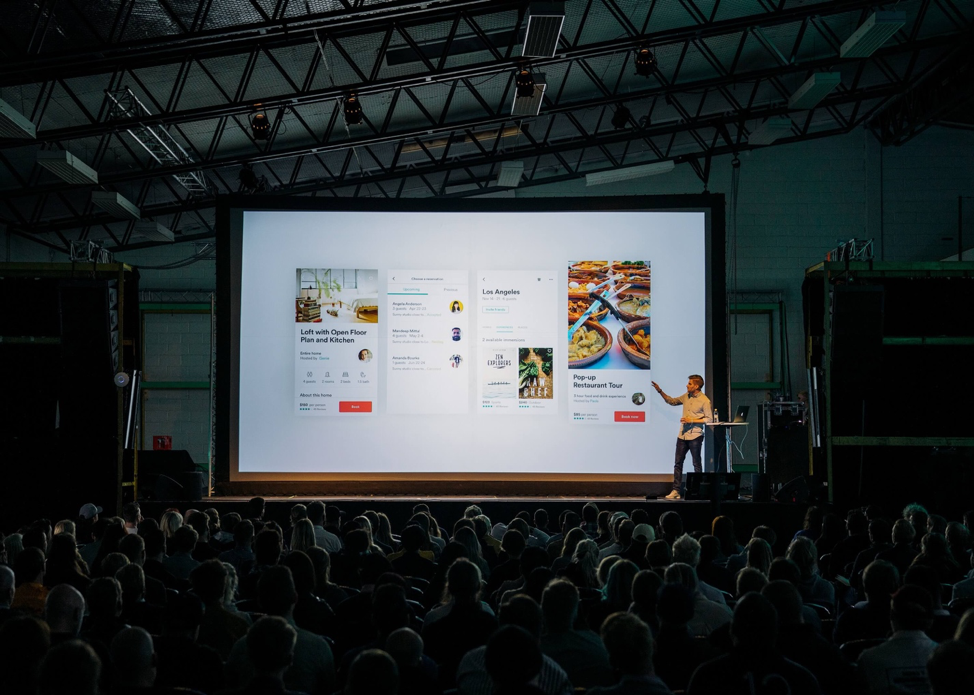
Photo by Teemu Paananen on Unsplash
Advisor Perspectives welcomes guest contributions. The views presented here do not necessarily represent those of Advisor Perspectives.
Click here to watch a video and learn more about Evidence Based Advisor Marketing.
I give a lot of talks. When I attend conferences, I listen to the other speakers. I learn a lot from both experiences.
As someone who has spent many hours researching the topics surrounding my profession, I have a protocol I follow whenever I engage in a new activity, whether it’s writing books and blogs, coaching advisors on how to convert prospects into clients, or creating content and designs for web pages.
I do the research. I don’t assume the way it’s always been done is supported by the evidence.
I took the same approach when I started speaking. It’s an ongoing process. Here’s what I learned from John Medina’s excellent book, Brain Rules.
The power of visuals
Medina’s message is straightforward: Vision is by far the most dominant sense, taking up half of our brain’s resources.
He describes the result of a fascinating experiment. Expert wine tasters in France were given white wine, which had been altered with a colorless, odorless red dye. Every one of the 54 wine-tasting professionals described the wine in terms typically used when tasting red wine.
Medina makes a compelling case for this central point: We learn and remember best through pictures, not through written or spoken words.
Despite this research, I typically see speakers using PowerPoint slides that are text-dense and image-sparse. Medina tells speakers to “burn” their PowerPoints and create new ones, consistent with his research.
My process
In my talks, I often use no presentation aids. If I do, I have only a couple of slides, solely of images, with no text.
Am I violating Medina’s research which indicates visuals trump spoken words?
I would be if – like most presentations – my talks consisted of me speaking for 45 minutes or so, followed by a few questions from the audience in the remaining time.
Here’s some research that should be a wake-up call, whether you are speaking to an audience or one-on-one to a prospect or client: The average adult attention span is only five minutes. After that, about 84% of your audience is likely to tune out.
My talks are usually 90 minutes in length. I have a surefire way to keep my audience engaged, without the use of presentation aids. It’s disarmingly simple.
I don’t give a “talk.”
In the introduction, I have my sponsor say this: Dan wanted me to tell you that he is not giving a presentation, interrupted by questions. Instead, it’s your questions interrupted by his talk.
Marketing Services For Evidence-Based Advisors
We offer consulting services on how to convert more prospects into clients through Solin Consulting, a division of Solin Strategic, LLC. Our evidence-based persuasion strategies have significantly increased conversion rates for our coaching clients
We offer a full range of digital marketing services exclusively to evidence-based advisors through Evidence Based Advisor Marketing, LLC (EBAM). These services include: web and content creation, video creation, production and post-production, social media consulting and e-mail marketing consulting. You can see websites we have designed, content we have drafted and videos we have produced here.
Click here to request a free, no obligation website evaluation.
For more information, please contact:
Dan Solin
[email protected]
(239) 949-1606
Schedule a call with Dan here
This statement is powerful. It tells the audience this will be an interactive discussion and not a “presentation.”
It’s much simpler to involve an audience (of any size) than you might think. I start by having the audience participate in an exercise intended to demonstrate how the brain functions. I do this before I’m formally introduced.
At the end of my introduction, the sponsor will ask: Tell us the point of that exercise. That cues me to get volunteers in the audience to describe their experience with the exercise.
From that time on there are so many questions we rarely have the opportunity to cover all the points I wanted to make.
That is fine with me.
Involve your audience in an interactive discussion as early as possible the next time you speak. If you must use PowerPoint, limit the number of slides and use images as much as possible.
Dan Solin is a New York Times best-selling author of the Smartest series of books. His latest book is The Smartest Sales Book You'll Ever Read. His sales coaching practice includes helping advisors convert prospects into clients and generating leads through videos and other elements of marketing. Dan is not affiliated with any advisory firm.
Get Dan's investing insights by signing up for his free, weekly newsletter here.
Subscribe to Dan’s YouTube investing channel here.
To be listed on our Middle America's Plan website as a Preferred Advisor who offers MAP to clients, click here.
Read more articles by Dan Solin
 Advisor Perspectives welcomes guest contributions. The views presented here do not necessarily represent those of Advisor Perspectives.











