Advisor Perspectives welcomes guest contributions. The views presented here do not necessarily represent those of Advisor Perspectives.
Most advisors are making life painful by sacrificing depth of client relationship for volume. Consider the “70 deep” model.
Your practice as a chaotic Picasso
All around the mulberry bush, the advisor chased the clients. The advisor thought 'twas all in fun. Then pop went the weasel.
The other day I was having a conversation with an advisor and it went something like this:
Me: “So you’re at what – about 50 clients? Or is it more like 100?”
Advisor: “About 50. My goal is to get one new client every month until I get to about 120 to 150 clients.”
Me: “Really? Are you sure you want to do that?”
Advisor: “Yeah sure. I can always just hire more people if I need help.”
He’s (naively) thinking he can own a yacht this way. And you may earn a ton of cash – in terms of top-line revenue – but at what expense?
This winds up becoming unattractive for everyone (most of all your clients) – it becomes what I call a “chaotic Picasso.” It looks like a pretty picture from afar but when you get up close it’s a complete mess.
What does a chaotic Picasso advisor practice depict?
- Advisor is running around with his/her hair on fire.
- The advisor’s staff is running around with their hair on fire.
- Nobody is truly happy in terms of compensation relative to time spent at work.
- Not enough time to develop a meaningful brand or niche and this translates into garbage, cliché marketing because you don’t have time to think about anything deeper.
- Your relationships are superficial – you don’t know your clients in and out – so you miss opportunities to gain more assets.
- You don’t get as many referrals as you want.
- Growth isn’t good. By adding new clients you place further strain on resources, which doesn’t justify the growth in revenue.
- You can’t make any good acquisitions or find a suitable successor.
- You can’t call on bigger clients with higher AUM or more sophisticated needs, because you don’t have time to provide in depth services.
- COIs don’t want to do business with you because all of this is obvious.
- Your profit margin stinks or you don’t even know what it is.
- The profitable clients pay the bills while the unprofitable clients consume the money that the profitable ones have created.
This is no renowned Guernica, I can tell you that.
Emotional neglect is taking its toll
What advisors say in their marketing and what they do in reality don’t quite match up. Seems like 100% of your websites say your services are sooooo personal, soooo customized, and your clients will feel like they’re family.
Whose family has 100 people in it?
I have a larger family than most – four kids, two parents, one brother, a sister-in-law, two nieces, and a handful of cousins – and of course there’s Antonio. About 20 people total and I still forget birthdays.
Can you really attend to the emotional needs of 100 or more people (like you say you do on all your web sites)? Can you take the time to understand them in a deep, meaningful way? Or while you’re talking to them you’re thinking about the other 20 things you have to do?
The 70 deep model
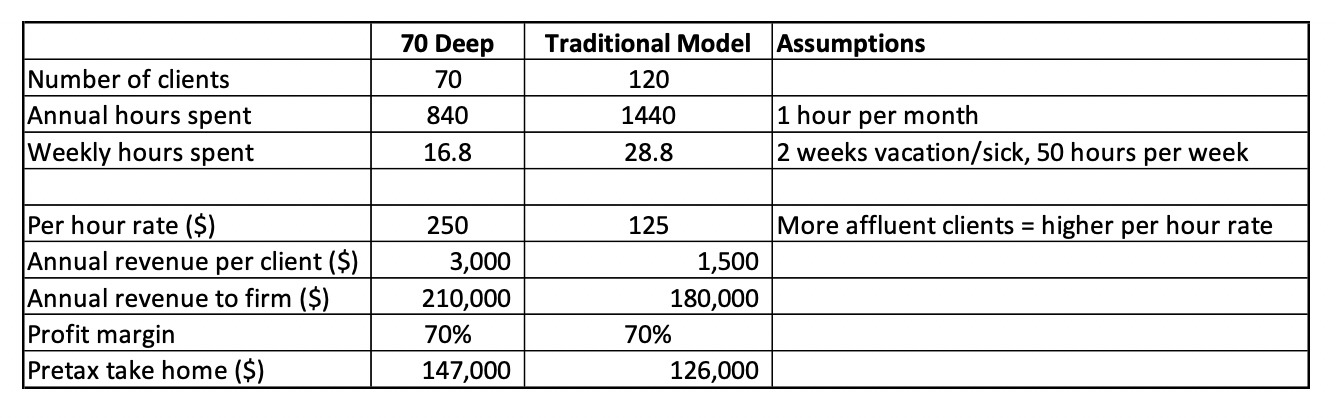
Here’s a quick comparison. Let’s say you instead designed an independent RIA firm with 70 clients with whom you have deep relationships. What does this look like compared to a 100+ clients practice?
In the 70 deep model, you’re averaging one hour a month to each client. That’s about 17 hours a week of total client facing time. This still leaves you an additional 33 hours a week of non-client facing time. In the 70 deep model, you’re serving more affluent clients with more assets and higher planning needs - hence the higher per hour rate.
In the traditional model, it’s flipped. You’re spending nearly 30 hours a week on client time leaving you with just 20 hours to manage the rest of your business – and you’ve got more things to manage. You’ve got fewer affluent clients with less sophisticated needs, hence the lower per-hour rate.
I’ve sketched it out so that the take home result is roughly the same, but let me ask you:
- Which advisor would you rather be?
- Which firm would you rather be a client of?
- Which advisor is relaxed and has more time to think?
- Which advisor has a lean, efficient business model?
- Which advisor is likely to attract/appeal to wealthier people?
- Which practice has higher potential to get higher quality referrals?
- Which practice has higher potential to earn the right to manage 100% of each client’s assets, or earn more planning fees from each client?
I’ve assigned both practices the same profit margin. In reality the smaller practice is more profitable due to higher revenue per client.
Stop mopping the deck
For people as obsessed with fees, fees, fees – I’ve never seen an industry as obsessed with fees as the financial advisor industry – you are in the dark when it comes to profitability.
I’ve seen many of you mopping up the deck – not at the helm of the ship. Are you one of those advisors who likes to program their own websites? Or who believes you have developed a “tactical fundamental strategy” that outperforms, but you can’t figure out why the rest of the world hasn’t caught on to the fact that you’re the next Warren Buffett?
Wake up and listen to this. The business has changed. You can’t do things the same way anymore. You need to outsource the $25/hour work and get out of your office and go meet some people for whom you can do $250/hour work.
I’ve heard advisors in denial. The bigger clients are snobs; they’re too much work. I want to work with the humble, less demanding smaller clients.
Smaller doesn’t equal easier. To them, it’s their life savings and they do not take their relative wealth into account. Deep down the advisor is afraid:
- What if more sophisticated clients don’t like me because I don’t hang out at the country club like they do?
- What if I can’t serve them?
- What if my firm isn’t equipped to offer these higher level services?
- What if I say something and look bad?
- Where am I going to find these people anyways?
Learn new skills. If you can’t, outsource to somebody who does. As for finding new people - does your LinkedIn profile look like this?
Yes, that’s right. It’s blank.
A blank space is the overall effect I’m trying to convey anyways. Bad pics, jargon cliché and nothing meaningful to say in the news feed. You may as well be invisible because you haven’t taken the time to earn the attention – you’re bogged down with administrative junk that you should be paying someone else to do!
Sara’s upshot
Profitability is something I talk about in my membership and on my podcast. If what I have said has struck a chord, comment on AP Viewpoint so that I may focus future articles on this topic.
Sara Grillo, CFA, is a marketing consultant who helps investment management, financial planning, and RIA firms fight the tendency to scatter meaningless clichés on their prospects and bore them as a result. Prior to launching her own firm, she was a financial advisor and worked at Lehman Brothers.
More Active Management Topics >
 Advisor Perspectives welcomes guest contributions. The views presented here do not necessarily represent those of Advisor Perspectives.