A Blueprint for a Prosperous, Sustainable Future
Membership required
Membership is now required to use this feature. To learn more:
View Membership BenefitsA Blueprint for a Prosperous, Sustainable Future1
“Live long and prosper.” – Mr. Spock (Leonard Nimoy)
Does a prosperous global society need access to energy supplies that grow faster than the population? In other words, does energy use per capita need to grow for productivity and wealth to increase? Conventional wisdom says yes, but a new book tackles this question and reaches the surprising and optimistic conclusion that we can live better while consuming less energy and fewer material resources.
To appreciate the importance of this issue, start by considering the following puzzles. Why has your record collection been replaced by a weightless assemblage of bits and bytes? Why do you use a third as much gasoline as your grandfather, even though you drive many more miles? Why is the long-term trend of real (inflation-adjusted) commodity prices down?
Because of dematerialization, argues MIT professor Andrew McAfee in his new book, More from Less.2 Every organism on Earth tries to economize, that is, to get more output from fewer inputs. But until recently mankind bucked the trend, consuming more and more and never getting to the “less” part.
That is partly an illusion, though.
We’ve been getting more from less for as long as we’ve been in existence – that is what economic growth is! But, due to increases in population growth, we have used an increased volume and weight of resources, until recently. We’ve begun to tip, however, into actually using fewer resources, without suffering any loss in utility. This trend will continue and intensify, and that’s what McAfee’s book is about.
The idea of dematerialization is not new. In his book Nine Chains to the Moon, the visionary architect and inventor R. Buckminster Fuller described “ephemeralization” almost a century ago.3 (The Greek-derived word “ephemeralization” sounds fancier than Latin “dematerialization,” but they’re the same thing.) Fuller wrote,
Do more and more with less and less until eventually you can do everything with nothing.
That’s hyperbole, typical of Fuller’s overwrought prose. You cannot make something out of nothing. But, as McAfee ably demonstrates, making more out of less is what much of the human enterprise is about, and is how we progress from poverty to prosperity.
The parable of the smartphone
Please join me in the following thought experiment. It is 1985, only 34 years ago, well within the modern era of advanced technology. Assemble a roomful of gadgets that will provide the same services as the apps that are now (in 2019) on your smartphone. While you’re doing so, keep track of the prices:
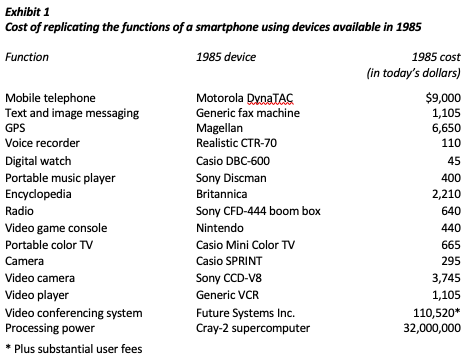
Source: https://www.webfx.com/blog/internet/how-much-did-the-stuff-on-your-smartphone-cost-30-years-ago/. Money amounts in 2015 (not 2019) dollars.
The room needed to accommodate all this would have to be quite large, and the total cost is $32,136,910. Drop the supercomputer (which has the same processing power, 1.9 gigaflops, as a good smartphone) and it’s $136,910.4 Drop the video conferencing system, too, and it’s a still princely $26,390.
For comparison – but you know this already – the best smartphone, capable of all these functions and many more, costs about $1,000 and fits in your pocket.
All right, I’m gilding the lily. Nobody would have bought 1.9 gigaflops of processing power in 1985 just because they didn’t have a smartphone. But that’s the power your phone now has, and it helps with complex apps like Waze, which merges three advanced technologies (a detailed street map with live-updated traffic information; a way of ascertaining the driver’s position, speed, and direction; and a social network for warning the driver about police and other inconveniences).
The exhibit also leaves out functions that were unimaginable in 1985, such as ride sharing software that not only matches drivers and riders but changes prices so that the supply of both adjusts to meet rapidly fluctuating demand. We are, indeed, doing more with less. (A smartphone is not quite “nothing,” Buckminster Fuller notwithstanding.)
And I’ve also cherry picked by discussing the most dramatic example of dematerialization I can find. Most things are not disappearing as quickly as the 1985 pile of gadgets. But, as McAfee shows, dematerialization is happening in many spheres of activity, including energy usage (very important), and is accelerating.
The second machine age
 McAfee, an MIT Sloan School professor and co-director of the MIT Initiative on the Digital Economy, is best known for his book co-authored with Erik Brynjolfsson, The Second Machine Age. That 2014 book expressed the concern that the current wave of robotic automation makes workers and machines into substitutes for each other, rather than complements as was the case in the first machine age (the Industrial Revolution). The prospect of mass unemployment and extreme inequality troubled them, even as they foresaw large increases in overall productivity and wealth that would result from “brilliant technologies.”
The current volume, a solo effort by McAfee, is more optimistic. In his conclusion, he writes that we now have the opportunity to replenish that which we’ve taken from the Earth, and that:
[a]mazingly enough, doing...this won’t require radical course changes in our economies or societies. We just need to let the four horsemen of the optimist – capitalism, technological progress, public awareness, and responsive government – do more of what they do. Which is, as we’ve seen, to let us and our planet flourish.
Did the environmental movement start off on a wrong track?
McAfee begins by recalling that the modern environmental movement adopted a formula proposed in 1971 by the biologist Paul Ehrlich and the physicist John Holdren to measure “society’s total negative impact on the environment.”5 The formula, as modified slightly in later work, is known as the IPAT model:

where I is impact, P is population, A is affluence (proxied by GDP per capita), and T is technology. Thus, affluence is always bad; but, backpedaling a bit, Ehrlich and Holdren admit that “technology could be either good (such as solar power) or bad (more coal plants), but when it was good, it ‘tend[ed] to be slow, costly, and insufficient in scale.’”6
This kind of thinking led to what I call a “poverty strategy” for saving the Earth. It is one of the worst ideas ever foisted by scientists on an uninformed and gullible public. Subsistence living is environmentally destructive, and early industrial life, while more economically rewarding, was polluting and poisonous. Only advanced technological societies can be environmentally clean – or can afford to.
This principle is formalized in the environmental Kuznets curve (EKC), or clean-dirty-clean curve, which says that societies first pollute more as they industrialize, then pollute less as they approach a post-industrial status. Two celebrated economists, Gene Grossman and Alan Krueger, set forth the EKC theory in the 1990s, and there is much evidence supporting it.7
CRIB notes
Yet the poverty strategy grew in popularity, evolving into a recipe for environmental salvation that McAfee calls CRIB: Consume less, Recycle, Impose limits, Back to the land. All, he says, are terrible ideas when executed naively or thoughtlessly. Some are terrible ideas no matter what you do. I’ll consider each, but not exactly in the order in which they appear in the acronym.
Consuming less is fine for the comfortable. You don’t really need a 4,000 square foot house or that third car. Many of us are overweight. But, of the 7.7 billion people now living, only between one and two billion have ever experienced a first-world living standard.8 The rest are hoping for their chance, and many are now getting it. We don’t want that to stop – it would be the cruelest trick ever played by the rich on the poor.
Recycling, McAfee, says, is “big business...yet...irrelevant for dematerialization. Why? Because recycling is about where resource-producing factories get their inputs, while dematerialization is about what’s happened to total demand for their outputs.”
“Back to the land is bad for the land,” McAfee advises. Back to the land is kind of cute; the image of self-sufficient agriculturalists, whether the stone-faced Iowa farm couple in Grant Wood’s famous painting or a group of hippies in modern Vermont, is appealing. But McAfee writes that
homesteaders use more land, water, and fertilizer than do “factory farmers”...[and] rural life is less environmentally friendly than urban...dwelling [which is very energy-efficient]... As economist Edward Glaeser summarizes, “If you want to be good to the environment, stay away from it.”
Now that’s an aphorism worth remembering!
Imposing limits: the best and the worst ideas
China’s one-child policy
McAfee reserves his strongest words – and biggest page budget – for Imposing limits.
It is “the worst idea, and the best one,” he says. He regards the one-child policy imposed by China in 1979 as the most destructive population control effort ever attempted. In fact, he goes a little overboard, quoting approvingly a group of Chinese demographers who write,
While [the Cultural Revolution and the Great Leap Forward were] grave mistakes [that] cost tens of millions of lives, the harms done were relatively short-lived and were corrected quickly afterward. The one-child policy, in contrast, will surpass them in impact by its role in creating a society with a seriously undermined family and kin structure....9
One can debate whether the benefits outweighed the costs of the one-child policy. They probably didn’t. But to say that it was more damaging than the Great Leap Forward and the Cultural Revolution is, well, a great leap backward. In an article on the value of trust in societies, Yuyu Chen of Peking University and David Yang of Harvard reminded us that the “man-made disaster” of the Great Leap Forward resulted in the worst famine in human history, killing 30 million people in 1958-1961.10
It is hard to feel sorrier for people never born – or the people who could have been their husbands, wives, and children, or who could have benefited from their creativity and productivity – than for those who were starved to death by an incredibly barbaric set of policies. And it is hard to “correct quickly afterward” the physical, mental, and economic damage done to the survivors. Famine is the cruelest of the four horsemen of the apocalypse. It is especially cruel when it could have been completely avoided.
By the way, a footnote of McAfee’s reminds us that a fanatic, in Winston Churchill’s memorable phrase, “can't change his mind and won't change the subject.” McAfee notes that “when China announced the formal end of the one-child policy in late 2015, [the 83-year-old] Paul Ehrlich responded with a tweet... ‘GIBBERING INSANITY – THE GROWTH-FOREVER GANG.’” We’ll leave it to the reader to decide who’s insane.
Preserving nature and natural resources
While imposing limits on childbirth meets with McAfee’s strong disapproval, imposing limits on exploitation of the environment elicits in him the opposite reaction. National parks, according to filmmaker Ken Burns “America’s best idea,” are a wonderfully effective way of preserving scenic natural wonders forever. We can protect wolves and bears and elephants and whales. We can make it criminal or exorbitantly costly to fill the air and water with poisons.
Only government can do these things, and as societies become more affluent they demand that their governments divert some resources, formerly dedicated to immediate survival, toward these higher goods. We saw this force at work in the United States in the last century and we are beginning to see it in China. Responsive government is an asset as important as natural resources, labor, capital, or social trust.
Inside dematerialization: Decoupling energy use from affluence
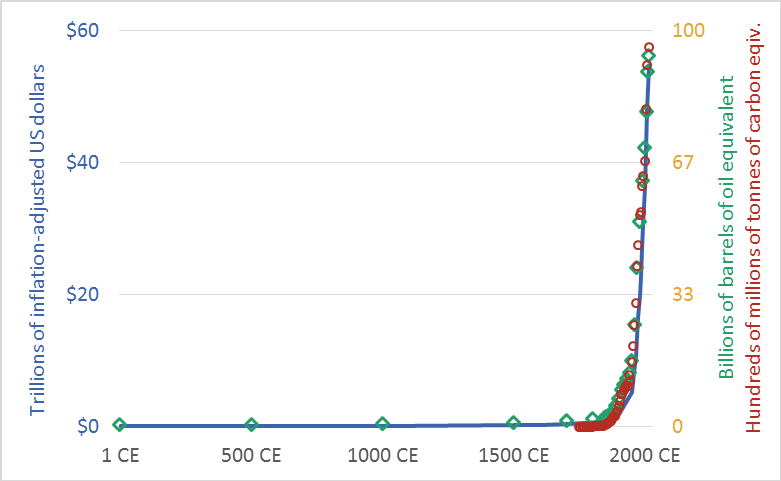
Let’s take a closer look at an aspect of dematerialization with which McAfee is deeply concerned: energy efficiency. The terrifying diagram in Exhibit 2, with its familiar hockey-stick shape, shows the tight link between the growth of global GDP (the blue line) and energy use (green and red dots) over a very long period of time – 2,000 years. Energy use grew at about the same rate as aggregate global GDP, that is, GDP per capita multiplied by world population. Both started rising rapidly around 1800, when the Industrial Revolution began.
Exhibit 2
Two thousand years of global GDP and energy use
Source: https://www.darrinqualman.com
The diagram ends in the year 2000, so what about the current millennium? World population is continuing to grow – albeit at a much reduced pace, with “peak population” expected to be between 9.5 and 11 billion sometime later in this century, followed by a decline. Moreover, continued growth in GDP per capita is not just desirable but necessary for those parts of the world that are not already rich. Thus, aggregate world GDP is going to grow a lot.
Energy and other resource must “decouple” from global GDP. Fortunately, as McAfee shows, and as Exhibit 3 makes clear, decoupling of energy use from GDP growth started almost a half-century ago, and continues to this day. We need to find, and are finding, ways to make this decoupling accelerate. (Energy is particularly important to the decoupling argument because it is the “master resource,” the resource that makes all other resources valuable because it “enables us to convert one material into another,” wrote the late Julian Simon a generation ago.)
Exhibit 3
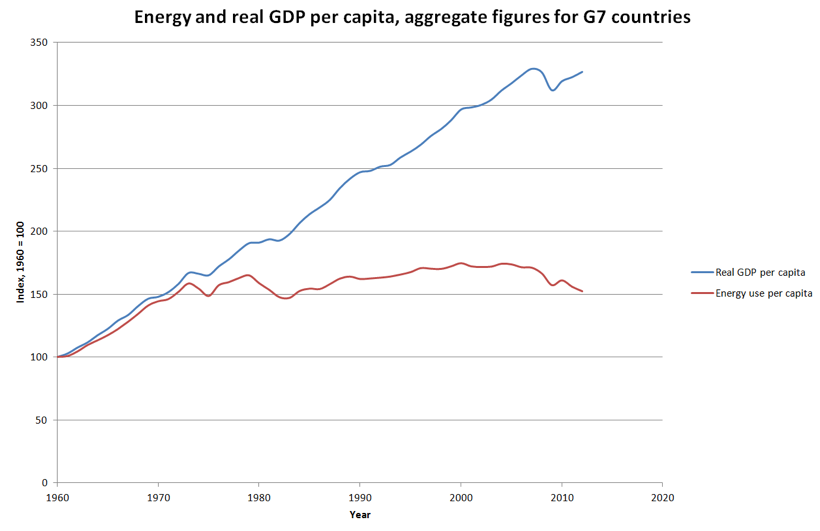
Source: Created by Reddit user usrname42 using data from the World Bank, http://databank.worldbank.org, series ‘GDP (Constant 2005 US$)’, ‘Energy Use (kt of oil equivalent)’, and ‘Population (Total)’.11
What causes this decoupling? McAfee credits both the supply-demand-price system of classical economics and the role of responsive government referred to earlier. The price system makes scarce resources expensive and causes users to economize or find cheaper and better substitutes. We can see this in Exhibit 3 where, in the 1970, huge increases in oil prices caused consumers and industry to use less oil. Governments, for their part, do things like imposing corporate average fuel economy (CAFE) standards on cars and rewarding taxpayers for installing energy-saving devices in their houses.
Over long periods of time, the resource savings made possible by decoupling (or, in simpler terms, increased efficiency) adds up meaningfully. At the 1.5% annual rate of improvement observed for both the U.S. and the world over the last quarter century,12 energy use per unit of GDP will decrease 37% by 2050 and 57% by 2075. These forecasts assume no radical change in the energy mix, such as fusion reactors or a yet undiscovered way of storing and transporting solar power – but such innovations can be expected over such a long period, especially when motivated by the prospect of large profits.
As a result, the actual improvement in energy efficiency will be quite a bit larger.
Capitalism and progress
Reacting to the anti-capitalist mood of the moment, McAfee places considerable emphasis on the importance of free markets in achieving the dematerialization he’s celebrating. “More from less” is embedded in the very nature of capitalism: capitalists may want to sell more and more, but they don’t want to buy more. So they are powerfully motivated to find ways to economize on inputs.
Here is a powerful example of More from Less that is decades old. In 1979, the Staggers Act was passed under the watch of President Carter. The law deregulated transportation. What happened? Innovation and capital investment boomed in freight transportation, driven by the efficient use of capital and the adoption of hyper-efficient shipping containers that fit on ships, trains, and trucks. U.S. freight railroads became the most efficient in the world.
We also got a green new deal out of this: The amount of energy used to move a ton of freight one mile fell by 65% between 1979 and 2010!
How government helps
But environmental remediation is not all about deregulation. Regulation helps too, as McAfee reminds us (beating some sense into the hard-core libertarians in the crowd). In January 2020, a global regulation known as IMO 2020 will prohibit all ocean-going ships from using fuels with a sulfur content above 0.5%, compared with 3.5% now. Only ships fitted with sulfur-cleaning devices called scrubbers will be allowed to continue burning high-sulfur fuel. Every country must follow these rules if they want their cargo unloaded, and the rule eliminates a terrible source of pollution – as did the Clean Air and Clean Water Acts in the U.S. a half-century ago.
Rich, efficient, and growing economies do this. McAfee identifies the twin factors of public awareness and responsive government as two of the four horsemen of the optimist. Everybody wants a clean environment, but poor people want other things more – eating, for example. It is hard to raise public awareness of environmental issues among people who have a very high time discount rate because they don’t know where their next meal is coming from.
As people become more prosperous, they not only demand more environmental protection from their government but have the ability to pay taxes to support the demand. And, of course, only a government that cares about the will of the people (and that is competent) will respond appropriately by regulating and deregulating, taxing and subsidizing, so as to produce the maximum environmental benefit while taking cost into consideration.
Disconnection
McAfee writes that personal disconnection is a threat to our well-being, right alongside climate change (which he says is real and bad), war, terrorism, and a pandemic. The wave of populism that is enveloping the world may be a reaction to that, with people perceiving a need to belong to something larger than a family and smaller than the human race. A nation-state or race fills that need. It’s irrational, but perhaps hard-wired into our collective behavior.
Disconnection is, of course, a real phenomenon, and McAfee is right to include it in the litany of problems that need to be solved. The sociologist Robert Putnam, in Bowling Alone (2000), argued that what he called “social capital” – the web of personal connections that builds trust in a community and lowers crime, loneliness, and transaction costs – is declining. It has declined further since 2000. The percentage of adults in the U.S. who are married is at an all-time low: 50%.13 These are signs of declining social health. And social capital is a vital ingredient, along with financial capital, human capital, and other traditional forms of wealth, for society to thrive and grow. I will leave it to the sociologists and others who have studied this topic more closely to comment further on McAfee’s views, but he is onto something.
Recommendations for readers
More from Less is a fairly easy read, and is modestly sized. However, it is about one narrow aspect of technological progress – dematerialization – and readers seeking a broader perspective on the future should check out McAfee’s previous book (with Erik Brynjolfsson), The Second Machine Age, instead. Peter Diamandis and Steven Kotler’s Abundance also hits many of the same notes, with a slightly different perspective. Both of those older volumes are basic reading for those interested in the literature of the new optimism.
But readers seeking the details of the dematerialization revolution should definitely read More from Less. It is the first modern popular book on this topic. All the other work is dryly academic.
At the risk of sounding mercenary, my own book, Fewer, Richer, Greener, covers these topics broadly and has a chapter on dematerialization, influenced by (and quoting admiringly) both of the books mentioned above. It will be published by Wiley in December 2019.14
Advice to investors
If the continued dematerialization that McAfee is forecasting takes place, it’s good for equities because, having been partly freed from resource-cost constraints, we will get a lot of economic growth. But it will not be good for all equities. Some companies and industries will be hurt while others will be helped immensely. Actively managed portfolios can benefit from this insight.
Natural resources firms might suffer while technology companies advance. Energy companies will have varied results depending on which energy sources turn out to be the most economical and plentiful. Thus, fundamental analysis by farsighted and well-informed analysts will help to generate returns superior to those produced by cap-weighted indices.
The rub is that most analysts think they’re farsighted and well informed. Those who have modest opinions of their own ability drop out of the active management game and buy index funds. Index funds today ensure that you benefit from the innovation and extraordinary growth in Apple and Amazon while Toys ‘R’ Us and J. C. Penney fade away; the same will happen with winners and losers from dematerialization, so index funds should not be considered verboten.
As always with active management, then, the toughest job is picking managers who will win, on a risk-adjusted basis, over the long term. They all say they will, but mathematics dictates that a little fewer than half can actually do so.
Last word
No physical quantity can grow at 3%, or 1%, or even 0.1% per year, forever. But the good news is that “utility,” that which is good and valuable to people, need not be delivered in physical form. Economic growth – that is, growth in utility – will continue long past the time that the use of physical resources has peaked and begun to decline.
Larry Siegel is the Gary P. Brinson Director of Research for the CFA Research Foundation and an independent consultant. Prior to that, he was director of research in the investment division of the Ford Foundation. His book, Fewer, Richer, Greener will be published by Wiley in 2019. He may be reached at [email protected] and his web site. The author thanks Stephen C. Sexauer, chief investment officer of the San Diego County Employees Retirement Association, for his substantial contributions to this article.
1 Full disclosure: While this article is original material, little snippets of it – some of the ideas and less of the wording – appear in my book, Fewer, Richer, Greener (forthcoming December 2019).
2 It’s rare that a subtitle is so long that it requires a footnote, but the full title of the book is More From Less: The Surprising Story of How We Learned to Prosper Using Fewer Resources – and What Happens Next. In coming up with a title, McAfee could have well afforded to implement some of the economizing forces that he loves so much.
3 Fuller, R. Buckminster. 1938. Nine Chains to the Moon: An Adventure Story of Thought. Philadelphia: J. B. Lippincott & Co. “Nine chains” refers to the idea that if you made a chain out of all the people on Earth at the time (a little over two billion) by having each stand on the next one’s head, it would stretch from the Earth to the Moon nine times over. Bucky Fuller was a little weird.
4 A gigaflop is a billion floating-point operations (“flops”) per second.
5 The quote is from McAfee, summarizing Ehrlich and Holdren’s work.
6 Again, the quote is McAfee’s. Double nested quotes are bad enough, but putting this attribution in the text would have required triple nested quotes.
7 Grossman, Gene M., and Alan B. Krueger. 1995. “Economic Growth and the Environment.” Quarterly Journal of Economics, vol. 110, no. 2 (February), pp. 353-377. They circulated a related, unpublished paper in 1991.
8 The total population of countries considered high-income by the World Bank is about 1.1 billion, but many people in middle-income countries, such as Mexico and China, live at a level that is well above average for their country and can be said to be experiencing a first-world living standard. But some people in high-income countries do not experience a first-world living standard.
9 Feng, Wang, Yong Cai, and Baochang Gu. 2012. “Population, Policy, and Politics: How Will History Judge China's One-Child Policy?” Population and Development Review, vol. 38, pp. 115-129.
10 Chen Yuyu, and David Y. Yang. 2019. “Historical Traumas and the Roots of Political Distrust: Political Inference from the Great Chinese Famine.” Working paper, http://davidyyang.com/pdfs/famine_draft.pdf. (Both this and the previously referenced paper cast doubt on the idea, popular in the U.S. and maybe elsewhere, that Chinese citizens can’t criticize their government’s past policies.)
11 Direct link to diagram: https://external-preview.redd.it/_NPxJrXYQHmrbu07wmDvpHxtnmbio-xG_ou8v01Q2oE.png?auto=webp&s=6412d094d244fe8b09330d136e4e2746552ef82e The relationship between GDP and CO2 output is, understandably, similar.
12 https://yearbook.enerdata.net/total-energy/world-energy-intensity-gdp-data.html
13 https://www.pewresearch.org/fact-tank/2017/09/14/as-u-s-marriage-rate-hovers-at-50-education-gap-in-marital-status-widens/
14 Feeding my ego even more, I appear (as an unnamed character) in More From Less. McAfee recounts the story that, almost a half-century ago, Milton Friedman autographed a MonopolyTM board, adding the phrase “Down With Monopoly.” I was the student who invited Professor Friedman to the sherry hour at the University of Chicago dorm where he did this.
Membership required
Membership is now required to use this feature. To learn more:
View Membership Benefits