Why Generational Differences Matter Less Than You Think
Membership required
Membership is now required to use this feature. To learn more:
View Membership BenefitsWe shouldn’t read too much into pop sociology, especially when investing other people’s money. William Strauss and Neil Howe built a following by studying substantive differences among generations: Baby Boomers, Millennials, Gen X and so forth.
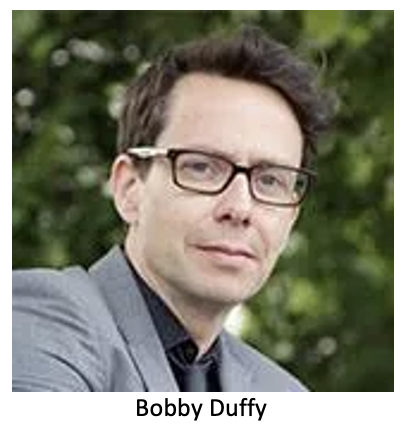
But that view is mistaken, according to Bobby Duffy.
Duffy asks whether our lives largely shaped by when we were born, as popular “generational analysts” try to convince us. Or are generations more similar than different? In a new book, The Generation Myth, Duffy, a British policy scholar, argues – somewhat effectively – for the latter.
 Peak generational silliness was achieved by Strauss and Howe, whose work (much beloved by both Steve Bannon and Al Gore) listed Anglo-American generations and their associated stereotypes from 1584 to 2069.1 In their later book, The Fourth Turning, they set forth a theory that categorized history – and their imagined future – into 20-year periods that follow one another deterministically: high, awakening, unraveling, and crisis. Each cycle thus lasts 80 years. We are (surprise!) in a crisis period.
It was high time somebody debunked this pseudoscientific nonsense. Duffy gives it a try in The Generation Myth, an “answer song” to Strauss and Howe’s bestselling books. Duffy’s book is full of interesting observations, arguments, and data. He is mostly correct that, in Tyler Cowen’s words, “the generations just don’t differ that much from each other.”2
Unfortunately, The Generation Myth doesn’t hang together as a book. The chapters are disconnected. Duffy’s writing is unexceptional. He lacks the storytelling ability needed to turn his rich lode of material into a powerful argument. Nevertheless, readers will be better off having read it.
The sociobiological roots of generational change – and similarity
Despite Duffy’s admirable effort to debunk historical determinism, he attaches some importance to generational thinking: “Generational perspectives are powerful because they are interwoven with the fundamentals of human existence and societal change.” In less flowery terms, generations differ from one another, not just because of shared experiences, but for a reason embedded in human nature: You admire your parents but want to be different from them. My father taught me to love classical music, but my heart is with rock and roll. I think hip-hop is just noise; my son does not. My father wanted to avoid another World War II; I wanted to avoid another Vietnam; my son wants to avoid another Iraq and Afghanistan. These attitudes are completely predictable, and (at one level) form the basis of generational difference and conflict.
But let’s drill down one more level and, drawing on Richard Dawkins in his “Battle of the Generations” (chapter 8 of The Selfish Gene), understand this perennial conflict as a struggle for scarce resources. A child’s parents, whether human or animal, instinctively conserve resources for themselves, the child’s living siblings, and siblings not yet born. The child’s survival instinct causes him or her to want all of the parents’ resources right now. (This is why raising kids is such a pain. Parents and children do have different needs and goals at a fundamental biological level.)
We ignore these insights from sociobiology and evolutionary psychology at our peril – in the psychologist Martin Daly’s great phrase, we’re “just another critter.”3 Respecting our biology is more important than figuring out, as Duffy tries to, whether millennials are having less sex than their parents did at the same age or spend too much time on their iPhones.
Three mechanisms for generational changes
Duffy separates the causes of long-term generational changes into three categories.
- “Period effects” are those that everyone experiences no matter what generation they’re in, because of world events. Examples are World War II and the coronavirus pandemic. Major technological changes, such as air travel and the internet, belong in this category.
- “Lifecycle effects” occur because individuals age. People tend to become more responsible, less adventurous, and more conservative when they have children. They also evolve financially, spending during the family formation years, then saving for retirement, and ultimately spending their retirement savings.
- Lastly, “cohort effects” are the ideals and practices specific to a given generation. Duffy argues that cohort effects get more attention than they deserve. A blog poster calling himself or herself Casey, participating in Tyler Cowen’s superb Marginal Revolution blog, summed up this thought concisely:
So much of the supposed differences between generations [are] just the more permanent differences between old people and young people.
Every new generation gets labeled as slackers and spoiled; every old one gets rightly criticized for being behind the curve of moral progress.
It’s been that way since the start of modernity.4
I would change “modernity” to “human history.”
Echoing Casey, Cowen wrote, “The generations just don’t differ that much from each other…” but then backpedaled: “…at least not in ways that show up as strong effects in the data, adjusting for other demographic features.”5 The backpedaling is justified. Some of the generational differences are salient. The current cohort of young people is probably the least religious in history, a fact that may explain the quasi-religious attachment of many of them to environmentalism, a topic to which I’ll return later. Everyone has to believe in something.
Because the book doesn’t sparkle but the topic is of universal interest, much of the rest of my review is a meditation on the differences and similarities between generations. We are all in the same human soup, and these similarities stand out when we see ourselves in people who came before us – sometimes millennia before us – and when we see those now-departed people in ourselves.
Let’s begin with a little case study familiar to most readers.
Generation X: Lazy or hyper-productive?
Generation X was widely maligned as late-maturing time wasters – “slackers.” That was the title of a 1990 movie about them. Dazed and Confused (1993) reinforced the stereotype, as did Reality Bites (1994) and the more thoughtful Bodies, Rest & Motion (1993).
Based on those portrayals, we should not have expected much from this generation. But now they are the pillars of society, raising families, working hard, earning, and saving – The Blind Side (2009), based on a true story, portrays a mature Generation X couple as parents of nearly miraculous ability. Today, the biggest problem with that generation is that there are not enough of them: When Baby Boomers age out of the workforce, there will not be enough tax money to support their massive Social Security and Medicare benefits.
Baby Boomers heard the same song from their parents when they grew long hair and listened to strange “rock” music. So did Jazz Age youngsters 40 years earlier. So, probably, did the followers of Socrates, whose elders thought his views so blasphemous that they had him put to death.
The evolution of environmentalism – and of one environmentalist
To dig deeper, let’s focus, as promised earlier, on environmentalism. Duffy, a conventional environmentalist, believes that our decisions are far too short term-oriented, and that older people discount their children’s future at too high a rate. I’m skeptical of that. Throughout history, parents and grandparents have sacrificed substantial resources to further their children’s chance of survival (in precarious societies) and success (in prosperous ones).
Some young people believe that this stewarding of resources has changed. “Baby Boomers have ruined everything,” they cry – but they offer no evidence of it. People born after 1964 in the U.S. stand to inherit somewhere between $30 trillion and $68 trillion.6 That’s a large multiple, even after adjusting for inflation, of what Baby Boomers themselves inherited. The world economy is more productive this year than in any other year in history. It will be even more productive next year, and so forth out into the future. Today’s young have much to look forward to.
If you’re concerned about natural resources, look at the prices: the Thomson Reuters/CoreCommodity CRB Index, a reflection of resource scarcity, has been falling since 2008 and (linking indices) is lower in real terms than it was in 1913.7 The Economist went back another 68 years and found that real commodity prices have declined since the mid-19th century.8 “Capitalism is the history of falling real prices,” writes the French investment manager Charles Gave. Those include the prices of natural resources, which would rise if we were running out of them.9
The saga of a generational icon
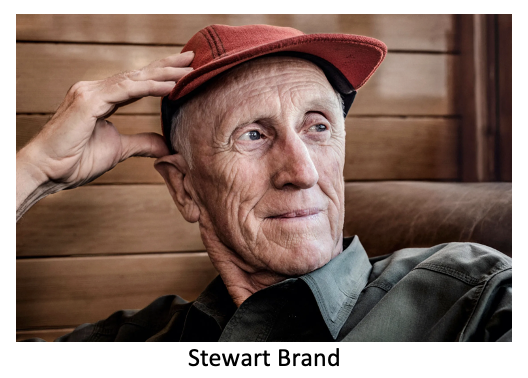 There’s no single archetypal character in the history of the Baby Boom generation, so I’ll just pick one of my favorites. Stewart Brand, born in 1938 and trained as a biologist in the 1950s, authored the immensely influential Whole Earth Catalog in 1968 and became a father figure to younger Baby Boomers. He was the “moral father” of Earth Day in 1970, which kicked off the second, modern environmental movement. (The first was that of John Muir and Teddy Roosevelt.) The subtitle of the Whole Earth Catalog is “access to tools,” which is telling. Brand’s goal in writing the book was to democratize technology, including simple technologies like books, maps, and gardening implements. But more advanced technology was in Brand’s – and our – future.
Brand was fascinated by computers, and as he entered middle age, he became an evangelist for personal computing. “He’s the one who put ‘personal’ and ‘computer’ together in the same sentence and introduced the concept to the world,” writes Carole Cadwalladr of The Guardian.10 He brought together the wildly different West Coast communities of radical hippies and technology geeks. This move is consistent with the idea that people become more practical as they age.
But did Brand, now 83, get more conservative as he aged, a migration that many people, including Bobby Duffy, would expect? That depends on what you mean by “conservative.” Fifty-some years after Earth Day, Brand is an ecomodernist and one of the leading voices of that movement. Ecomodernism, one author writes, “is a school of environmental thought centered on using technology to reduce environmental impacts while maintaining a high standard of living for human beings.”11 That goal is conservative in the best sense, preserving the most valuable aspects of the past as we address the challenges of the future. Politically, Brand and his ecomodernist colleagues are not conservative: “[His foundation] supports state action centered on technology development.”12
Brand and his colleagues’ concern for the future is so intense that they established an organization called the Foundation for the Long Now. The Long Now is defined as the period from 10,000 years ago to 10,000 years in the future. Like many aging people, Brand has changed with the times and promotes technology that makes that makes environmental remediation possible in a way that it wasn’t 50 years ago.
Brand is countercultural, not mainstream. That may distinguish the Baby Boomer generation from others. But maybe not. Other generational heroes, whom I’ll get to, have been different from the mainstream too. It is hard to attract attention when you’re similar to everyone else.
Do old people dismiss their children’s concerns?
The lifecycle process underlying this story, and the story of many other creators and thought leaders, is evidence that people tend to become more practical, wiser, and more concerned about the future as they age. This is true of most people, not just the most accomplished or inspiring of them. My friends and colleagues who are around my age (I’m 67) seem more oriented to the future – not just their children’s future, but the future in general – than they did in their youth, which was typically lived in the here-and-now. I agree with Duffy: “[T]he idea that older leaders are not interested in young people or future-focused issues such as climate change is…patently false.”
That’s been true of every generation throughout history – it is only natural to want to make the world better for one’s descendants.
Is having icons characteristic of all generations?
I’ve outlined the journey of a man who became an icon to Baby Boomers. Are the Baby Boomers unique in having generational heroes, including better-known ones such as Bob Dylan, John F. Kennedy, and Martin Luther King?
Of course not. The heroes just vary in occupation and contribution to society. Statesmen who inspired a generation include Lincoln, Churchill, and both Roosevelts; Napoleon, to an absurd degree, if you were a 19th-century Frenchman. Creative artists who became the voice of one generation or another include Beethoven, Van Gogh, and Walt Whitman. The attachment of young Germans to Goethe in the early 19th century is legendary.
Businessmen have also been inspirational – Edison a while back, Bill Gates and Steve Jobs more recently, Elon Musk today. Religious figures, now cutting a more subdued figure, have inspired people over the centuries. The need for heroes is a civilizational constant – a way in which age cohorts are more alike than different – and human achievement keeps providing plausible candidates.
How generations differ
Having considered ways in which generations are similar, let’s look at ways in which they differ. It is hard for us to imagine the world view of someone who endured World War II as it was experienced in Europe. Likewise, it would be difficult to explain to a time traveler from before the 20th century what it’s like to live with the threat of nuclear war.
Today’s young people’s obsession with climate change has a generation-defining character in that a significant number of people are choosing not to have children because of it. That choice might be a first in world history, and it will reverberate through the demographics and culture of the rest of this century. Climate change is a real problem, but we’ll probably look back in 100 years and say that it was just another one of those obstacles that mankind had to overcome, like wars, pandemics, and the need for reliable food and energy supplies. The dikes to be built around Dhaka and Saigon will seem just as natural a feature of the landscape as the dikes around Amsterdam, some of which are 800 years old. (I sure hope so. I’m sticking my neck out a bit here.)
Advice for investors
While Bobby Duffy’s message of generational similarity is comforting and more right than wrong, investors should keep a close eye on differences as well as similarities between age groups. Duffy’s research and rhetoric do not put to rest the concern that generations are different enough to have serous misunderstandings. One need only remember the “generation gap,” with respect to the Vietnam War, that almost tore the country apart a half-century ago. Today, young and old roast each other on social media, which is better than fighting in the streets. But it’s not great – the raw feelings are obviously there.
Looking at economic growth, which is the ultimate driver of equity returns, the parade of generations does not directly affect growth rates other than through demographic (age distribution) forces, which I mention briefly below. However, they do affect which companies grow and which fade. Each of Duffy’s three factors – period, lifecycle, and cohort effects – needs to be taken into consideration when selecting securities, industries, or managers.
Period effects are hard to distinguish from ordinary technological change – is there an “Apple generation” that is qualitatively different from the “General Motors generation”? That is a stretch. If Apple users were 50 years younger, they’d probably buy General Motors cars.
Lifecycle effects, however, affect investment returns profoundly. Right now, I’d rather own assisted-living than baby-carriage stocks. Of course, that “insight” is so obvious that it’s likely to be priced in. But analysts can check out that intuition to see if there’s opportunity there.
In addition, there are lifecycle effects on the market. Young societies have strong economic growth rates. The timing of this effect is complex, because the very young don’t produce much, but when they move into adulthood, their productivity soars, and equity prices rise in anticipation of that. Aging societies, in contrast, have had low interest rates, although never before as low as in the current episode of “financial repression.” (Financial repression occurs when governments set interest rates artificially low to relieve their own debt burden, making life tough for savers.13) Someday the U.S. will be young again – especially if we boost our birth rate and welcome ambitious immigrants – and interest rates will rise.
Finally, cohort effects, the focus of Duffy’s book, influence markets, mostly by having differential effects on companies and industries. The musical recording industry grew at warp speed in the 1960s and early 1970s as popular music dominated the culture. Today, people in the age group that used to buy lots of records – say, 12 to 30 years old – play video games instead. Incredibly, it has gotten tougher to get young people to buy cars; the driver’s test on one’s 16th birthday used to be a near-universal rite of passage. It no longer is. The test was followed within a couple of years by the purchase of an old jalopy or perhaps a cheap new vehicle. One can no longer count on that sale. Analysts should be keenly aware of cultural changes such as these.
Last word
Business – and especially investing – is applied social science,14 and Bobby Duffy’s analysis should be treated as part of a more general self-education plan on that topic. There is a huge amount of literature to sift through. Most of the literature is baloney, but there is good work being done. The Generation Myth is good work, even if Duffy’s style of blending data with commentary is not artful. Investors and their advisors should look at generational issues from a variety of perspectives, including Duffy’s.
Laurence B. Siegel is the Gary P. Brinson Director of Research at the CFA Institute Research Foundation, the author of Fewer, Richer, Greener: Prospects for Humanity in an Age of Abundance, and an independent consultant. His latest book, Unknown Knowns: On Economics, Investing, Progress, and Folly, contains many articles previously published in Advisor Perspectives. He may be reached at [email protected]. His website is http://www.larrysiegel.org.
The author thanks Lee Kaplan for his assistance.
1Strauss and Howe propose an even longer list of generations at https://en.wikipedia.org/wiki/Strauss–Howe_generational_theory. The first is the Arthurian generation (yes, that Arthur), born in England between 1433 and 1460. The “real” King Arthur lived – if he lived at all – a thousand years earlier, but youths of the mid-1400s were enamored of the chivalrous king and the legends surrounding him.
I was drawn in by Strauss and Howe’s ideas when I first heard them. Only after some time had passed did I begin mentally to pick them apart.
2The quote is from Cowen’s micro-review of The Generation Myth, in which he summarizes Duffy’s (not Cowen’s) main thesis. https://marginalrevolution.com/marginalrevolution/2021/11/what-ive-been-reading-208.html
4https://marginalrevolution.com/marginalrevolution/21/0211/what-ive-been-reading-208.html, comment posted by “Casey” on November 16, 2021 at 13:16:06.
5https://marginalrevolution.com/marginalrevolution/2021/11/what-ive-been-reading-208.html. Cowen adds, “But I am not entirely convinced.” Good for him. Real differences between generations exist and should not be overlooked.
6https://www.forbes.com/sites/josephcoughlin/2021/11/16/millennials-are-banking-on-the-great-wealth-transfer-4-words-why-you-shouldnt-cash-that-check-yet/?sh=647bbb8d2dde. Why such a large range? We don’t know how many children will be in the inheritance pool. We don’t know how much Baby Boomers will consume before they die (and people are living longer, upping their lifetime consumption). And we don’t know how much the amount to be inherited will grow, due either to increases in market value or to additional production between now and the time that the money is inherited.
7https://www.jstor.org/stable/3872481
8“In real terms,” The Economist wrote in 2005, “industrial commodity prices are a mere 30% of their value in 1845.” See https://www.economist.com/finance-and-economics/2005/02/10/160-years-on.
9Personal communication.
10https://www.theguardian.com/books/2013/may/05/stewart-brand-whole-earth-catalog
11https://ballotpedia.org/Ecomodernism
12https://en.wikipedia.org/wiki/Ecomodernism. See also http://www.ecomodernism.org, Brand’s 2018 book Whole Earth Discipline, a recent biography of Brand at https://www.amazon.com/Whole-Earth-Lives-Stewart-Brand/dp/0735223947/, and the five “Greener” chapters of my book, Fewer, Richer, Greener, especially the ones about Brand (chapter 24) and ecomodernism (chapter 25).
13See my article co-authored with Tom Coleman, https://larrysiegel.org/phooey-on-financial-repression/. The term “financial repression” was first used in the 1970s by economists Ronald McKinnon and Edward Shaw to refer to the negative real interest rates of the time.
14Hat tip to Gary Hoover. I like the quote so much that I use it often possible. See https://www.advisorperspectives.com/articles/2021/08/09/niall-ferguson-says-were-getting-worse-at-dealing-with-catastrophes-but-hes-wrong in the Conclusion.
Membership required
Membership is now required to use this feature. To learn more:
View Membership BenefitsSponsored Content
Upcoming Virtual Events View All












