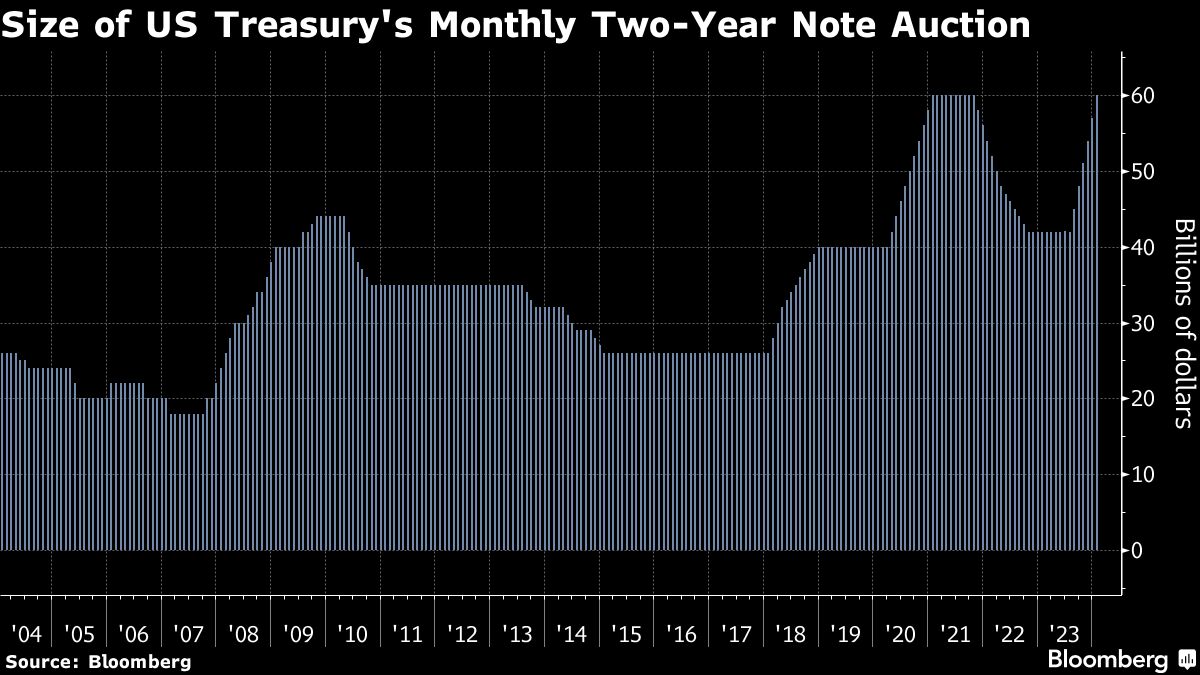
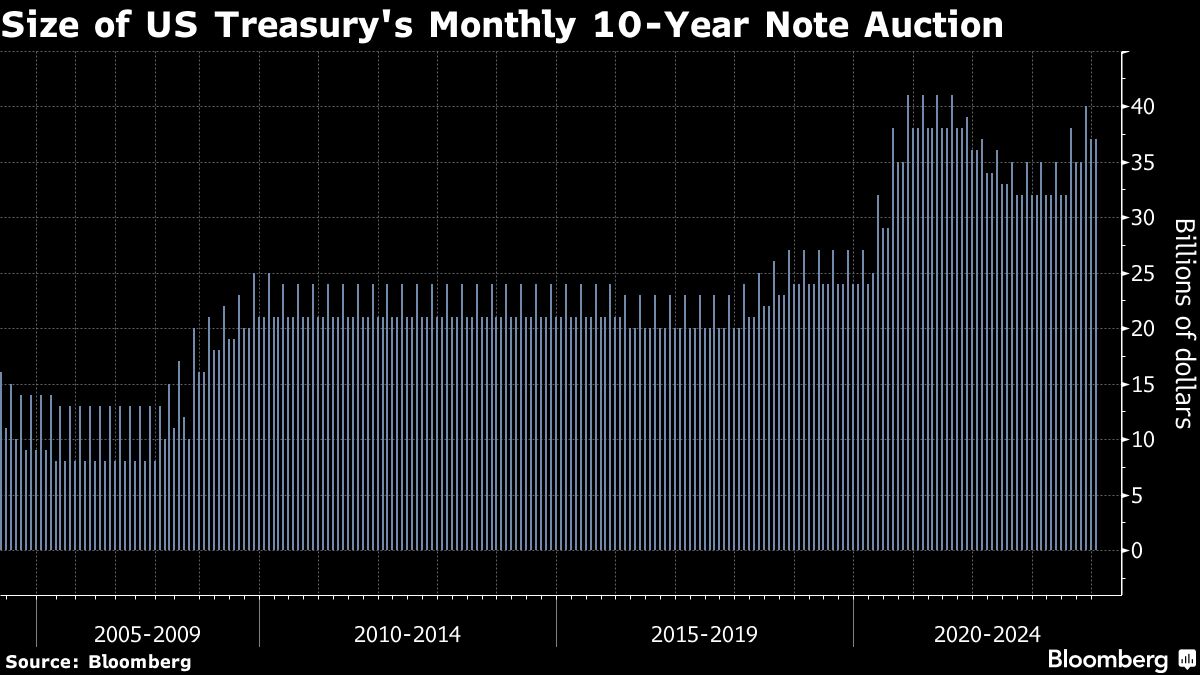
When the Treasury Department previews its note and bond auction sizes for the next three months on Jan. 31, some of the projected sizes are likely to be the biggest investors have ever seen.
The sizes of the US government’s monthly two- and five-year notes are already at peak levels. On Tuesday and Wednesday, $60 billion of two-year notes and $61 billion of five-year notes were sold. Each amount matched the most ever for the tenor. The biggest-ever size for any Treasury note or bond auction was $62 billion, for seven-year notes sold between January and October 2021.
When the last quarterly round of auctions was announced in November, Treasury officials said they anticipated “one additional quarter of increases to coupon sizes will likely be needed,” suggesting the two- and five-year sales will break new ground. If November’s increases are repeated for the coming quarter, the April five-year auction will be $70 billion, 63% bigger than a year earlier.
“There is absolutely no precedent for the pace and magnitude of these supply increases” during a period of economic expansion, said William O’Donnell, rates desk strategist at Citigroup Inc.
“There has been enough demand to meet the rising supply for now” — witness the steep yield declines since October — “but if inflation doesn’t continue to make progress and market hopes for rate cuts are even partly dashed, supply is going to become a problem and could be an accelerant to the upside,” he said.
Treasury yields have declined by about a percentage point in anticipation that the Federal Reserve — which raised interest rates 11 times during the past two years to arrest a surge in inflation — will begin lowering them this year.
February-to-April could also feature the biggest-ever 10-year note auctions, which include a quarterly new issue that gets expanded via reopenings over the next two months. The peak sizes for those were $41 billion (beginning in November 2020) and $38 billion. Most Treasury bills, the class of securities that mature in a year or less and are sold at a discount to their final value, are already being sold in record sizes.
The increases are being driven by the federal budget deficit — including higher interest expense on the existing debt — and the Fed’s policy of not rolling over $60 billion a month of its Treasury holdings, requiring that larger amounts be sold to private investors. For example, the Treasury Department in October estimated a $548 billion financing need for the first quarter of 2024 and Fed securities redemptions totaling $172 billion. Those estimates are set to be revised on Jan. 29.
Globally, similar circumstances will cause public debt supply among major developed economies “to remain elevated this year and beyond,” according to a Jan. 17 report by Goldman Sachs analyst Bill Zu. While that’s likely to put upward pressure on yields, the sensitivity of yields to public debt has declined over time, owing in part to higher global private-sector savings, Zu says.
Not all Treasury notes and bonds are near record sizes, and combined coupon issuance is set to remain below the peak levels reached amid the federal government’s pandemic response in 2021. In cutting auction sizes in late 2021 and 2022 as the crisis ebbed, the Treasury Department slashed the amounts of some of its less-popular notes and bonds, such as seven-year notes and 20-year bonds. The latest seven year, sold Thursday, was for $41 billion, still down by a third from its peak.
A message from Advisor Perspectives and VettaFi: To learn more about this and other topics, check out our full schedule of upcoming CE-approved virtual events.
Bloomberg News provided this article. For more articles like this please visit
bloomberg.com.