Financial planning is one of a multitude of reasons investors seek the help of a financial professional. Learn how SmartAsset AMP can connect you with prospective clients.
Advisor Perspectives welcomes guest contributions. The views presented here do not necessarily represent those of Advisor Perspectives.
While the cost of higher education remains high, both 529 college savings plans and Roth IRAs offer valuable benefits for families looking to save for their children’s education. While 529 plans are specifically designed for educational expenses, Roth IRAs offer a dual-purpose approach, allowing you to save simultaneously for retirement and education costs. Deciding between a 529 plan versus Roth IRA can be difficult, with significant long-term implications for your finances.
What Is a 529 Plan?
If you’re looking to save for your child’s future education, a 529 college savings plan is one of the most popular choices available. Each state, except Wyoming, offers its own 529 plan or multiple plans, as does Washington, D.C. But you can select any 529 plan in the country, no matter which state you live in.
529s include the ability to avoid federal income taxes and the majority of state income taxes on any qualified withdrawals. However, the only way to maintain this perk is to use the funds for qualified higher-education expenses or tuition for elementary and secondary schools. Should you spend the money elsewhere, you’ll have to pay all federal and state taxes in addition to a 10% federal tax surcharge.
There are two main forms of 529 plans: education savings plans and prepaid tuition plans. Education savings plans allow account holders to save for qualified education expenses and fees of their beneficiary through an investment portfolio. On the other hand, prepaid tuition plans are much more focused. Those who select these plans essentially pre-purchase credits at a university far in advance.
529 plans also come with several restrictions. Education savings plans are paired with specifically chosen investments, giving 529 plan account holders much less overall flexibility. Until your beneficiary attends school, a 529 plan will essentially lock your money in place. Furthermore, you must use the funds of a prepaid tuition plan at a participating school, or you run the risk of receiving a much smaller return on your account.
Government-based financial aid is one of the premier sources of funding for many college students. Just keep in mind that if you or your beneficiary has a 529 plan of any kind, they may be eligible for less in financial aid. This is because the government assumes that the money you’ve saved will cover a portion of the tuition and related costs. How much having a 529 plan impacts a person’s financial aid eligibility can vary, and may be minimal.
What Is a Roth IRA?
A Roth IRA is a common retirement savings vehicle that account holders fund with after-tax money. This means that if you choose a Roth IRA, you won’t be able to deduct your contributions on your annual tax return. All earnings and withdrawals are tax-free after you reach 59.5 years old.
But Roth IRAs are also a versatile tool when it comes to paying tuition and other college education costs. You can pull from your funds before 59.5 without incurring a penalty if you are using the money on qualified higher-education expenses. This is an especially helpful benefit for Roth IRA account holders who aren’t 59.5 or older by the time they need to pay for their children’s or grandchildren’s tuition, room and board, and other fees.
Once you reach 59.5 years old, you can withdraw the entirety of your Roth IRA’s balance (earnings and all) tax-free. That’s assuming you’ve had the account for at least five years. Of course, Roth IRAs are designed for individuals who believe their future tax rates will be higher than their tax rate during their working years.
529 Plans versus Roth IRAs
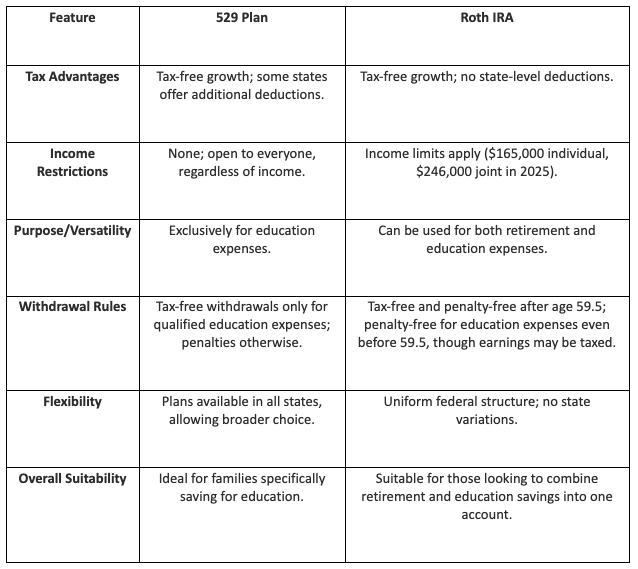
When it comes to taxes, 529 plans versus Roth IRAs work in a fairly similar fashion. Each provides the chance to grow balances on a tax-free basis, though some states offer an additional 529 deduction. Anyone can get a 529 plan, regardless of income. Roth IRAs, by contrast, are not open to all. They have individual and joint maximum income stipulations. For 2025, these are $165,000 and $246,000, respectively. In turn, 529 plans have a few tax and eligibility advantages over Roth IRAs.
One area where 529 plans simply cannot match Roth IRAs is versatility. You can use Roth IRA accounts to fund both your retirement and a beneficiary’s education. You may find this especially attractive if you anticipate paying for these educational costs once you’re 59.5 or older. As soon as you reach this crucial age, you can withdraw the entirety or your account’s balance without tax implications. And for younger parents, too, Roth IRA withdrawals are penalty-free if you use the money on qualifying education expenses.
Ultimately, 529 plans exist for the sole purpose of helping families save for the expensive cost of education. The fact that consumers can take advantage of plans in any state affords them ample choice, and the chance to receive maximum benefits. But if you want to combine your retirement and education cost savings into a single account, a Roth IRA could be worth considering.
The following table sums up how a 529 plan vs. Roth IRA compares in terms of paying for a college education:
How to Open a 529 Plan and a Roth IRA
State governments are typically very flexible in the rules surrounding eligibility for their 529 plans. You can open a plan in any state, regardless of where you call home. Once you choose the 529 plan for you, you can stop by the state’s website to learn how to start the process.
Roth IRAs call for a bit more groundwork than 529 plans, especially at the beginning. Many different financial institutions such as banks, brokerage firms and robo-advisors provide Roth IRAs. Banks will usually offer fixed interest rates that are, like certificates of deposit (CDs), tiered based on your account balance.
For those who prefer a more DIY approach, online broker accounts will let you build your own investment portfolio. A robo-advisor Roth IRA can also select your investments for you based on your personal risk tolerance and other factors.
Bottom Line
529 plans and Roth IRAs are two tax-advantaged accounts designed to help you save for future expenses. While 529 plans are primarily intended for qualified education costs, Roth IRAs provide greater flexibility by allowing savings to be used for either retirement or education expenses. Both types of accounts are funded with after-tax dollars, enabling your investments to grow tax-free, one of their main benefits.
Chris Thompson is Senior Managing Editor of SEO at SmartAsset. He's an expert in many areas of personal finance, including retirement, estate planning, savings, taxes and financial planning. He has worked in the personal finance industry for nearly a decade as both an editor and writer. Chris studied communications in Austria and ultimately graduated with a journalism degree from Montclair State University, where he also received the coveted Journalism Achievement Award.
SmartAdvisor helps qualified financial advisors build meaningful relationships directly with mass-affluent consumers who are actively searching for financial advice. Learn more about how our platform can help grow your practice.
A message from Advisor Perspectives and VettaFi: To learn more about this and other topics, check out some of our webcasts.
More 529/College Planning Topics >
 Financial planning is one of a multitude of reasons investors seek the help of a financial professional. Learn how SmartAsset AMP can connect you with prospective clients.