After weeks of hand-wringing around demand for long-term US debt, all eyes are on Thursday’s 30-year Treasury auction for a fresh read on whether spiraling deficits are causing investors to shun the maturity.
The $22 billion sale, set for 1 p.m. New York time, is part of the government’s regularly scheduled borrowings. Yet it will take place as Congress considers President Donald Trump’s massive tax bill, which by some projections will add trillions of dollars to US budget gaps, potentially requiring more bond issuance to finance the spending.
That backdrop, along with worries the president’s trade war threatens to reignite inflation and dim global demand for US assets broadly, has punished the longest-maturity Treasuries in particular. Investors have grown more wary of lending to the US government for such a long time, and have demanded higher yields as a result, increasing a cushion known as the term premium.
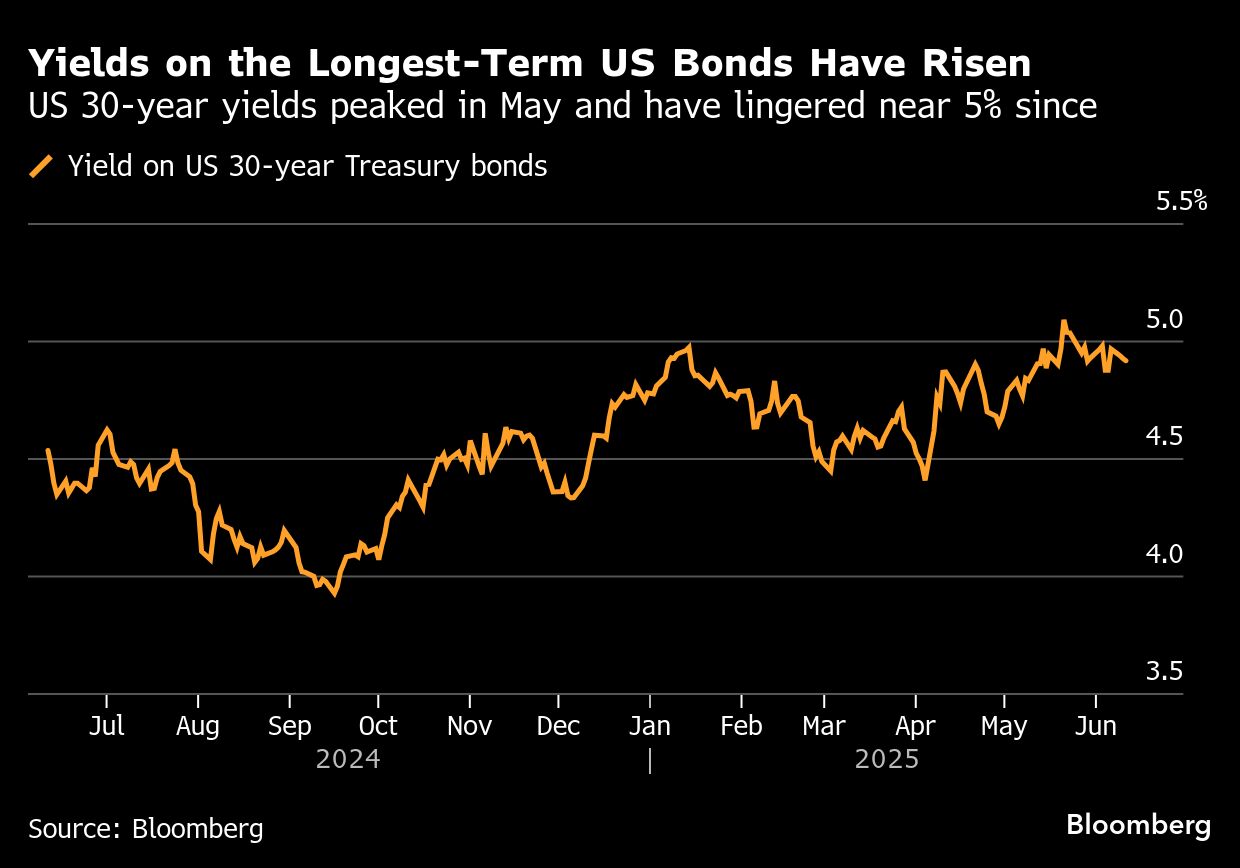
While Wednesday’s 10-year auction attracted strong buying and Thursday’s deal is a reopening that’s $3 billion less than the last offering of the maturity, investors remain cautious. A surprisingly poor reception for a 20-year auction in May contributed to a selloff that pushed 30-year rates as high as 5.15%, leaving them just shy of an almost two-decade high and sparking losses in stocks and the dollar. The last 30-year sale also saw somewhat weak demand.
“Given what occurred with the 20-year a couple of weeks ago, there will be heightened interest, especially for the 30-year,” said Kevin Flanagan, head of fixed-income strategy at WisdomTree.

On Thursday, Treasuries advanced along with European bonds. US yields fell about 7 basis points across maturities after softer-than-forecast data on producer prices and a report showing a jump in recurring applications for jobless claims. The bond gains follow a rally Wednesday spurred by data showing underlying US consumer inflation rose in May by less than forecast, which led traders to boost bets on Federal Reserve interest-rate cuts this year.
“The inflation and claims data should support a decent 30-year auction today — not stellar, but OK,” said Jack McIntyre, a portfolio manager at Brandywine Global Investment Management.
However, inflation remains above the Fed’s 2% target, and policymakers have signaled that they’re waiting to see how much tariffs lift consumer inflation before they ease rates further. The long bond is particularly vulnerable to the threat of resurgent price pressures.
Stepping Away
Amid all these risks, bond managers including DoubleLine Capital and Pacific Investment Management Co, have favored owning Treasuries with 10 or fewer years to maturity, while allocating less to the long end.
This week, Pimco reiterated that it’s staying underweight long-maturity debt over the next half-decade, while DoubleLine’s Jeffrey Gundlach said long-term Treasuries are no longer seen as legitimate risk-free investments.
Ahead of Thursday’s auction, the 30-year yielded around 4.85%. That’s more than a half-point above its early April low, when US tariffs were starting to roil markets.
Since peaking in May, the yield has settled into a range that suggests 5% is attracting buyers, and that level is seen as a ceiling heading into the auction.
“There is a 5% threshold that does garner investor demand,” Gregory Peters, co-chief investment officer at PGIM Fixed Income, told Bloomberg TV.
“I see the long end trading cheap for quite some time,” he said. “The point is that there is so much debt that needs to get refinanced and financed, and that does not include the additional debt” coming from the tax bill before Congress.
Of note, US customs duties brought in record revenue in May, helping shrink the federal budget shortfall for the month.
Case for Buying
Guneet Dhingra, head of US rates strategy at BNP Paribas SA, sees a case for buying the 30-year around current levels, on the view that it already reflects the worsening fiscal picture and could rebound on strong auction demand or if deficit fears ease.
There’s also the network of primary dealers that are required to bid at auctions, which will serve as a backstop should investors steer clear on Thursday.
The focus will be on demand metrics for the sale, and where its yield clears relative to the pre-auction bidding deadline. A breakdown of domestic- and foreign-based buyers will be released later this month.
“There’s a lot of debt to come and so we’re obsessively watching the auction stats to see if we get the signals that people are leaving,” said David Hoag, a fixed-income portfolio manager at Capital Group.
“We’re watching it very closely because one of the mechanisms for term premium to rise is if the non-US buyer starts to exit this market — or not even exit, but just kind of stop and slow the buying trajectory.”
A message from Advisor Perspectives and VettaFi: To learn more about this and othertopics, check out some of our webcasts.
Bloomberg News provided this article. For more articles like this please visit
bloomberg.com.
Read more articles by Michael Mackenzie