In a May report on alternative scenarios for the long-term US budget outlook, the Congressional Budget Office estimated the impact of productivity growth that was faster or slower than the 1% annual average in its baseline forecast. It made a big difference.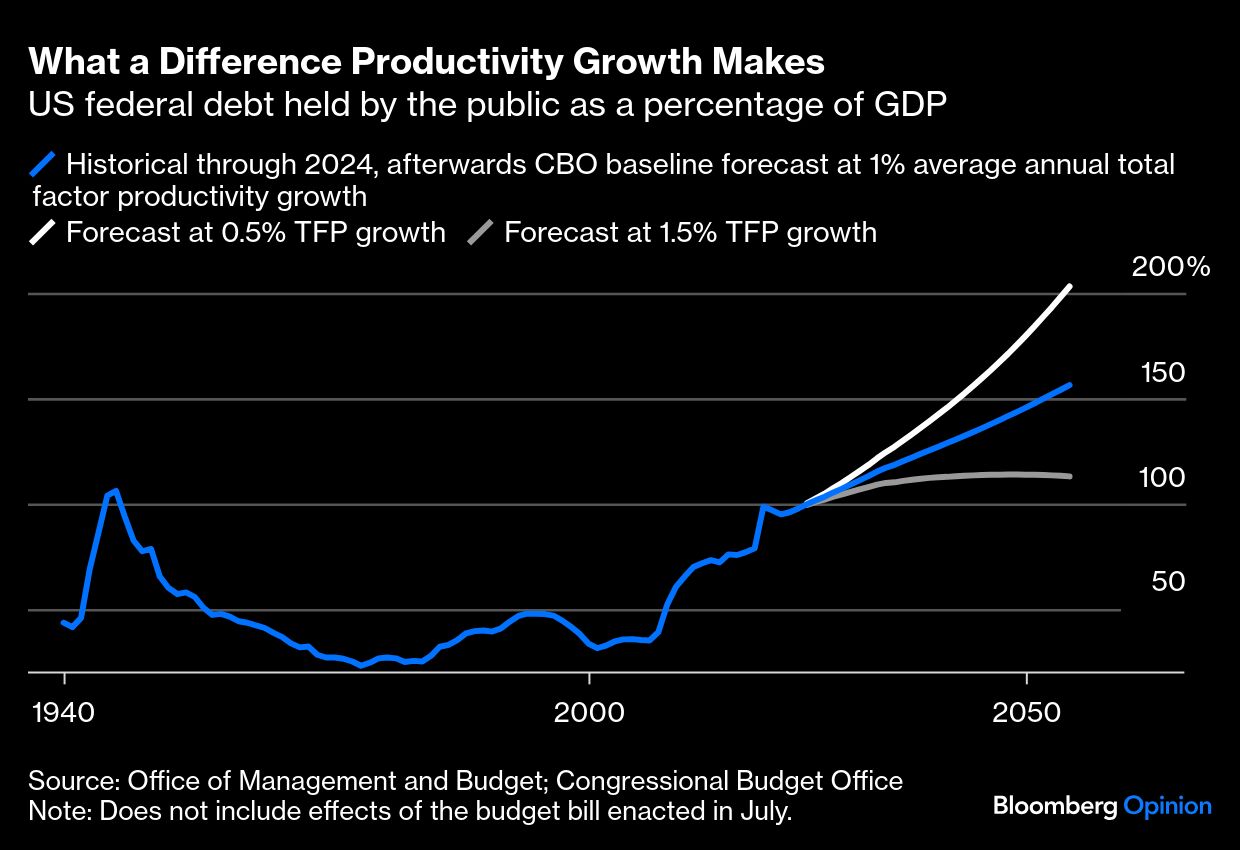
These forecasts were completed before the passage of the Republican-backed budget bill, which by the CBO’s reckoning markedly worsened the debt outlook. But the basic point still holds — higher-than-expected productivity growth could turn what is starting to look like an out-of-control debt problem into a much more manageable one, with the debt-to-gross-domestic-product ratio flattening rather than continuing to rise.
That’s “could,” not “would.” Deutsche Bank economists Jim Reid, Henry Allen and Raj Bhattacharyya, who took note of these CBO projections a few weeks ago, warned that higher productivity growth “may simply encourage policymakers to continue with fiscal giveaways — so debt could still rise.” Still, it would definitely give policymakers in Washington more options if total factor productivity growth averaged 1.5% a year over the next three decades instead of 1%.
How likely is that? Well, it’s a pace that the US has certainly attained in the past but has failed to meet for most of the past half century. For most of the past two decades it hasn’t even reached 1%.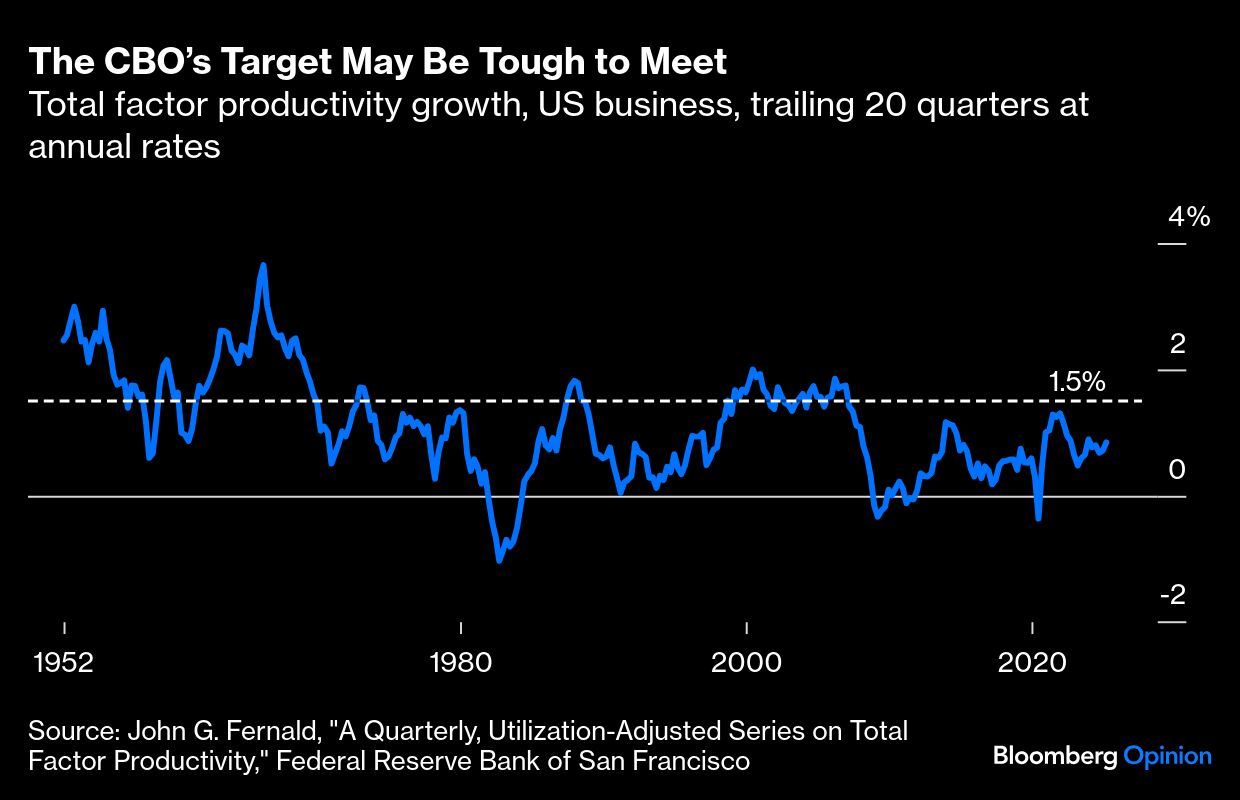
I converted the quarterly TFP growth statistics from the Federal Reserve Bank of San Francisco into rolling five-year figures because it can be awfully hard to see the trend in quarterly or annual data. Another approach is to divide economic history into what you might call productivity eras, which Northwestern University economics professor emeritus Robert Gordon did in the 2010 paper from which these statistics were taken: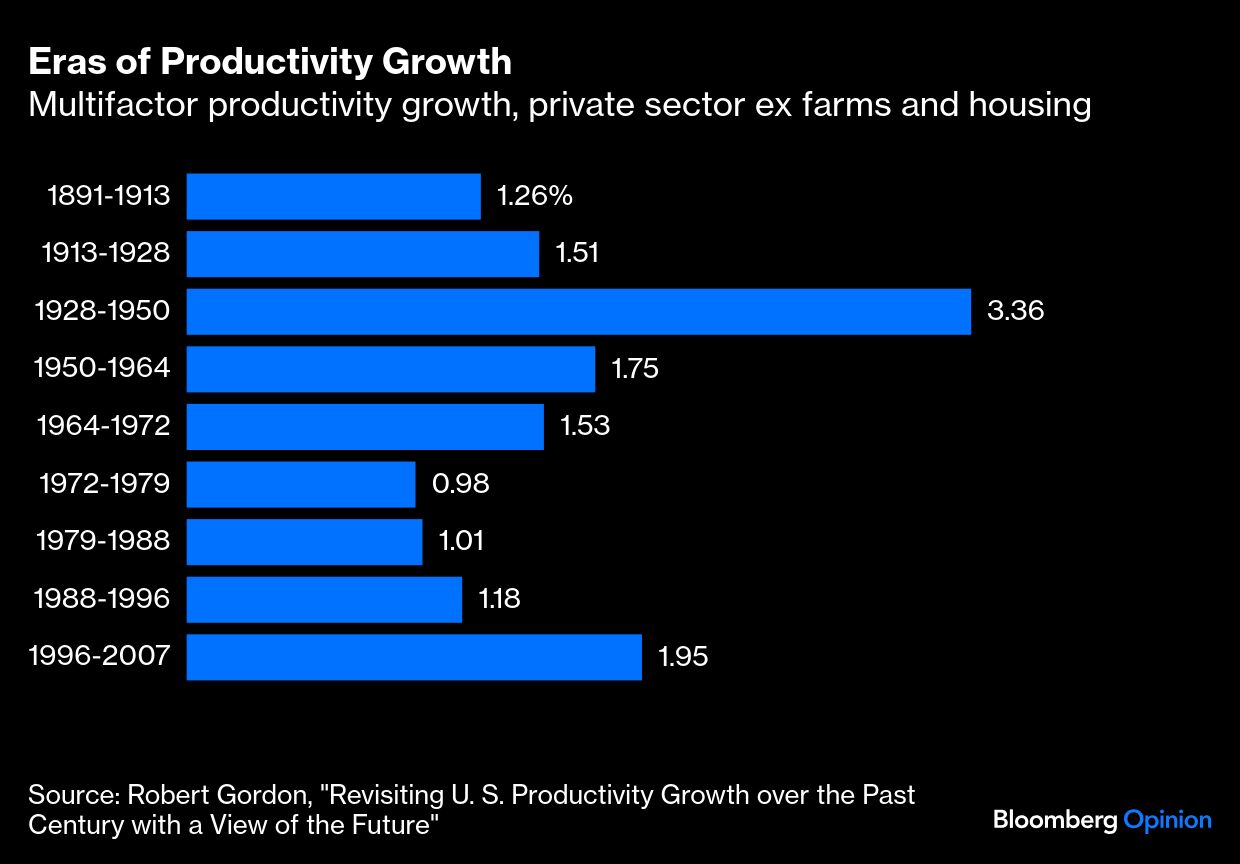
Total factor productivity and multifactor productivity are basically same thing; the latter just happened to be the term Gordon used in that paper. Elsewhere, Gordon has called TFP “the best available measure of innovation and technical change.” Labor productivity is simply output divided by hours worked and can thus be reliably increased by replacing people with machines. TFP or MFP attempts to factor in the cost of the machines by dividing output by a weighted average of labor and capital input (with labor weighted at 0.7 and capital at 0.3).