Playing the Odds on U.S. Stocks in August & September 2025
Membership required
Membership is now required to use this feature. To learn more:
View Membership Benefits Advisor Perspectives welcomes guest contributions. The views presented here do not necessarily represent those of Advisor Perspectives.
- August historically offers strong returns for U.S. stocks, with a 64% chance of gains and the highest average return among asset classes.
- September is the worst month for U.S. stocks, with a 50/50 chance of losses, and the only month with a negative average return.
- To improve odds in September, overweight gold and international bonds, which have outperformed, and underweight U.S. technology stocks.
- Diversification beyond U.S. stocks has added value in 2025, reversing the trend of U.S. stock dominance over the past 15 years.
There is a seasonality in asset class investment performance that is revealed in the history of calendar month returns. Based on history, investors should be “all in” U.S. stocks this August but “mostly out” in September. Over the past 99 years, the best asset class to invest in during August has been the U.S. Total Stock Market. It has achieved an average return of 1.20% and the investment has been profitable 66% of the time. By contrast, in September the U.S. Total Stock market ranks 11th among asset classes and is profitable only 50% of the time.
In the following, I report on the best and worst months for U.S. stocks alone, and then I extend my analysis beyond U.S. stocks to include most asset classes.
Playing the U.S. Stock Market Game
Playing the stock market is a gamble, and each month of the year, this game has different odds for success, as shown in the following graphic: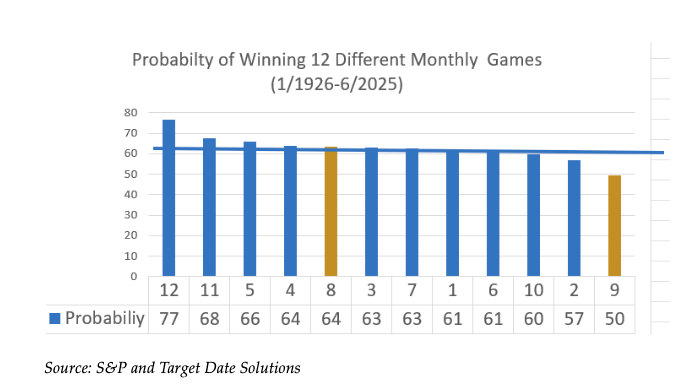
The best odds are in December when you have a 77% chance of making money — i.e., having a positive return. The odds are in your favor (better than 50/50) in most of the other months, except September when there’s only a 50/50 chance of profiting in the stock market.
In Las Vegas, skilled gamblers base their bets on the probability of winning. Should you play the September 2025 game? Should you bet the same as you do in the high odds months, like December?
August has been a good month, with a 64% chance of a positive return, a little above the average 63% probability.
That Time of Year Again
It’s August-–September again, so any number of articles will remind us that September has been the worst month for U.S. stock markets, but no one will comment on August as being a pretty good month. Here’s a recap on the history of monthly returns on the S&P 500 Index over the past 99.5 years (1,194 months):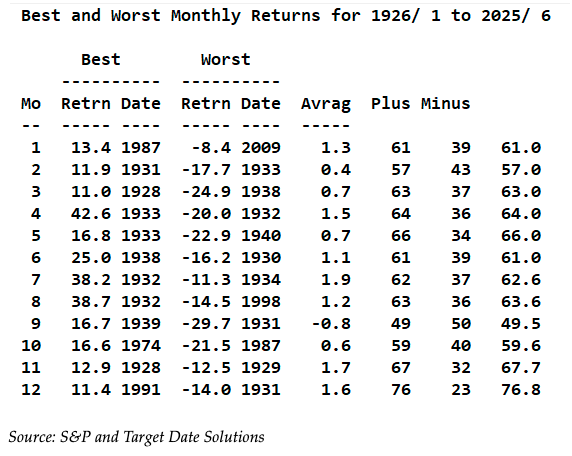
Shown graphically, September leaps off the page as being the only month with an average negative return, and the magnitude of average loss is serious at -0.8%. Meanwhile, August’s 1.2% average return is above the overall average 1.0% monthly return.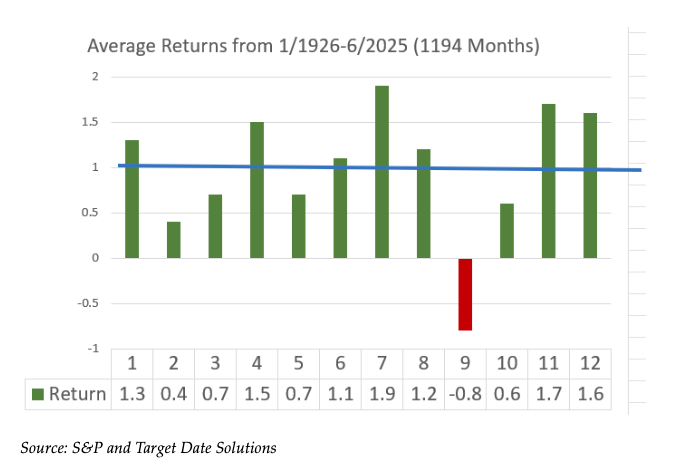
September has been the worst performing month because:
- It has the lowest average return. The average loss in September has been -0.8%, due in part to the fact that the worst month ever was a September. A 29.7% loss in September 1931 is the worst monthly loss in U.S. history. All of the other 11 months have positive average returns.
- 49 of the past 99 Septembers — 49.5% — have suffered losses, as opposed to the other months that have had positive returns 64% of the time.
Momentum or Reversal
The U.S. stock market has earned 7.86% so far this year, as of Aug. 4, on pace for a 14% annual 2025 return. Based on history, August should see a continuation of the bull run. But this September could disappoint if the current bull market reverses, or it will surprise to the upside if the bull runs. Which do you think will be the case?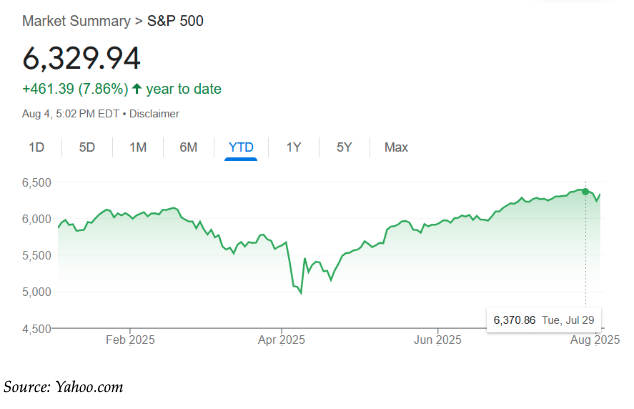
A Possible Explanation
In his book The Beast on Wall Street, Dr. Robert Haugen argues that investors muck up market behavior with their emotions, so the news of the day frequently results in market moves that don’t make sense. Markets go up on bad news and down on good news.
During the summer, many traders are on vacation, so less mucking up occurs July through August. But then the mucking up restarts when the traders return to their desks in September.
Place Your Bets
As shown in the following table from Lazy Portfolio ETF, sorted by best-to-worst September returns, winning and losing asset classes vary by month. In the case of September:
- Gold and international bonds are the best performing asset classes in September, with a 0.45% average return. Gold has delivered positive returns in September 83% of the time — very good odds. The best month for gold is January, and the worst is March. International bonds have delivered positive September returns 68% of the time. December is the best month for this asset class and, April is the worst month.
- U.S. Technology stocks have the worst September performance, losing -0.79% on average. These stocks win 52% of the time in September, so not an even odds bet. February is the worst month for this asset class. January is the best month.
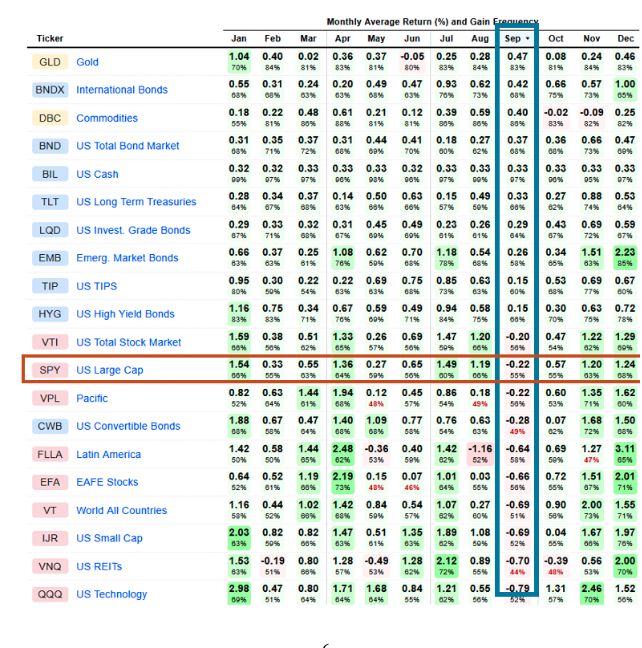
Source: Lazy Portfolio ETF; 30-year returns updated as of July 31, 2025.
You can use this table every month to see where the odds are in and out of your favor.
Changing Fortunes
Coming into 2025, U.S. stocks had dominated for the previous 15 years as the best performing asset class, so diversification beyond U.S. stocks did not “work” — it undermined performance. But that has changed. As shown in the following, U.S. stocks are not the best performing asset class so far this year, so diversification into foreign securities and gold has added value.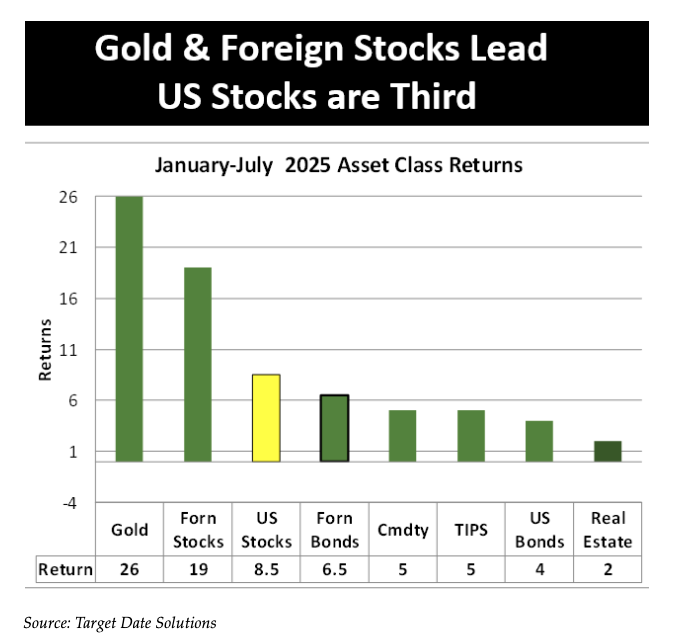
Investments in other asset classes have benefited performance, as can be seen in the performance of target date funds (TDFs). In the past 15 years, until now, diversification did not benefit investors because U.S. stocks dominated.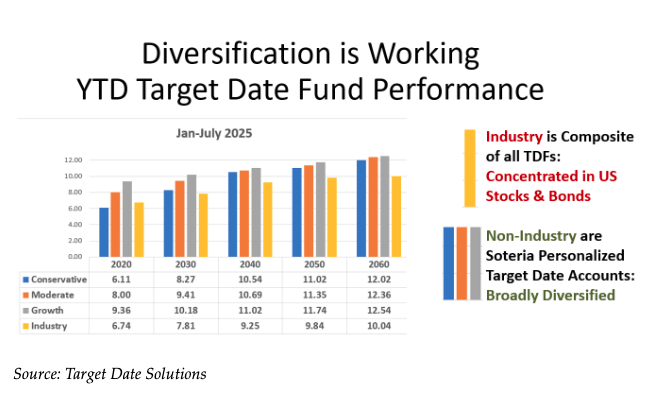
Conclusion
This August is likely (64% probability) to deliver a positive U.S. stock market return. In addition, U.S. stocks have been the best-performing asset class in August, which is justification for staying the course.
Although the historical odds mean this September’s U.S. stock market is at a disadvantage with a 50/50 chance of a loss, you can influence the odds in your favor by overweighting gold and foreign bonds and underweighting U.S. technology stocks based on their September histories of successes and failures.
Good luck!
Ron Surz is president of Target Date Solutions, developer of the patented Safe Landing Glide Path and Soteria personalized target date accounts. He is also co-host of the Baby Boomer Investing Show. Surz’s passion is helping his fellow baby boomers at this critical time in their lives when they are relying on their lifetime savings to support a retirement with dignity, so he wrote a book, “Baby Boomer Investing in the Perilous 2020s,” and he provides a financial educational curriculum.
For anyone who relies on TDFs — or advises those who do — Surz’s new book is a must-read guide to understanding the risks, solutions, and future of a secure retirement.
A message from Advisor Perspectives and VettaFi: To learn more about this and other topics, check out some of our webcasts.
Membership required
Membership is now required to use this feature. To learn more:
View Membership BenefitsSponsored Content
Upcoming Virtual Events View All