Ever since the birth of Bitcoin in 2009, China has tightened the screws on cryptocurrencies with unfailing regularity: once every four years, in fact. In the coming months, however, the People’s Republic could signal a change in its stance, and the world of money will have to take notice.
Start with Beijing’s past moves. In 2013, it ordered payment providers to cancel services to the likes of BTC China, a popular venue back then for people to swap yuan for Bitcoin. In 2017, authorities outlawed initial coin offerings. BTC China and other outlets shut down. The biggest blow to the industry came in 2021, when regulators declared all crypto trading by Chinese nationals to be illegal, including on foreign bourses.
With the, apparently coincidental, four-year anniversary of the last big tightening coming up this month, expect the next move by authorities to be a change of heart, a relaxation. The reason is the US dollar. Or to be more precise, an expected deluge of dollar-pegged stablecoins.
Now that the US has given its regulatory nod to these 1:1 clones of fiat money, the $5.7 trillion stablecoin market is set to double. As transactions expand, and more digital dollars are minted, they’ll come to challenge monetary sovereignty in the rest of the world.
China won’t be spared. Billions of dollars in crypto assets are flowing into self-custodial Chinese wallets. Although mining is banned onshore, the mainland remains an important market for speculation. Beijing has so far looked the other way because those betting on price appreciation can always find a way to buy Bitcoin, Ether, and whatever meme coin may be the fashion of the day. All they need is a virtual private network.
Authorities can’t take the same resigned approach toward stablecoins. As a bridge between conventional money and speculative crypto investment they were mostly harmless. But as a mainstream medium of exchange they would slip into regular transactions.
That won’t go down well with Beijing. Every dollar stablecoin issuer will buy US government debt to back its liabilities. The likes of Tether and Circle Internet Group Inc., the issuers of USDT and USDC, already own more of dollar-denominated, short-term securities than China. A surge in Chinese appetite for these tokens, especially for cross-border payments, may further buttress US safe assets, and, therefore, the dollar itself.
China’s ambition, however, is the exact opposite. It doesn’t want to spend the 21st century toiling under the yoke of the greenback. Yet, further prohibitions will achieve nothing. To beat American stablecoins, it’s time to join the game — in Hong Kong. The special administrative region is both a global financial center, and Beijing’s lab for crypto experimentation.

The city is getting ready to issue licenses for Hong Kong dollar stablecoins. Going forward, though, it could also host regulated digital copies of the yuan, or at least its offshore variant: the CNH. Enough influential Chinese voices are discussing the possibility.
The utility of such coins may lie in geopolitics. The Trump administration’s tariff war has given fresh urgency to China’s search for its own sphere of influence. President Xi Jinping’s warm meeting in Tianjin with Russia’s Vladimir Putin and India’s Narendra Modi, and an upcoming call with BRICS leaders convened by Brazil's Luiz Inacio Lula da Silva, are opportunities for China to shape new trade and payments alliances.
It was widely believed that a digital version of the official currency — the e-CNY — would complement other state-backed efforts, such as CIPS, which bypasses the dollar and facilitates trade with Russia in yuan. However, the e-CNY hasn’t quite taken off even within China. It appears likely that for cross-border payments, Beijing’s focus will shift to Hong Kong-issued, private-sector stablecoins, the kind that JD.com Inc. and Ant Group Co., an affiliate of Alibaba Group Holding Ltd., are lobbying for.
But will Beijing want to even tacitly bless such projects? Bitcoin is no longer the vehicle of choice for money-laundering. More than three-fifths of crypto-based illicit activity now occurs using stablecoins. A digital twin of offshore yuan jumping from one pseudonymous wallet to another on a public blockchain will pose the same risk. Which is why Hong Kong requires that at least initially, the issuers — or the city’s licensed crypto exchanges — verify the identity of token holders every time stablecoins are issued, redeemed, or traded.
For the anything-goes world of crypto, that’s a pretty onerous restriction. For Beijing, though, it’s a crucial guardrail. Regulators don’t want brokers to talk up stablecoins to the domestic audience. They want steady growth — not a frenzy. “By permitting CNH-based stablecoin trials in Hong Kong, Chinese authorities can explore tokenized renminbi circulation offshore while keeping mainland capital controls intact,” Zongyuan Zoe Liu, a scholar at the Council on Foreign Relations, wrote recently.
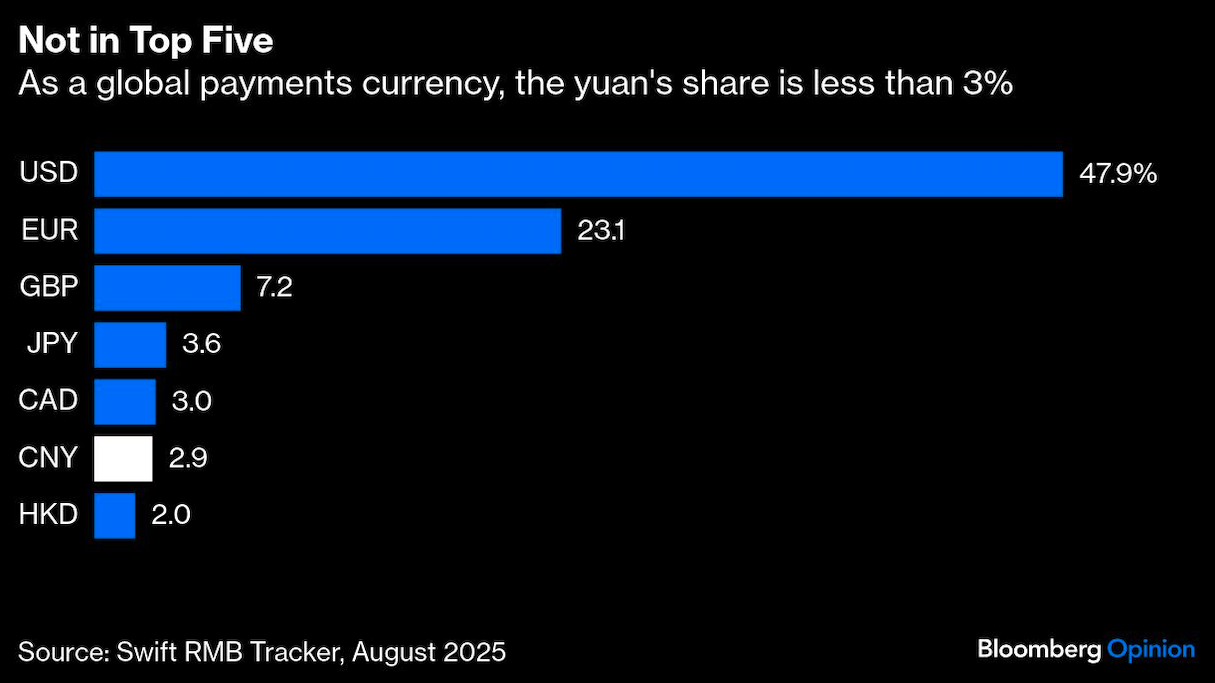
CNH stablecoins aren’t going to make the yuan the world’s preferred reserve currency. Its 3% share in global payments won’t increase dramatically even if Beijing can convince suppliers in Belt-and-Road nations to accept private-sector digital yuan as payment.
The objective here is to stay relevant as a belligerent White House seeks to weaponize its control of the global financial flows. China doesn’t like crypto any more than it did in the past. But it never turned its back on blockchain technology. It’s time to collect a reward for that faith — by dipping into stablecoins.
A message from Advisor Perspectives and VettaFi: Thinking about starting your own RIA, making a move to a different firm, or specializing in a new area? Read our latest articles on financial advisor transitions.
Bloomberg News provided this article. For more articles like this please visit
bloomberg.com.
Read more articles by Andy Mukherjee