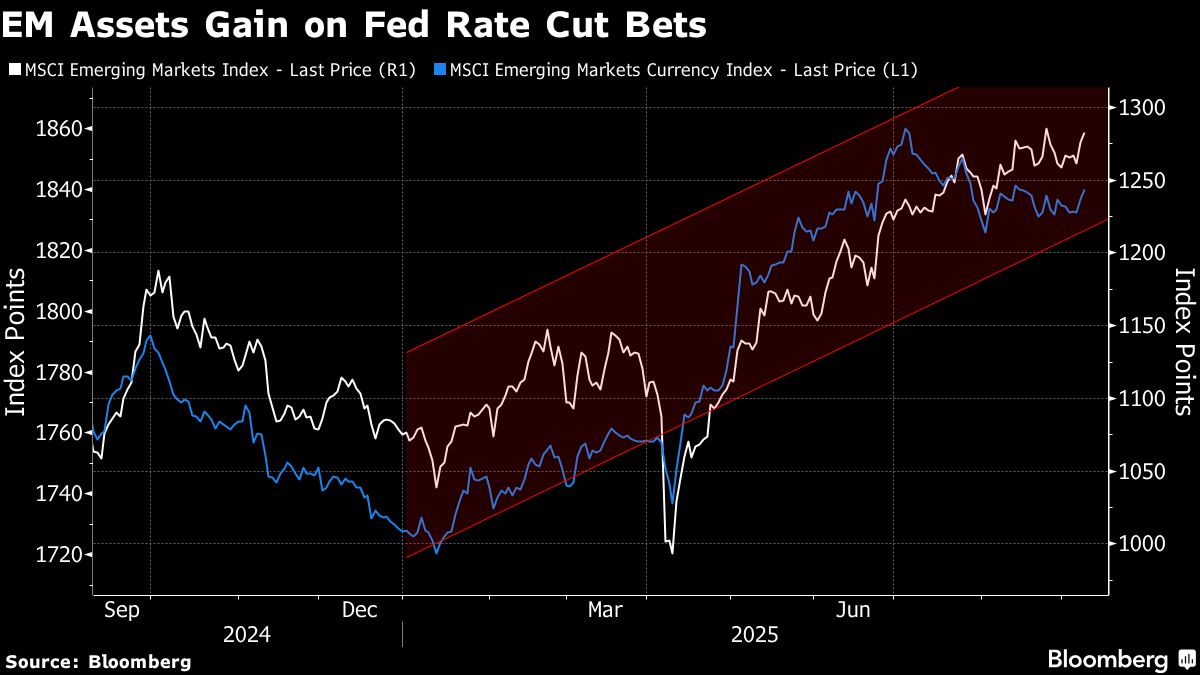
Emerging-market currencies and stocks rose as expectations of an imminent US monetary policy easing pushed the dollar lower and strengthened investor appetite for riskier assets.
The MSCI gauge for developing-markets equities rose 0.6%, while the index tracking currencies was up 0.2%. Chinese big-tech companies, including Alibaba Group Holdings Ltd. and Tencent Holdings Ltd., were the main drivers of equity gains, while Asian currencies also outperformed peers.
Developing economies are benefiting from increasing odds of an interest-rate cut by the Federal Reserve, with traders now fully pricing in a quarter-point reduction this month. Some strategists even see a chance of a bigger half-point move.
“The central bankers kicked off the last interest rate cut cycle almost exactly a year ago in exactly the same way,” Thu Lan Nguyen, head of FX and commodity research at Commerzbank AG, said in a note. “Considering the current situation on the labor market, which has deteriorated dramatically compared to that time, another sharp interest rate cut would only be consistent.”

Emerging-market assets have rallied this year, with the equity benchmark rising every month through August. Carry trades also offered attractive returns, while local bond funds continued to register inflows.
In emerging-market currencies, Thai baht was the best performer on Monday, rising 1% against the dollar to a four-year high.
Elsewhere in Asia, investors monitored political risks, after Indonesian President Prabowo Subianto removed Finance Minister Sri Mulyani Indrawati from her post.
Later on Monday, investors will await the outcome of a virtual BRICS summit convened by Brazil to discuss Donald Trump’s trade policy. The key data highlights include US inflation numbers that could further shape expectations of the monetary policy outlook.
“Markets remain concerned about tariff-driven inflation,” wrote Christopher Wong, senior foreign-exchange strategist at Oversea-Chinese Banking Corp., adding that any unexpected price increases could unsettle US dollar bears.
In credit markets, Argentina’s dollar bonds fell the most among peers on Monday after President Javier Milei’s defeat in a key provincial election deepened concerns around political support for his economic agenda. Sovereign notes dropped across the curve, with bonds maturing in 2035 falling more than 5 cents on the dollar to trade at around 56 cents.
Meanwhile, Saudi Arabia’s sovereign wealth fund is set to sell international bonds to help finance its massive investment plans, joining an issuance rush fueled by high appetite for emerging-market assets.
A message from Advisor Perspectives and VettaFi: To learn more about this and other topics, check out some of our webcasts.
Bloomberg News provided this article. For more articles like this please visit
bloomberg.com.
Read more articles by Peter Laca, Bhaskar Dutta