President Donald Trump announced a fresh round of tariffs on pharmaceuticals, heavy trucks and furniture, including a 100% duty on patented drugs unless the producer is building a manufacturing plant in the US.
“Starting October 1st, 2025, we will be imposing a 100% Tariff on any branded or patented Pharmaceutical Product, unless a Company IS BUILDING their Pharmaceutical Manufacturing Plant in America,” Trump posted on social media Thursday, without offering specifics on which producers will be impacted. “There will, therefore, be no Tariff on these Pharmaceutical Products if construction has started.”
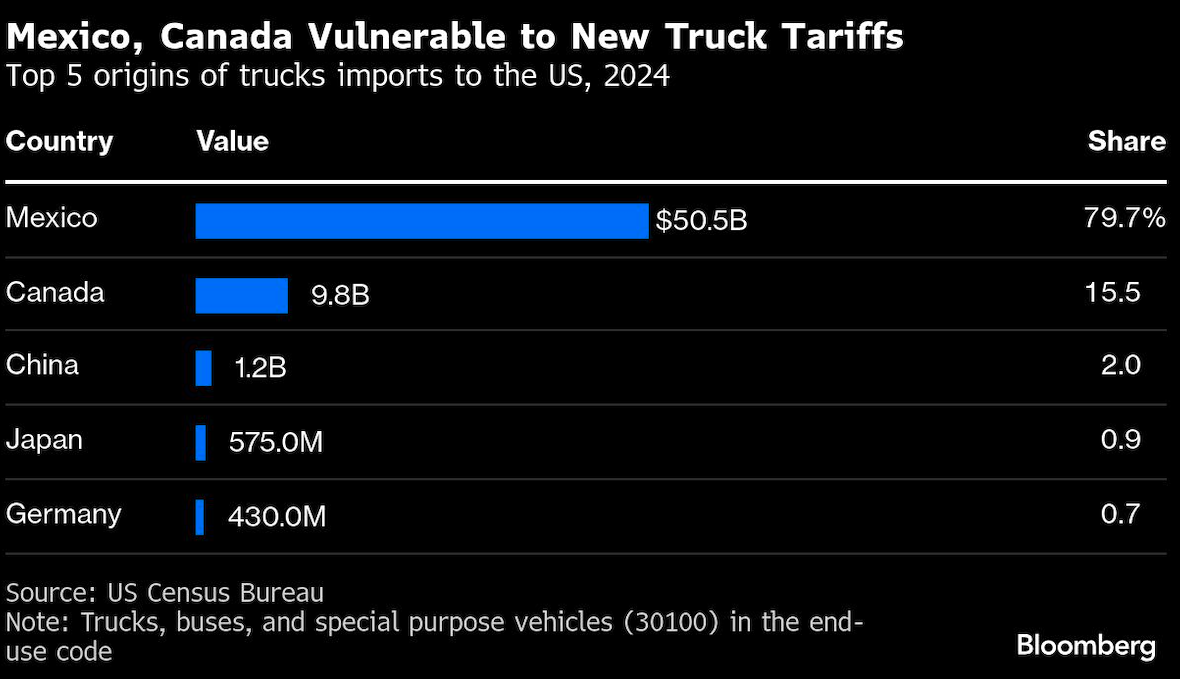
Trump’s post was one of several on new industry-focused tariffs set to begin next Wednesday. Imported heavy trucks will be subject to a 25% duty, kitchen cabinets and bathroom vanities will be hit with a 50% charge, and upholstered furniture imports are to be taxed at 30%.
Taken together, the moves amount to a rapid expansion of Trump’s tariff regime, which he started to erect shortly after taking office. It comes at a time when the president has flexed his executive powers like none of his modern predecessors. Just as Trump made the levies public, former FBI Director James Comey — a longtime Trump political enemy — was indicted on perjury charges under heavy pressure from the president.
Most European drugmakers slumped in early trading, led by a drop of as much as 3.1% in Novo Nordisk A/S. GSK Plc slid as much as 1.1%, while AstraZeneca Plc fell as much as 1.6%.
“Trump is never going to be done with tariffs,” Deborah Elms, head of trade policy at Hinrich Foundation, said on Bloomberg Television.
Trump’s posts offered no further details. The pharmaceuticals plan, as described by the president, may allow for wide exemptions for companies with presences in the US. The White House did not immediately respond to a request for more specifics.
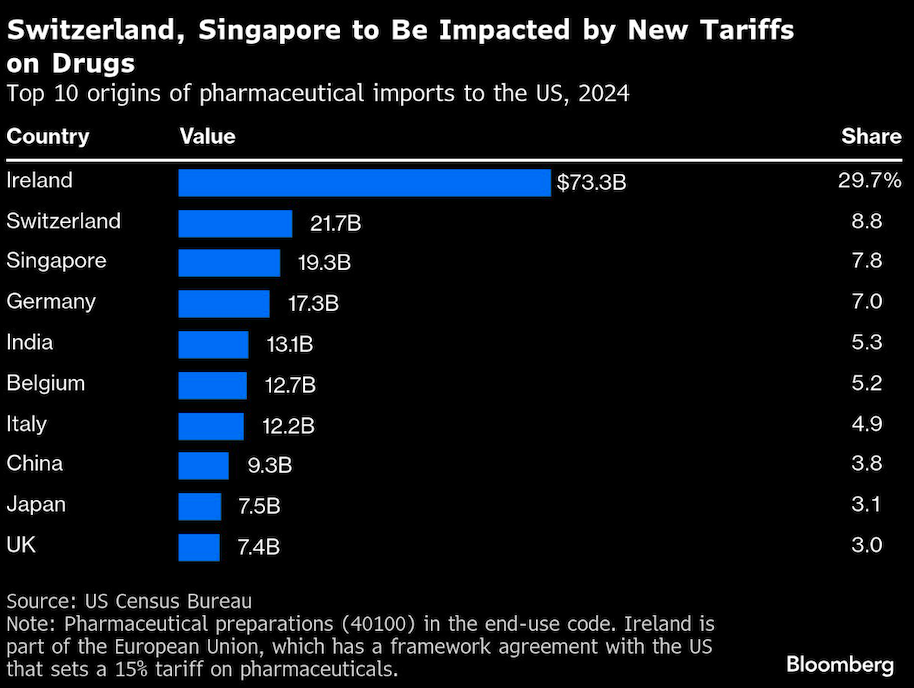
The levy on branded pharmaceuticals may raise the average US tariff rate by up to 3.3 percentage points, according to Bloomberg Economics, though the impact may be offset by the exemption for companies building local manufacturing facilities. Singapore and Switzerland are the countries most exposed to the move.

Major drugmakers, including Merck & Co., AstraZeneca and Johnson & Johnson, have announced billions of dollars in planned US manufacturing investments in the months since Trump’s inauguration, following the president’s repeated threats to impose levies on drugs imported from overseas.
“The actual comment from the President is direct but its impact may be somewhere between nebulous and negligible,” Mizuho Securities health-care specialist Jared Holz said in a note. “All major players have some production presence domestically and almost all have announced increased investment directly tied towards local manufacturing.”
Still, some could be left vulnerable. Multinational drugmakers have said they primarily rely on plants in the US to supply the domestic market, but not all of them have broken ground on their promised expansions.
What Bloomberg Economics Says...
“The countries most exposed to the move are Singapore and Switzerland. The UK also has some important pharmaceuticals exports to the US – its trade agreement with the US mentioned that special rates would be considered in the event of new Section 232 tariff, but no formal rate was agreed. A similar approach seems also to be in place for Japan.”
— Nicole Gorton-Caratelli and Maeva Cousin.
Several of America’s best-selling drugs are still largely produced abroad. The main ingredient in Novo Nordisk’s diabetes and weight-loss juggernauts Ozempic and Wegovy is made in Denmark, while a critical first step in the production of Mounjaro, Eli Lilly & Co.’s rival GLP-1, happens in Ireland.
Johnson & Johnson’s immune-disease therapy Stelara and cancer drug Darzalex are manufactured in Switzerland and Denmark, respectively. Opdivo, Bristol-Myers Squibb Co.’ blockbuster cancer immunotherapy, relies heavily on production in Ireland and Switzerland. Novartis AG’s Cosentyx and Entresto also originate in Swiss facilities.
Unless those companies can show they’ve broken ground on US sites that will take on production, their biggest sellers could face tariffs that would instantly double import costs. Novo Nordisk, for example, is building a new 1.4 million square foot manufacturing plant in North Carolina, while Eli Lilly earlier this year announced plans for four new US manufacturing sites.
Some Japanese pharmaceutical companies also make drugs for rare and serious conditions that might be subject to the new tariff. Hemlibra, used to help clot blood in hemophilia patients, is made by Japanese drugmaker Chugai Pharmaceutical Co, while Enhertu, used to deliver chemotherapy directly to breast cancer cells without damaging healthy ones, is made by Daiichi Sankyo Co.
Trump is imposing product-based levies using Section 232 of the Trade Expansion Act, which allows the administration to impose tariffs without congressional action if imports are deemed a national security threat. The approach has already been used to impose levies on automobile, copper, steel and aluminum imports.
Other duties on critical imports, including semiconductors and critical minerals, are expected in the coming weeks. His government has also launched investigations into imports of robotics, industrial machinery and medical devices that could have wide-ranging effects for domestic manufacturers.
The Trump administration is also weighing a plan to reduce US reliance on overseas semiconductor manufacturing, the Wall Street Journal reported Friday, citing people familiar with the matter. It will aim to have companies make the same number of chips in the US as they do overseas, the people said, adding that Commerce Secretary Howard Lutnick had spoken to some corporate executives about the matter.
In April, the Commerce Department began investigating the impact of all drug imports — both finished generic and branded medicines as well as the ingredients used to make them — on US national security.
Trump has previewed his move on pharmaceutical tariffs for months, albeit in haphazard fashion. In early July, Trump said he intended to give drug companies some leeway to bring their operations to the US before slapping tariffs of as much as 200% on their products. Then, on July 15, the president said he was likely to begin imposing tariffs on pharmaceuticals by the end of the month.
If the new tariffs don’t stack on top of existing country deals, their impact will be limited as several major foreign production economies have reached trade deals with the White House. For example, in late July, the US and EU reached a broad trade agreement that includes 15% tariffs on pharmaceutical products.
The industry-based tariffs offer potentially more durability than the country-level levies Trump imposed under the International Emergency Economic Powers Act. The Supreme Court has agreed to consider a challenge to those tariffs, after two lower courts have already declared them illegal.
Trump has also targeted the drug industry in other ways. The tariff announcement follows an executive order that attempts to reduce prices by aligning American drug costs with the lowest prices paid abroad. The order, which Trump signed May 12, asks companies to cut prices voluntarily or face regulatory measures, though it’s unclear how exactly that will be enacted.
The president announced his tariff plan days ahead of a White House-imposed deadline for 17 of the biggest drug manufacturers to voluntarily reduce what they charge the US government for approved medicines and set the price of new drugs on par with what they cost overseas. In a July letter to company CEOs, Trump threatened to “deploy every tool in our arsenal” to punish companies that don’t comply by Monday.
“This refreshed threat on pharma has been brought up by Trump several times as a negotiation tool,” said Anna Wu, cross-asset strategist at VanEck Associates Corp. in Sydney.
A message from Advisor Perspectives and VettaFi: Stay ahead of market changes with our daily updates on key market and economic indicators. Visit the AP Charts and Analysis site for our expert insights.
Bloomberg News provided this article. For more articles like this please visit
bloomberg.com.
Read more articles by Lauren Dezenski, Madison Muller and Jennifer A. Dlouhy