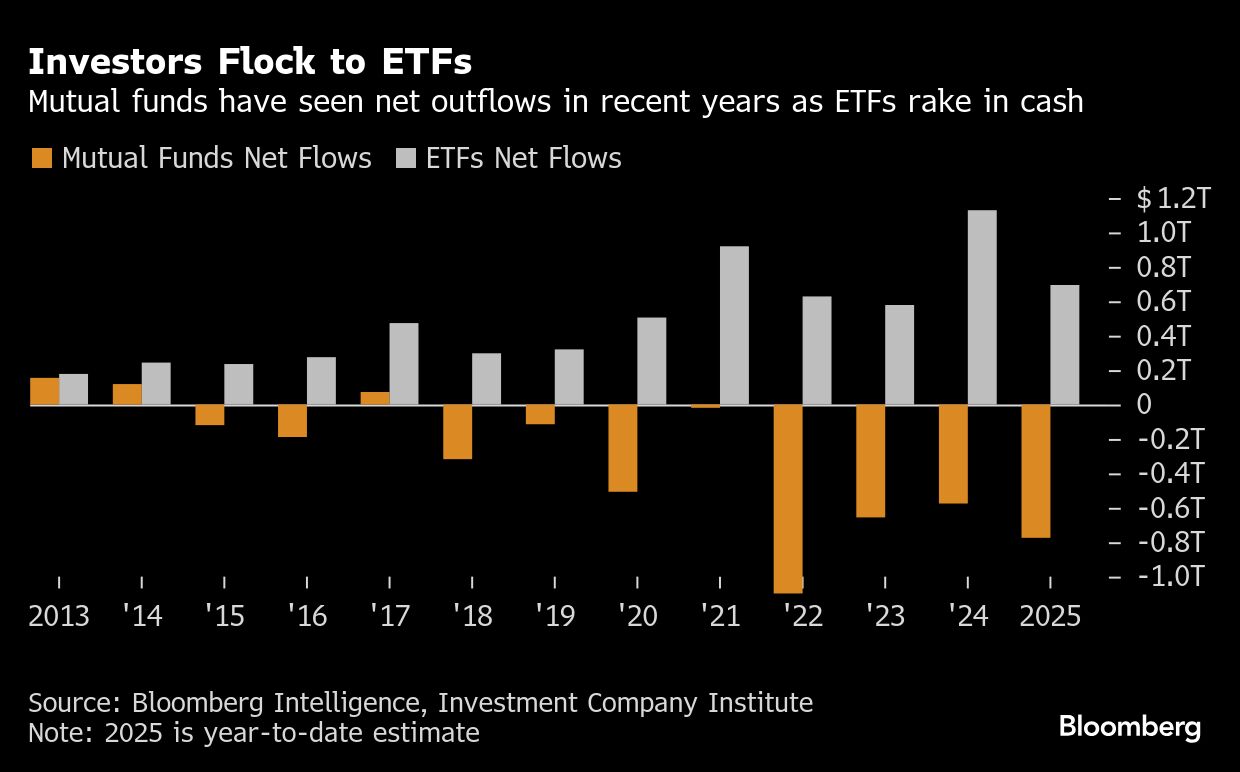
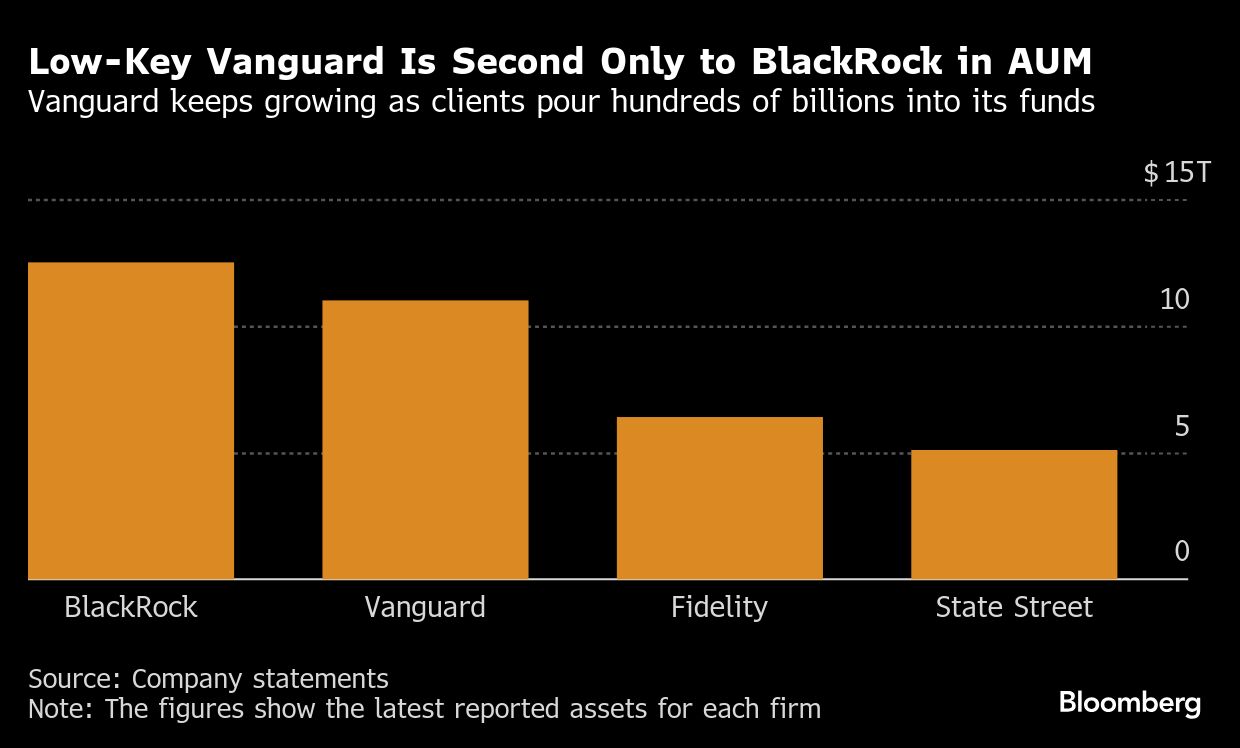
For more than two decades, US money managers have looked on enviously as Vanguard Group reaped the benefits of a unique structure that grafted the advantages of an ETF onto its biggest mutual funds. The design, protected by patent, saved its investors billions of dollars and helped the Jack Bogle-founded firm grow into an $11 trillion giant.
Now, in what could be the most consequential shift in the American investment industry in years, Vanguard is finally set to lose that competitive edge.
Dozens of rival asset managers are on the brink of adopting the same structure, after the US Securities and Exchange Commission indicated it will allow the quantitative firm Dimensional Fund Advisors to do so in the coming weeks. Roughly 80 more competitors are in the queue for approval, including nearly every major name in the business.
The model they want to follow creates an exchange-traded fund as one of the share classes of a mutual fund, a move that ports the famous tax efficiency of the younger structure to the older vehicle. Assuming the approvals come, it will likely trigger a wave of new ETF launches, re-write the tax and performance of countless mutual funds, and potentially finally erode the barrier that has until now largely locked ETFs out of the American retirement system.
“We already feel like we’re attached to a rocket ship, moving as fast as we can to launch more products,” said Brittany Christensen, head of business development and senior vice president at Tidal Financial Group, which helps create and run ETFs. “When I think about putting more fuel on that fire, that’s absolutely what this does.”
Technical challenges to implementing the new structure remain, so the landscape won’t alter overnight. And since most major money managers already offer ETFs — having long ago given in to investor demand for the easier-to-trade, often cheaper vehicles — some market watchers have questioned how many will actually deploy it.
But the size of the waitlist — more than six-times the number of firms that were racing for approval to launch Bitcoin funds — suggests huge industry-wide enthusiasm to take up the Vanguard blueprint. Eric Balchunas, senior ETF analyst at Bloomberg Intelligence, said it’s “like sitting on a bunch of CDs and here’s a chance to convert them all into digital.”
Waiting Game
Asset manager giants including BlackRock Inc., Fidelity Investments, T. Rowe Price Group and Franklin Resources Inc. are among the firms seeking regulatory permission to deploy the hybrid structure. Some have been waiting for about two years, ever since Vanguard’s patent expired.
In a virtual meeting on Monday, the SEC told pending applicants they should conform their filings to that of DFA’s, but did not provide guarantees on when they would sign off on the next applications, according to four people familiar with the matter.
BlackRock, Fidelity, Morgan Stanley and F/m Investments are among those that have already updated their paperwork.
“This is big for the T. Rowes of this world that don’t already have super well-established ETF businesses and they’re suffering outflows from their mutual funds,” said Adam Sabban, associate director, equity strategies at Morningstar Inc. While it’s unclear if it will help generate new inflows, “it could help them retain their current assets and slow the pace of outflows,” he said.
Some firms, including F/m, are looking to create mutual fund share classes of ETFs, opening the door for those products to break into 401ks. The pension system was built around mutual funds, and most platforms are not equipped to handle the intraday moves and liquidity of an ETF.
Advantage Vanguard
Unexpectedly, even the pioneer of the ETF-within-a-mutual-fund model is on the waitlist. Vanguard only has permission to use the structure on passive funds, so the firm is now seeking approval to deploy it in active products.
“The multi-share class ETF structure has served Vanguard index investors well for more than two decades,” said a company spokesperson. “The structure has multiple benefits for both conventional mutual fund and ETF investors, and Vanguard looks forward to bringing the benefits of the multi-share class ETF structure to investors in active funds.”
Malvern, Pennsylvania-based Vanguard first introduced the model in 2001, when ETFs were still in their infancy. Recognizing its potential value, the firm obtained a patent that restricted rivals from using it until 2023.
Technically, the dual share class structure remained available for other issuers, provided they agreed a licensing arrangement with Vanguard and gained exemptive relief from the SEC. But in the years since granting Vanguard approval, the watchdog developed worries relating to conflicts of interest among share classes, and no other exemptions were given.
The SEC said it intends to approve DFA’s relief application later in October, unless there is a request for a hearing on the matter.
“For too long, the artificial divide between mutual fund and ETF share classes has limited investor choice, operational efficiency, and resulted in suboptimal tax treatment,” SEC Commissioner Mark Uyeda said in a Monday statement. The proposed approval will facilitate competition because “similar relief has been long held by a single asset manager,” he said.
The regulator said on Wednesday that owing to the government shutdown it was unable to provide further comment.
‘Y2K Moment’
The level of maturity already reached by the ETF industry may blunt the impact of the widespread use of the dual share class structure.
Dave Nadig, president and director of research at etf.com, believes that any issuer with a decent approach will have pushed into ETFs years ago. Ben Fulton, CEO of WEBs Investments Inc., sees potential for this to be a “Y2K moment,” where significant time and resources are spent to achieve very little.
Firms planning to deploy dual share classes face plenty of practical hurdles. A May report from JPMorgan Chase & Co. argued that launching a successful ETF strategy “is not just as simple as adding a share class to an existing mutual fund and expecting it to gain assets.”
“An issuer needs to focus on the addition of capital markets services, a specific ETF distribution plan, platform strategies, and operational impacts as part of a successful launch plan,” the authors wrote.
One issue is how firms will handle investors who want to switch, tax-free, from the mutual fund share class into the ETF class, to benefit from the intraday liquidity in the latter wrapper. The process is not automatic and requires both the asset manager and the individual investor to take action.
“There’s some work left to be done with the platforms in terms of making that operationally more efficient,” Gerard O’Reilly, DFA’s co-CEO and co-CIO, told Bloomberg TV on Monday. DFA is hoping to have ETF share classes for a number of mutual funds available in the first couple months of 2026, he said.
Meanwhile, issuers launching an ETF for the first time will need to liaise with market makers, which play a key role in keeping fund shares trading through the day — something not needed by mutual funds. If mutual fund companies launch ETF share classes en masse, it could put huge demand on the market-making ecosystem.
It’s also an open question whether broker-dealers, who have strict requirements to operate in the best interest of their clients, will need to shift assets into the ETF share class, or whether they will be required to allow both share classes of the same fund on their platforms simultaneously.
In a survey by Cerulli Associates in May, more than half of ETF issuers polled said “broker-dealer reluctance to approve/make share classes available on platform” was a significant challenge.
“Although we’ve been working with several asset managers on operational readiness, I still think there’s going to be work for some of them — especially with the distribution channel, with the broker-dealers — to ensure that everyone’s ready for this,” said Frank Koudelka, global head of ETF Solutions at State Street.
Still, the direction of travel is clear, according to Ben Johnson, head of client solutions at Morningstar. He said all concerns and obstacles facing the use of ETF share classes would be overcome within as little as three years.
“ETFs are playing a starring role in life after mutual funds,” he said. “Their role is going to be elevated even further now.”
A message from Advisor Perspectives and VettaFi: Discover something new! Click here to register for our upcoming webcasts.
Bloomberg News provided this article. For more articles like this please visit
bloomberg.com.