The jaw-dropping spike in gold prices is a reminder of what primal creatures we humans are — especially the species among us known as active traders. But the surge should also remind us of the importance of calling on the more evolved parts of our brain.
Consider that there is no rational reason for gold, which has risen 50% this year and almost reached $4,000 per ounce on Monday, to be inherently valuable. Its price tends to go up when the world looks uncertain — it is supposedly a (redundancy alert) “safe haven”— as an alternative to the dollar. But why does gold have this status? A dollar can buy things. The stock market offers ownership in profitable companies. A bond promises a stream of payments. What does gold offer?
It has some industrial uses, but a lot of its appeal seems to be that it is both shiny and scarce. When times are uncertain, the most primitive parts of our brain find these qualities compelling.
We should resist this impulse. There is nothing safe about gold as an asset. Like any other commodity, its prices are extremely volatile. All it adds to a portfolio is risk.
To be fair, investors also turn to gold because of its long history as a currency. When it seems like the great modern economic experiment — markets, safe debt and fiat currencies — might fail, or just get a little gnarly, there is a natural inclination to turn to the OG store of value: gold.

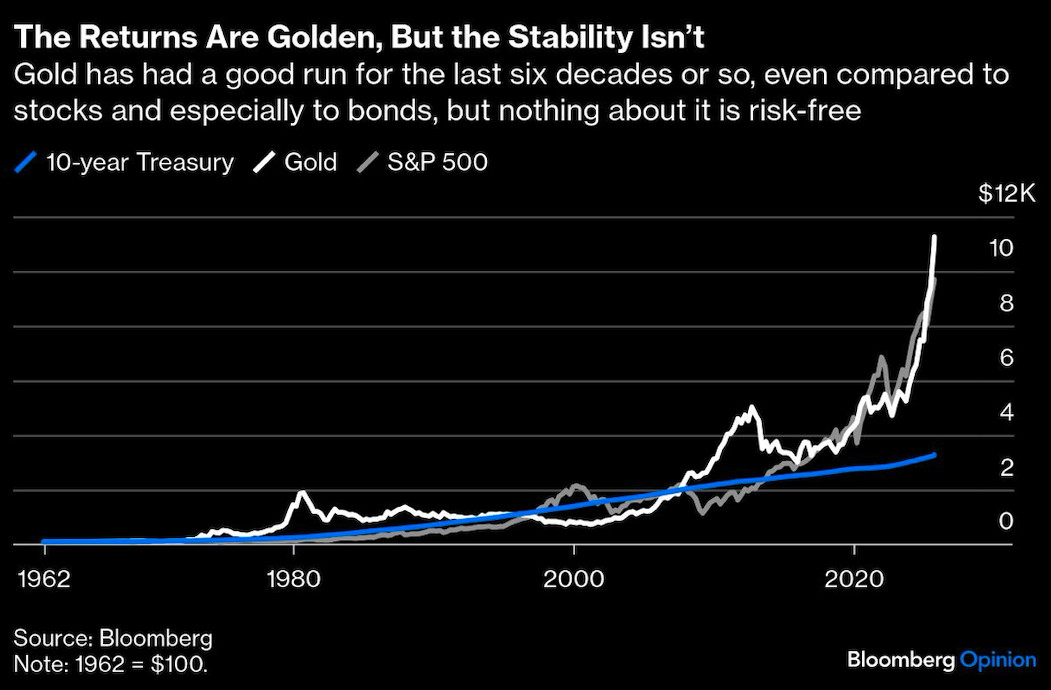
And gold has certainly had a good run for the last six decades or so, even compared to the S&P 500 and especially compared to the 10-year Treasury bond. But nothing about it is risk-free. The price is extremely volatile, and investors have been rewarded with good returns because they are taking on that risk.
Gold does not even provide a consistent hedge. True, in some kinds of markets gold can outperform stocks, and sometimes it is negatively correlated with them. But that doesn’t mean it is a more stable asset. If markets turn, there is no guarantee gold will hold its value. During some of the worst of the financial crisis in 2008, gold’s price fell 6%.
Maybe, as investors like to say, this time is different. After all, there are good reasons to be nervous about markets right now. Unlike in 2008, inflation is a serious concern in the US: There are signs it could go higher just as the Federal Reserve has embarked on a rate-cutting cycle. That could make inflation even worse.
Given these renewed concerns about inflation and the bipartisan commitment to a high-debt future for America, the outlook for bonds is also far from risk-free. Granted, over the last 60 years, nothing has beaten 10-year US Treasuries (except for shorter-duration bonds) for investors looking for a stable and certain return. But maybe that won’t be the case for much longer. Meanwhile, the stock market is also looking frothy, with investors and even Fed Chair Jay Powell speculating stocks are expensive and correction could be coming. And don’t get me started on crypto.
But again, none of this makes gold a low-risk alternative.
Investing in gold is fine if you enjoy speculating and think it will go up further. But when the argument is, “This is a low-risk asset that also beats the market,” put me down as skeptical. Both things can’t be true. And any investor who thinks they can be, is certain to be disappointed.
A message from Advisor Perspectives and VettaFi: Stay ahead of market changes with our daily updates on key market and economic indicators. Visit the AP Charts and Analysis site for our expert insights.
Bloomberg News provided this article. For more articles like this please visit
bloomberg.com.
Read more articles by Allison Schrager