Advanced Sales Techniques for Advisors: Know Your Client’s Buying Style
Membership required
Membership is now required to use this feature. To learn more:
View Membership Benefits Advisor Perspectives welcomes guest contributions. The views presented here do not necessarily represent those of Advisor Perspectives.
Yogi Berra, manager of the New York Yankees baseball team, sagely said, "You can observe a lot just by watching." You can increase your closing ratios and production if you use the right communication tools.
According to researchers Bandler and Grinder at UC Santa Cruz, people tend to think in three basic ways:
- Visually
- Auditorily
- Kinesthetically
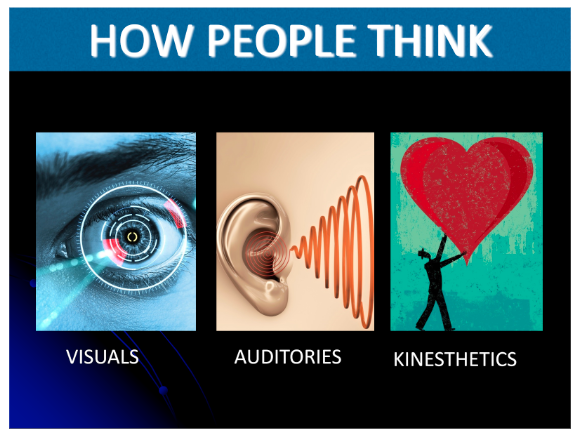
Visually oriented people think best through visuals and want to see a message, while auditorily oriented people are more easily influenced by sounds. Kinesthetically oriented people, the third group, understand ideas more quickly based on feelings.
Visual people make sense of words by constructing or recalling images in their mind. If they cannot make a picture of your ideas, they may have trouble understanding. Auditory people make decisions largely on the basis of how ideas sound. They often talk to themselves internally in order to comprehend a message. Kinesthetic people, on the other hand, process information through their feelings. They experience visceral gut-level emotions when talking to you. They may even know whether or not they like you as a person after just a few minutes.
As communication is a two-way street, it is important to know which style you use to sell, also. Think about your first hour of wakefulness this morning. What do you remember best? What did you see? What did you hear? What did you feel? What stands out most in your mind?
If you remember more of what you saw, you are probably more visually based. If you remember more of what you heard, you are probably more auditorily attuned. If what you felt this morning sticks out most your mind, chances are you are kinesthetically oriented.
You can determine whether your client is more visual, auditory or kinesthetic based on the direction they move their eyes when they think, as well as the words and predicates they use when talking.
Visual People
Visual people possess minds that work like a View-Master toy, with a lever advancing each picture, showing a three-dimensional view of the world. They love ideas they can see. They understand concepts that allows them to create pictures.
About 35% of your prospects fit this category. They translate all your words into pictures they can comprehend, and you can use images to build trust and rapport with them. These are prospects who like bar charts, graphs, beautiful scenes, and other things that help them think readily in pictures.
Visual people will give you certain cues to show you how they think. You probably heard in a communication training course, "Always watch their eyes." But nobody ever explained what you should be looking for.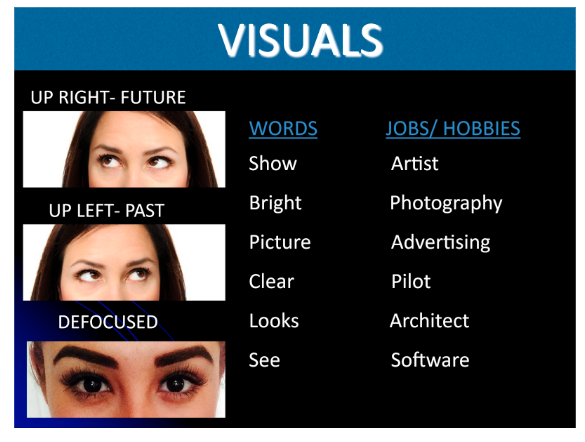
They move their eyes in three basic directions. Visuals will look up to their right when thinking about future information. When doing this they are constructing and creating thoughts of what may happen. You may ask a question such as, “Mr. Prospect, how much income will you need in retirement?” If he looks up to the right, he is constructing a number.
If he looks upward to his left, he is recalling memories. You may ask “What motivated you to buy the annuity I see in your portfolio?” If he looks up and to the left, he may be searching his memory for pictures of the person who sold it to him.
Finally, visual people may move their eyes into a defocused, blank stare. Have you ever noticed someone staring with a blank glazed look? When your prospect does this, they may be synthesizing and translating your words into pictures they can understand more quickly.
Even the words these people use are visually based. Visual people use words such as:
- “Look,” (that looks good to me);
- “Clear,” (that’s clear so far);
- “I see,” (I see what you mean); or
- “View,” (here is my view on this perspective).
People do not use words randomly. When your client talks, they are giving you specific information about their thought process. If they think in visual pictures, they will talk that way. When they use visual words, they will buy using visual images.
Use specific strategies when dealing with visual people:
- Draw illustrations of your ideas on paper.
- Talk with your hands. Visual people see this as "charismatic." This allows them to picture your message.
- When showing a visual person a fact sheet, hand it to them and stop talking. When your prospect is done processing the information, they'll re-establish eye contact.
- Watch what you wear. Color research has shown that visual people may rate you higher in credibility when you wear blues and grays instead of browns or beiges.
The most important process to use with visual people is to match their words. They want to hear specific words from you that describe your product clearly in pictures. Phrases that help them access their natural thought picture system quickly are:
- “Do you see what I am talking about?"
- "What is your view on this?"
- "In your perspective does this look like it will work for you?"
- "Do you envision this as the kind of retirement you want to have?"
If you use visual, sight-based words on your visual prospect, you will get more rapport and trust.
Auditory People
Auditory people, on the other hand, tend to think in a sound-oriented mode. They make sense of your message by recalling past conversations. They may also evaluate your ideas primarily on the sound of your voice and the tone of your delivery.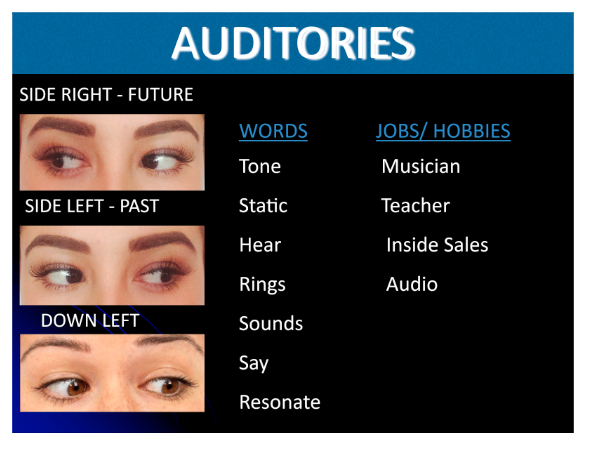
Auditory people also move their eyes in three distinct directions. When they move their eyes directly to their right, they are constructing and creating sounds. For example, you might say to a prospect, “Where do you want to spend your retirement?” He may move his eyes to the right, thinking, “I want to move to Hawaii, but I wonder what my wife will say?” He is, in effect, hearing future sounds. If he moves his eyes to the left, he is hearing past sounds — perhaps in response to you asking, “Have you ever heard of our company before?”
When a prospect looks down and to the left, he may be thinking in internal dialogue. Downward left eye movement indicates that your prospect is hearing his own conversation.
Auditory people also use key words to let you know they are thinking. They may use words as:
- ‘Ring’ (that rings a bell);
- ‘Sounds’ (it sounds good to me);
- ‘Hear’ (I hear you); or
- ‘Say’ (I like what you’re saying).
Obviously, listening to the words they use is even easier than watching their eye movements. Both will give you a sure-fire tool to determine how they are engaged in the process.
When communicating with auditory people, match their predicates. Use phrases such as, “I’ll bet that rings a bell,” or “Does that sound good to you?” Another phrase might be, “Do you like what you are hearing so far?” By using these auditory leading words, you will help sound-based prospects understand your message much more quickly.
The second technique is to tickle their ears. One financial planner in Orange County, California, unconsciously uses rhyme as he speaks. He presents insurance products by saying, “We need to keep your family protected. You don’t want to die and leave them financially abjected, dejected or rejected.”
The third way to tune in to auditory people is to select the correct background office music. Research done at Wal-Mart found that when slow music is played, sales are substantially higher than faster music. While visual people may not even notice any music at all, auditory people will find their mood affected by it.
A broker in Dallas uses a personal background stereo system in his office so he can control the type of music played. He plays classical music during probing, data gathering interviews, and faster-paced melodies when he wants his auditory clients to make decisions more quickly. The Musak Corporation has spent millions of dollars researching the types of tunes and tempos that will produce the highest levels of worker performance. They literally can prescribe Musak that speeds workers up after lunch or even slows them down toward quitting time. The fourth technique is to explain illustrations as you proceed during a presentation. While with visual people, you may find that they would rather read the illustration themselves while you remain quiet, auditory people prefer to have you explain it to them.
Kinesthetic People
Kinesthetics, are feelings-based people. They feel hot or cold about almost everything they experience. When these feelings-based individuals read a book or watch a movie, they may not simply view it as entertainment, but as an experience. Such people will reject or accept ideas based on how they “felt” during exposure to them. Kinesthetic people will also show you their thought process by the way they move their eyes and the words they use. They typically move their eyes in only one direction: downward to the right. This indicates they are thinking in a feeling-based mode.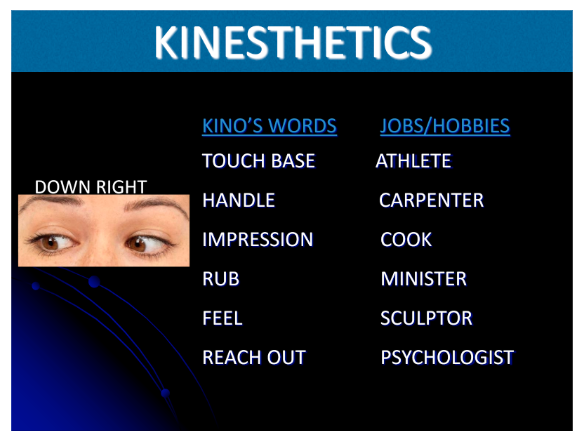
You can also determine a kinesthetic person’s thought process through the specific words they tend to use. You will hear them use verbs such as those found in the following statements:
- “It sure made an impression on me”;
- “How does that grab you?”
- “Let’s touch base next week”;
- “Here’s how I feel about it”; and
- “It really touched me.”
With kinesthetic clients and prospects, you may want to do the following:
- Match their words. Use phrases like some of the ones listed above. If you use these verbs, they will understand by getting a feeling for the meaning behind your message.
- Give them things to touch. Since they are feeling-based, they are likely to develop an emotion around ideas you make tangible, so tangible they can literally touch it. Have you ever noticed that some prospects actually reach out and grab brochures as you talk? These kinesthetic prospects are showing you how to communicate with them more effectively.
Communicate With the Client in Their Language
If, as an advisor, you knew which communication style (visual, auditory or kinesthetic) a client preferred, would it make you a more effective educator? Would the client develop rapport with you more quickly? If he could get greater rapport, would he be more trusting? Your prospects buy trust first, product solutions second. With these techniques, you will be a more effective advisor because you will be a better communicator.
You will not engage clients as rapidly without using these strategies. If you are visual, you probably have clients who are also visual. If you are feelings-based and kinesthetic, you tend to communicate with everyone else in the same feeling way.
You may also be mismatching your prospects by not using their mental buying system, which can get in the way of closing more business. If you are visual, you might say, “How does this look to you?” to your visual prospect. She may think in response, “I really see what you’re talking about.”
Auditory people frequently establish rapport more quickly with people who possess a disc-jockey-like resonance in their voices. They often have internal conversations with themselves, trying to make sense out of information. I knew a physician a few years ago who would literally talk himself through a decision out loud. He would sit next to a staff nurse and ask her a question she could not possibly answer. He would then answer it himself and thank her for the help in solving the problem.
A Final Example
A financial salesperson in Florida, June Williams, found out how much one’s selling method matters. She was trying to sell life insurance to a physician. About ten minutes into the presentation of showing pictures, drawings, illustrations, and giving visual examples, the prospect said, “Wait a second, June. Time out. Just talk to me about this. Explain it to me. Describe it to me. I do not want to look at all these charts, graphs, and brochures.”
June mistakenly said, “If I don’t show you these charts and illustrations, you really won’t understand the plan.” He just said, “Try me.”
June did precisely that. She put all her felt pens and charts away and just talked with her prospect for a few minutes without the use of any visual aids. As she spoke, the physician leaned back in his chair, closed his eyes and started smiling. She thought he was dozing off and said, “If you’re going to fall asleep, we can reschedule the meeting!”
In spite of her hostile remark, the physician opened his eyes, winked at her, and said, “How much do I need to give you to get this plan started right now?”
This man preferred an auditory communication style. He did not want to look at her illustrations, he wanted to listen. He was much more motivated by hearing the insurance plan than he was by looking at it. Fortunately, he told June how he wanted to be sold to. Most of your prospects will not give you that courtesy. They will simply reject the idea without telling you why.
If you do not communicate with your prospect in their unique thinking mode, they will not become your client. If you can keep rapport high by matching their buying mode, you will double your business.
I would love to send you a free video on “Discovering Your Client’s Buying Style. “Write me at [email protected] or call 714-368-3650. We will spend a few minutes talking about your goals for increasing your business this year.
Dr. Kerry Johnson is “America’s Business Psychologist.” He is the best-selling author of 17 books including the recently released, How to Recruit, Hire and Retain Great People. He is also a frequent speaker at financial conferences around the world. Peak Performance Coaching, his one-on-one coaching program, promises to increase your business by 80% in 8 weeks. To see if you are a candidate for this fast-track system, click on www.KerryJohnson.com/coaching and take a free evaluation test. You will learn about your strengths and what is holding you back. Or call, 714-368-3650 for more information.
A message from Advisor Perspectives and VettaFi: Discover something new! Click here to register for our upcoming webcasts.
Membership required
Membership is now required to use this feature. To learn more:
View Membership BenefitsSponsored Content
Upcoming Virtual Events View All












