Sometimes there are economic narratives that don’t quite deserve a debunking — they have more than a kernel of truth to them — but rather demand an appropriate level of skepticism. Three such stories are widespread today.
The first is the idea that artificial intelligence is driving a surge in US GDP growth. The second is that AI is weakening the labor market. And the third is that the recent expansion of consumer spending is concentrated at the top. None of these stories is false, exactly, but each is drenched in uncertainty, so we need to be cautious in how we interpret them and precise in what we do and do not know.
When it comes to GDP, There’s little question that investment in artificial intelligence has grown substantially. At the end of 2021, businesses invested $1 trillion annualized in software, information processing equipment and data centers. By the second quarter of 2025, that figure was $1.4 trillion — a 40% increase over 4 years.
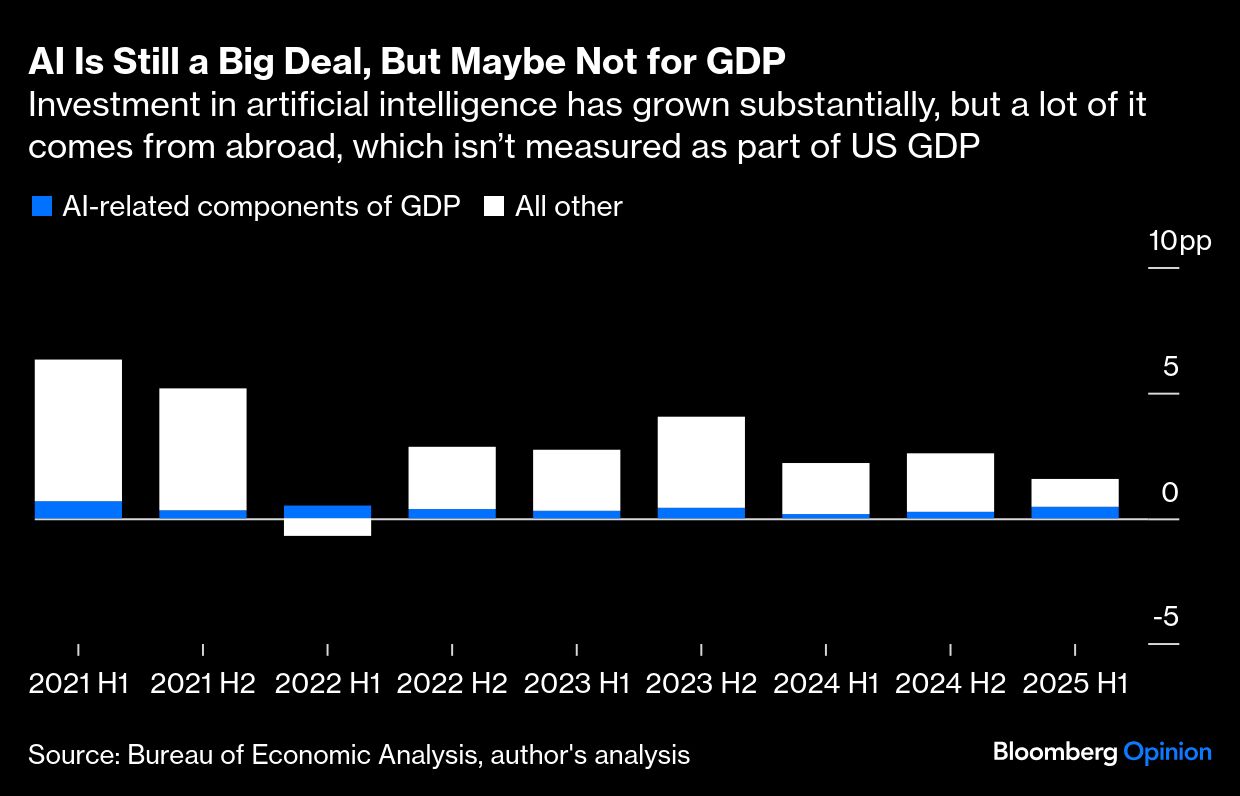
There’s a crucial caveat, however: a significant portion of this AI investment was imported, and that means that the role of AI investment on GDP growth is not quite as big as meets the eye (remember: GDP is a measure of the value of output produced within US borders). The final use of imports in real time cannot be tracked with absolute certainty, but the circumstantial evidence is strong. Since the beginning of 2024, overall imports of information processing equipment and software have risen by $189 billion annualized, while domestic business investment in these categories increased by $172 billion and consumer spending rose by only $29 billion. That strongly suggests that much of the AI investment boom has been fueled by imports.
Of course, there’s nothing wrong with companies importing equipment that allows them to expand here in the US — quite the opposite — but it does affect the GDP math. Without removing the impact of imports, AI-related commodities — software, information processing equipment and data centers — accounted for 1.3 percentage points of the 1.6% annualized real GDP growth over the first half of 2025 across consumer spending, business investment and exports, a staggering amount. But netting out the jump in AI-related imports, that contribution falls to 0.5 percentage point.
That’s still impressive, but less extraordinary than first meets the eye. To put that 0.5 percentage points in perspective, that’s about the magnitude of the negative effect on 2025 growth that the Yale Budget Lab expects from tariffs in 2025.
The second story about AI suggests that it is driving up unemployment rates, particularly among young college graduates. There’s been some thoughtful recent research finding significant AI effects on new hires, which finds that early-career workers in AI-exposed occupations have indeed seen employment declines while more experienced workers in the same fields have maintained or grown their employment.
Yet the evidence is not uniform. My Budget Lab colleague Martha Gimbel and her coauthors for example recently found that changes in the occupational mix since 2022 are in line with previous technological transitions, such as the rise of personal computers or the internet. They also find that neither the share of workers in high-AI exposure occupations nor their unemployment durations has shifted materially since AI began rising in prominence.
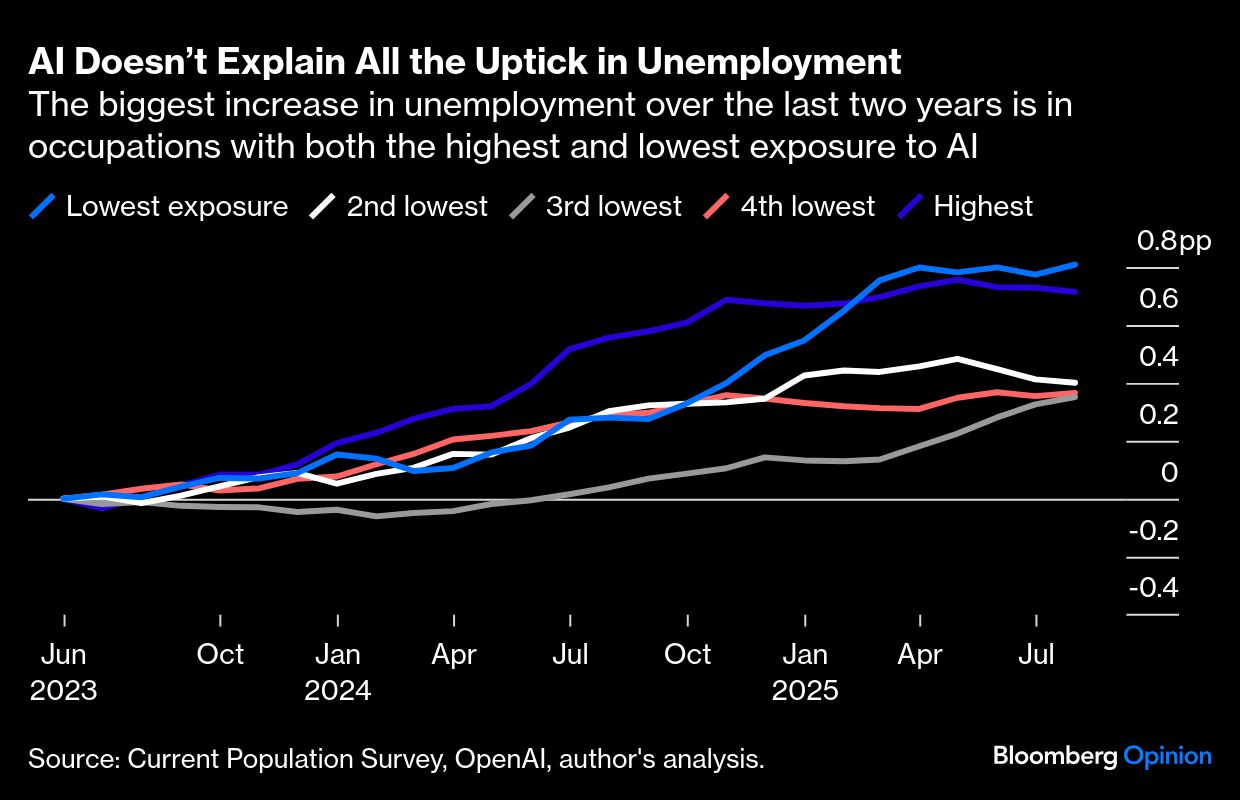
Moreover, it’s clear that even if AI is affecting the labor market, it’s far from the only story. The 12-month moving average of the unemployment rates reached a trough in June 2023 at 3.5%; since then, it’s risen 0.6 percentage point. The biggest increases in occupational unemployment rates since then have been among jobs with both the highest and lowest exposure to automation from AI. This suggests that even if AI actually is a culprit in the recent labor market slowdown, it’s not the only one. It’s possible that new hires may be disproportionately hurting right now simply because they are typically the first to feel the pinch when cracks appear in the labor market.
What about a K-shaped expansion in the US, in which higher-income consumers drive most of the economic growth while lower-income households struggle? This is not an unfounded worry. If the labor market is indeed slowing, workers at the bottom are the most exposed.
But I would advise extreme caution with estimates of the distribution of consumer spending, especially when they come from single private sources. While the government produces solid aggregate consumer spending data each month, reliable spending data, with the necessary detail to track different households and validate private data, is often lagged by years.
What data we do have complicate the K-shaped narrative so far. Bureau of Economic Analysis data through 2023 show that the bottom quintile of households accounted for 9% of consumer spending — higher than at any point before the pandemic. The Federal Reserve Bank of New York's Survey of Consumer Expectations shows that households below $50,000 in income, those making $50,000 to 100,000, and those above $100,000 all reported very similar spending increases — about 4% — over the 12 months ending in August 2025.
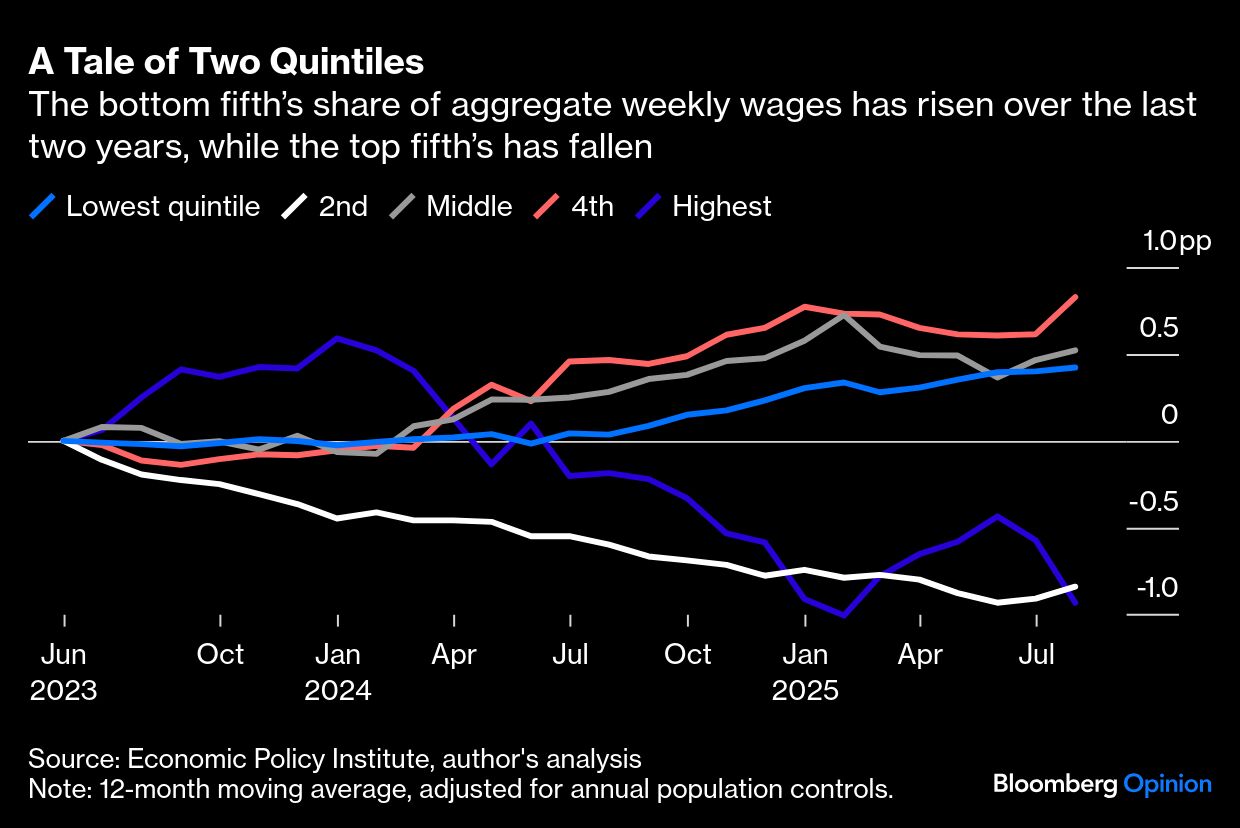
Additionally, while consumer spending is not the same as wages, the two are highly correlated. While inflation-adjusted weekly wages at the 10th percentile have somewhat lagged those of higher-wage workers, they have still grown by roughly 2% over the past two years. Moreover, the bottom fifth’s share of aggregate weekly wages has actually risen over the last two years, while the top fifth’s share has fallen.
Again, none of these narratives is off-base. Each of them likely contains elements of truth. But they all come with asterisks, and have nuances that don’t fit into headlines. With so much uncertainty and change in the US economy right now, no single explanation can be complete.
A message from Advisor Perspectives and VettaFi: Discover something new! Click here to register for our upcoming webcasts.
Bloomberg News provided this article. For more articles like this please visit
bloomberg.com.