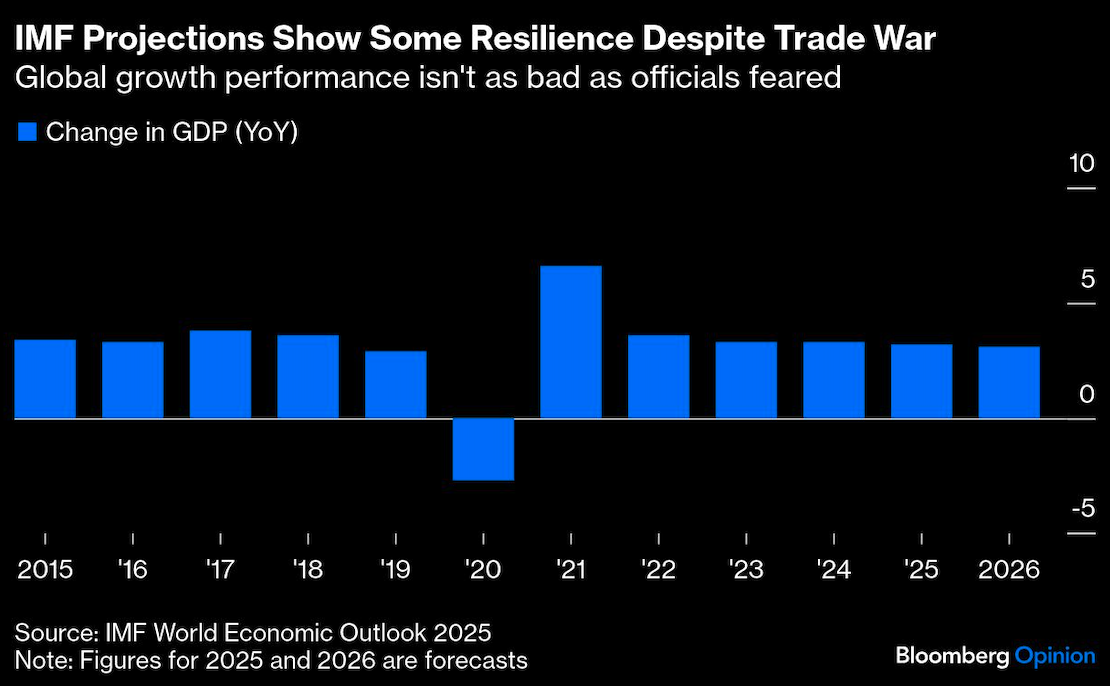
Seldom has the middling been the cause of so much relief. Six months after the White House unveiled steep tariffs, the global economy has held up well — mainly by outperforming some doleful projections. There's been no recession. Forecasts have even been revised up a touch.
Just imagine how things could be humming along without some self-inflicted wounds by the two countries that matter the most. After a few months of positive noises from America and China, relations again soured after Beijing cla
mped down on exports of rare-earths elements that are vital to manufacturing everything from cars to fighter jets. In return, President Donald Trump threatened even more tariffs on Beijing. There's still hope that commercial ties will avoid a more dangerous breakdown. Treasury Secretary Scott Bessent hinted at a long cooling-off period.
It says a lot about contemporary resilience that a downturn isn't yet in sight. Australia, which counts China and the US as two of its top three trading partners, certainly doesn't consider its own situation dire. “We are in a pretty good spot,” Reserve Bank chief Michele Bullock said recently. Bullock was careful to draw a distinction between that and a more foreboding overseas picture, disagreeing with what she called the “rosy” view of markets. There is no shortage of warnings that a slump may occur, and a nasty one at that. After all, you don't get to smash as much crockery, as the Trump team has, without some consequences.
If you were looking for a few pithy words to characterize the four-year-old global expansion, the “yes, but” economy might work. Caveats have dogged activity ever since businesses began emerging from Covid. The rebound was fueled by fiscal and monetary largess. The rapid rate hikes to combat subsequent inflation ran the risk of producing a downturn. That didn't happen. Then Liberation Day came along on April 2, when tariffs were rolled out. Growth hasn’t been undone yet.
“It’s not as bad as we feared, but it’s worse than we anticipated a year ago and worse than we need,” International Monetary Fund Chief Economist Pierre-Olivier Gourinchas told reporters last week. The IMF raised its forecast for world growth this year to 3.2%, up a touch from the 3% predicted in July. It will ease in 2026 to 3.1%, hardly the stuff of disaster.

The harm from trade dislocations may have been offset by a frontloading of exports before some of the levies kick in, and frenzied investment in artificial intelligence. The latter offers plenty else to worry about. Gourinchas even made a comparison with the dot-com experience in the 1990s, which, when the bubble eventually burst, contributed to a recession in 2001.
But we shouldn't be so harsh about the ’90s. It’s remembered as a time of great prosperity in the West and, along with some froth, real economic gains. Alan Greenspan, then chairman of the Federal Reserve and well on his way to guru status, described the era as belonging to a “new economy,” a paradigm shift where massive investments in technology allowed growth to accelerate without generating much inflation. That was possible, he argued at the time, because of the productivity enhancements gained in the process. He wasn't wrong.
So what might today’s solid top line numbers be missing? For one thing, neither superpower looks so great in isolation. The outlook for both the US and China was marked lower by the IMF. US gross domestic product will increase 2% this year, down by a decent margin from the prior 12 months, and hover around that level. China will go backward to 4.2% in 2026 from 4.8%, according to the estimates. (In recent years, the government has targeted growth of around 5%.)
The factors that have weighed on China — the real-estate crash, an over-reliance on exports, sub-par domestic demand, and deflation — aren’t abating. The latest figures showed the longest price declines since the 1970s.
The American economy has its own issues. While the government shutdown has delayed the release of key data on employment and other metrics, any resolution will unleash a flood of information on the state of the economy. Some investors expect the deluge will provide more evidence of weakness to support more monetary easing. Traders are piling into bets on at least one outsize interest-rate reduction by the Fed.
But for all these flaws, and several more, the key economies keep muddling through. Rarely has a glass half-full looked quite so alluring.
A message from Advisor Perspectives and VettaFi: Ready for your next career move?Explore our articles on financial advisor transitions.
Bloomberg News provided this article. For more articles like this please visit
bloomberg.com.
Read more articles by Daniel Moss