Advisor Perspectives welcomes guest contributions. The views presented here do not necessarily represent those of Advisor Perspectives.
- The $4 trillion target date fund (TDF) industry is an oligopoly that quashes innovation, but two innovations are challenging the oligopoly with better designs for participants: a U-shaped glidepath and personalization.
- A U-shaped glidepath offers smarter risk management, protecting near-retirees and outperforming the index over a 20-year test period.
- Personalization based on risk tolerance, not just risk capacity, empowers investors to manage their unique retirement lifepaths.
- With baby boomers in the Retirement Risk Zone, adopting U-shaped glidepaths and true personalization is crucial to avoid devastating losses.
- Advisors make it all happen by managing these innovations with their favorite investment managers.
“Me too” target date funds (TDFs) are languishing in obscurity against the oligopoly that manages two-thirds of the $4 trillion TDF market. To compete, you need to innovate toward better participant results. You need to be different and better. There have been no innovations to TDFs in their entire 19-year history, until now. It’s time. This article introduces trailblazing innovations that improve participant results with:
- Smarter risk management along a revolutionary U-shaped glidepath that wins on both risk and return, allowing participants to be safer and richer.
- Personalization based on risk tolerance that lets participants manage their own unique lifepaths, because investing is personal.
Advisors are in the driver’s seat for implementing these innovations and can play a crucial role in steering their clients into a well-funded retirement using a less risky approach. Below, I detail the benefits that they can convey to their clients.
Smarter Risk Management
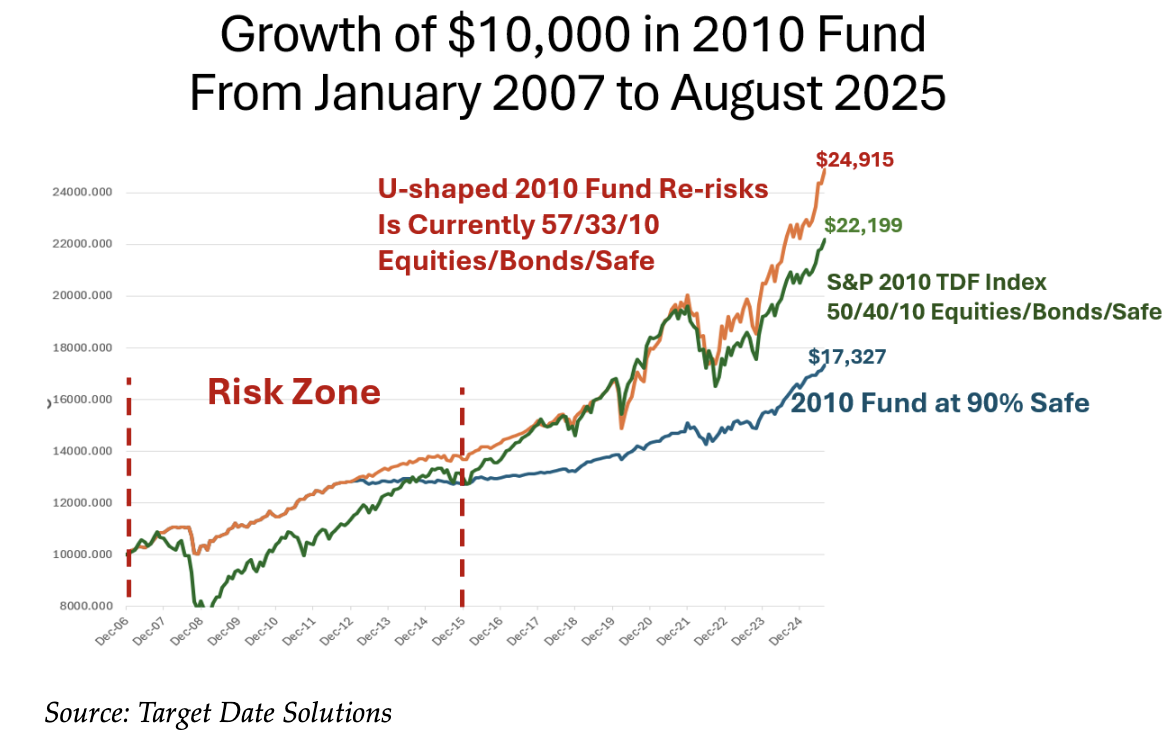
A U-shaped glidepath protects against sequence of return risk near retirement by being very conservative, and then it re-risks in retirement to extend the life of investments. The typical TDF cannot re-risk in retirement because it is already very high risk at its target date. U-shape requires safety at the target date, which protects against sequence of return risk. The U-shaped 2010 fund, with a 15-year post-retirement history, has come through this process with a very successful result.
This innovation protects in the Retirement Risk Zone and it outperforms the S&P 2010 TDF Index. The orange line is the 2010 U-shaped growth index.
The U-shaped glidepath has delivered more wealth than the index, and with controlled risk, especially for those near retirement in 2008 who did not suffer the losses experienced by other TDFs. The U-shape starts retirement very safely and then gradually takes on more risk as retirement progresses.
The point is that the 2010 fund is the first (and only) test of the U-shaped design so far. Start to finish, it’s 20 years. This particular 20 years started with a crash (easy win for a conservative design), followed by the longest bull market ever (a challenge for the U-shaped design).
The encouraging news is that U-shaped wins — one in a row! In 10 years from now we’ll know how the U-shaped 2020 fund fares in its 20-year journey. Time flies.
Personalization That Works
Personalization of TDFs has come to market as Personalized Target Date Accounts (PTDAs), but it’s based on the use of recordkeeper data that reveals risk capacity, which is the wrong basis, as capacity is the ability to take risk. Sensible personalization should be based on risk tolerance, or the willingness to take risk. Most rich people with high risk capacity want to stay rich, so their risk tolerance is low, as I have detailed in another article.
This brings us to choices. Personalization gives participants the ability to manage their own personal lifepaths through time, via the choice of risk level and retirement date (investment horizon).
Personalized Choice
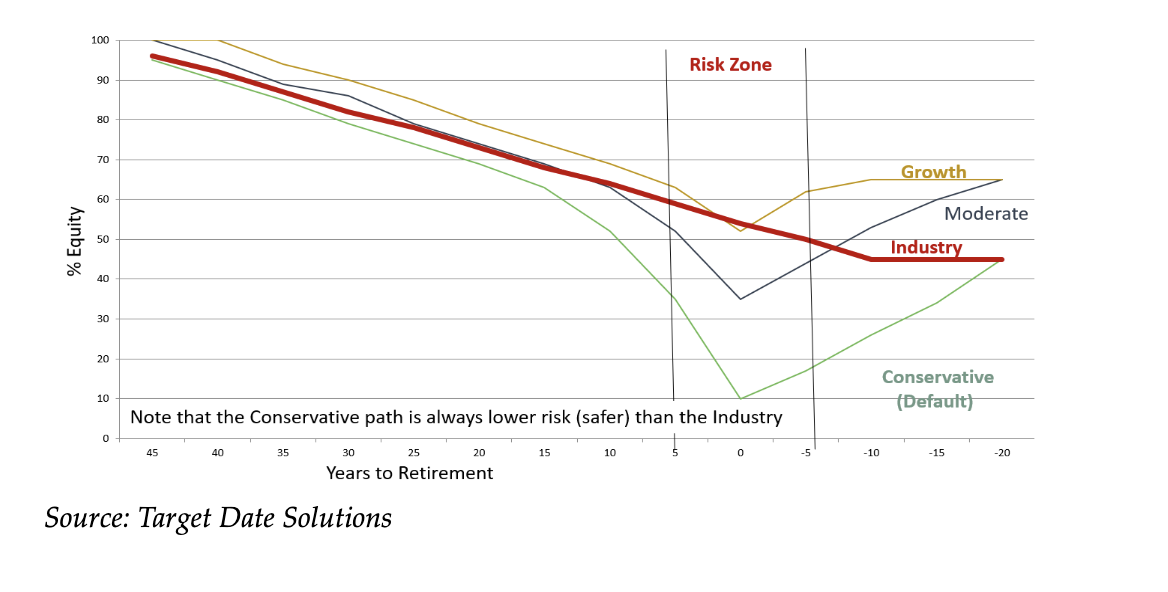
Unlike most target date funds (TDFs) with a single glidepath, PTDAs come with an array of glidepaths with varying risks, such as those shown in the following graphic.
The “Industry” shown in the graph is the S&P target date fund index aggregate of all TDFs. It is 85% in risky assets at the target date. By contrast, the “Conservative” glidepath is 20% risky at the target date. It is like the glidepath followed by the Federal Thrift Savings (TSP) TDF, and others.
RPAG’s flexPATH TDFs with their risk-based glidepaths have attracted more than $100 billion from small plans, paving the way for Soteria U-shaped SaaS that extends this framework to personalized target date accounts that enable participants to manage their own unique lifepaths. flexPATH is a family of CITs that uses 25 funds from 20 managers along its three glidepaths. Soteria also has low, middle and high risk glidepaths, but underlying funds are specified by the plan’s advisors, and participants choose where they are on which glidepath.
Conclusion
There are only a couple TDF innovations currently under consideration: a U-shaped curve and personalization. The early results for the U-shaped curve, covering the past 20 years, are now in, and they are very promising. Of course, the next 20 years won’t be like the last 20, but there are persuasive reasons to actually implement the approach. The 2020 fund is now five years into its post-retirement path.
The past 15 years have been the longest bull market. Investors have become lulled into a sense of permanence — believing downturns are no longer part of the investment landscape. That mindset leaves portfolios — including typical TDFs — exposed when a crash inevitably returns, pursuant to Stein’s Law that if something cannot go on forever, it will stop.
In this decade, baby boomers are in the Retirement Risk Zone, during which a crash could ruin the rest of their lives. Baby boomers in TDFs are in the 2020 and 2030 funds, both of which are typically not safe, with 50% in equities and 40% in long-term bonds. By contrast, the U-shape, at 80% safe, protects them against sequence of return risk now, and eases them back into higher expected returns as they leave the Risk Zone.
Personalization is also worthy of consideration because investing is personal, but it’s important to recognize the difference between risk capacity and risk tolerance. Sound personalization requires an assessment of risk tolerance.
TDFs for retirement savings investing were launched in 2006 with the passage of the Pension Protection Act. Not much has changed in the ensuing 19 years. It’s time for improvements. For those who would like to compete against the TDF oligopoly, you’ll need to be something other than just another “me too” fund. Advisors can play a key role in this potential revolution, and participants can benefit.
Ron Surz is president of Target Date Solutions, developer of the patented Safe Landing Glide Path and Soteria personalized target date accounts. He is also co-host of the Baby Boomer Investing Show. Surz’s passion is helping his fellow baby boomers at this critical time in their lives when they are relying on their lifetime savings to support a retirement with dignity, so he wrote a book, “Baby Boomer Investing in the Perilous 2020s,” and he provides a financial educational curriculum.
For anyone who relies on TDFs — or advises those who do — Surz’s new book is a must-read guide to understanding the risks, solutions, and future of a secure retirement.
A message from Advisor Perspectives and VettaFi: Discover something new! Click here to register for our upcoming webcasts.
Read more articles by Ron Surz
 Advisor Perspectives welcomes guest contributions. The views presented here do not necessarily represent those of Advisor Perspectives.