Investors’ certainty that the Federal Reserve would follow its recent interest-rate cut with another in December has evaporated. Treasuries dropped by the most in nearly five months after Chair Jerome Powell — departing from his previous messaging — said with heavy emphasis that another cut by the end of the year was “not a foregone conclusion.”
This adjustment was both wise and consequential. Amid much economic uncertainty, and with essential data unavailable due to the government shutdown, the central bank needs to be — and be seen to be — open-minded. That investors were previously all but certain of another cut proves that the Fed’s earlier messaging had gone astray.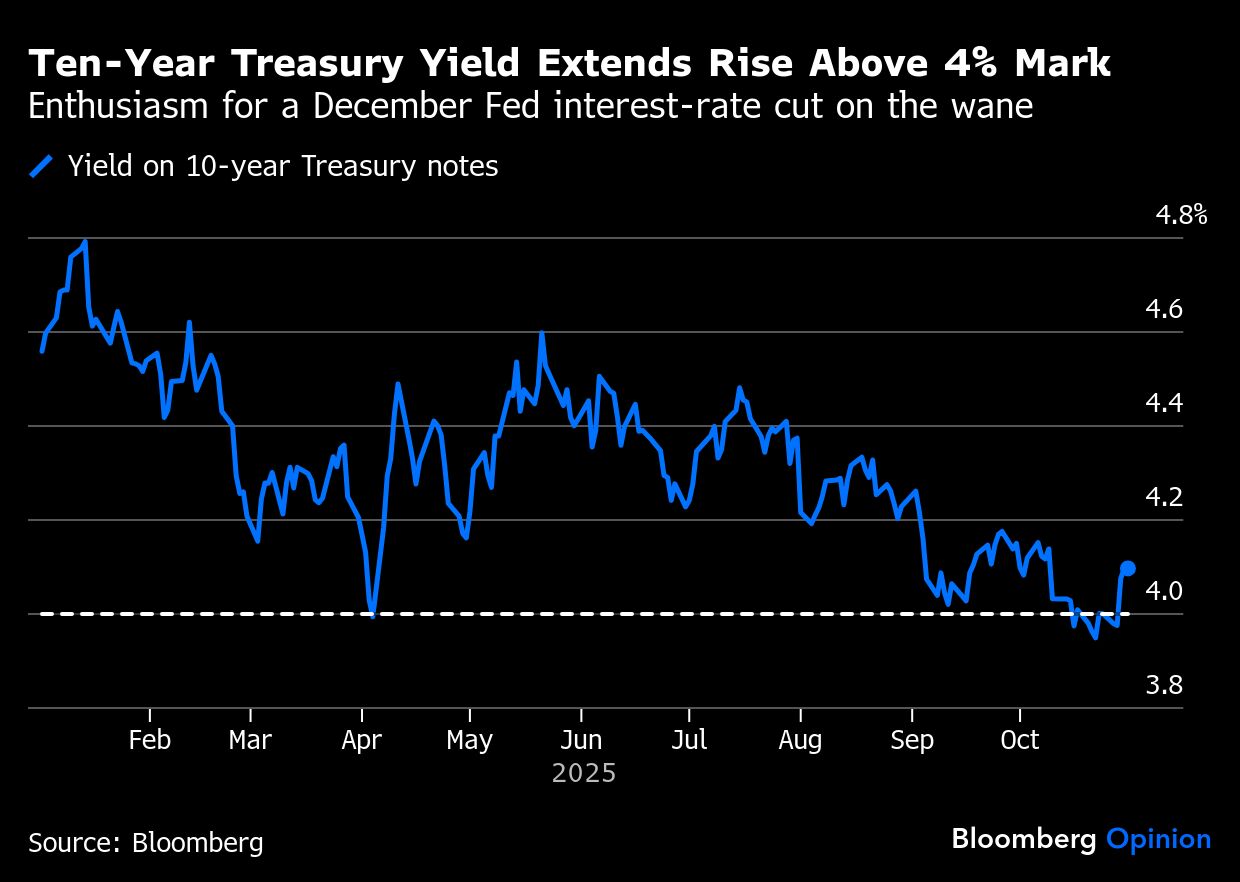
Reasonable people can disagree about whether the recent easing was justified and whether more is required. As Fed officials have explained, the labor market is cooling and the risk of unemployment is rising. At the same time, inflation remains stuck well above the bank’s 2% target. These trends pull monetary policy in opposite directions. Balancing the risks appropriately would be difficult even if the relevant data was at hand — and, at the moment, it isn’t.
In such circumstances, uncertainty is a good thing — an acknowledgement of reality. Exaggerated confidence in the likely course of interest rates not only induces investors to make mistakes but also tends to box the Fed in. Policymakers prefer not to shock financial markets if they can help it. Indeed, this was probably a factor in going ahead with the cut announced last week: Having led investors to regard it as certain, the Fed would’ve had some explaining to do if it had suddenly decided otherwise.
As John Maynard Keynes (possibly) once said, “When the facts change, I change my mind.” It’s a mistake for the Fed to deny itself this option.











