The passage of landmark stablecoin legislation in the US is supercharging the debate on Wall Street over the digital assets’ true potential for boosting the dollar and becoming a meaningful source of demand for short-dated Treasuries.
While views vary, strategists at firms from JPMorgan Chase & Co. to Deutsche Bank AG and Goldman Sachs Group Inc. all agree that it’s far too soon to declare stablecoins as game changers, no matter how upbeat US President Donald Trump and his advisers are about the tokens’ role as a new multi-trillion-dollar pillar to prop up US finances. And some see risks as well.
“The projections are so large that people are watching, but not taking any directional bets,” said Steven Zeng, US markets strategist at Deutsche Bank. “There are quite a few skeptics as well.”
Stablecoins are digital tokens whose value is pegged to a conventional currency, most commonly the US dollar, making them less volatile than market-based cryptocurrencies such as Bitcoin. They serve as substitutes for cash on blockchains, and can be used as a way to store money digitally like in a bank account, or for real-time transfers or trades.
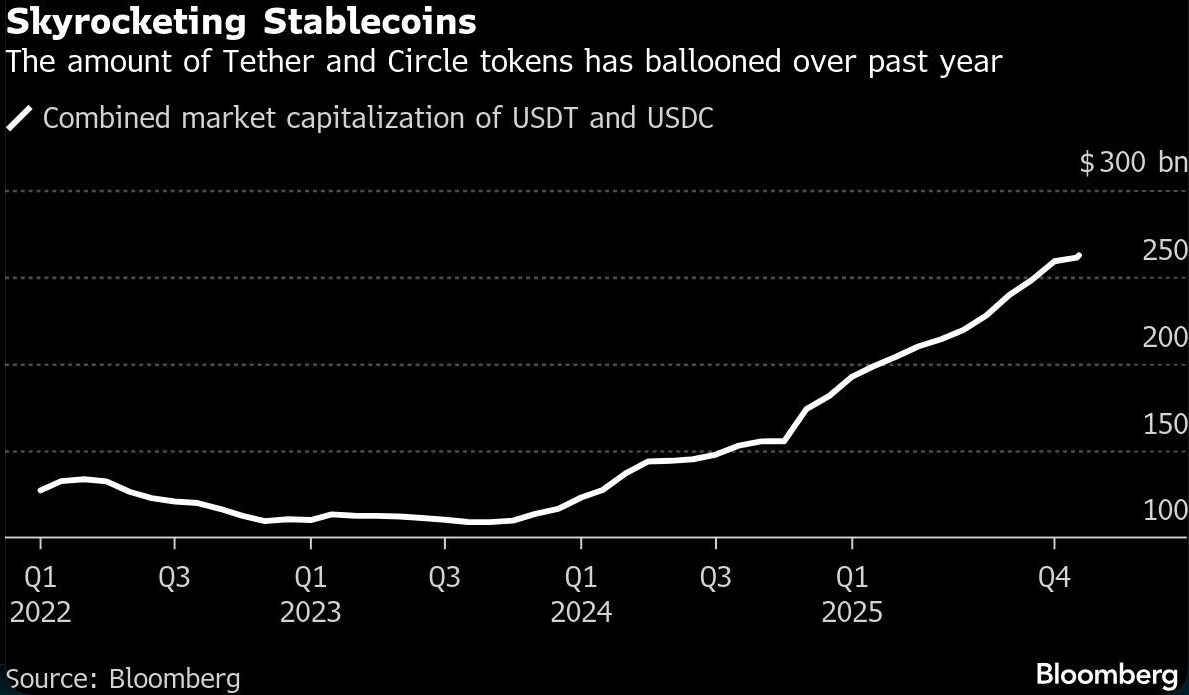
Momentum around stablecoins has accelerated since the so-called Genius Act became law in July, with industry backers championing the legislation as pivotal for paving the way toward wider use of dollar-denominated digital coins in the financial system. US Treasury Secretary Scott Bessent estimated last month that passage of the act could drive growth in the dollar—backed stablecoin market to $3 trillion by 2030 from about $300 billion now.
Under the new law, stablecoin issuers will be required to fully back dollar-based digital tokens with Treasury bills and other cash equivalents, and Bessent’s contention is that the coming “surge” of stablecoin-induced demand will allow the Treasury to issue more bills. That, in turn, would reduce the government’s reliance on long-term debt and ease pressure on mortgage rates and other borrowing costs that key off of longer-dated benchmarks.
“The Treasury Department is focused on borrowing costs,” said Robert Tipp, chief investment strategist and head of global bonds at PGIM Fixed Income. Stablecoins “can help in the process,” he said.
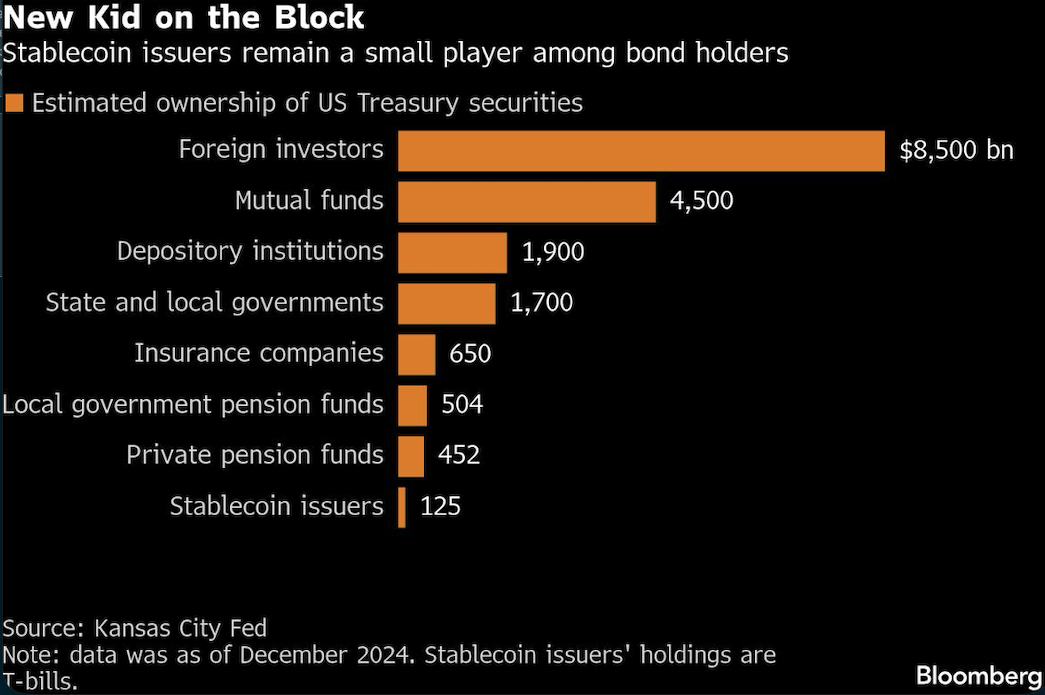
Already, dollar-based stablecoins — dominated by Tether Inc.’s USDT coin and Circle Internet Financial Inc.’s USDC token — hold roughly $125 billion Treasury bills, approaching 2% of the market outstanding as of the end of last year, according to a study by the Kansas City Federal Reserve Bank in August.
These issuers bought about $40 billion of bills last year alone, according to the Bank for International Settlements. They’re still dwarfed by US money-market funds, which hold about $3.4 trillion of Treasury debt, according to data from the Securities and Exchange Commission.
Most analysts agree the stablecoin market is likely to grow under the new regulatory regime, which will be hammered out over the next year. But estimates diverge widely. JPMorgan Chase expects the market to expand to up to $700 billion over the next few years, while Citigroup Inc.’s bull-case scenario envisions as much as $4 trillion.
“Certainly I think there’s a lot of positive momentum that we have seen over the past year,” said Teresa Ho, head of US short duration strategy at JPMorgan. “But the speed at which it’s going to grow — I don’t think it’s going to grow to $2, $3, $4 trillion in just a couple years of time.”
The goal of crypto industry backers is for stablecoins to evolve into a mainstream form of payment, a development that would pose a direct challenge to the traditional banking system. Banks, especially smaller ones, have warned about a potential drain on deposits and subsequent reduced access to credit. Larger banks are looking to stave off competition by issuing their own stablecoins, which generate profits from interest on the reserves.
For now, stablecoins are still used primarily to facilitate crypto trading, and recent volatile markets show how sentiment around digital assets can shift dramatically, with stablecoin outflows a potential knock-on effect. And even if the rosiest growth forecasts come to pass, the actual boost to Treasury-bill demand may not be as great as some estimate.
Net Effect
Skeptics point out that stablecoin inflows largely come from four channels: government money-market funds, bank deposits, physical cash, and foreign demand for dollars.
Given that stablecoins are prohibited from paying interest under the Genius Act, yield-seeking investors have little incentive to shift money out of savings accounts or money-market funds, constraining their potential growth. And even if investors do move funds from money-market vehicles — currently the largest buyers of T-bills — the net effect may be zero. Instead of creating new demand for bills, it simply shifts who holds them.
“I am suspicious,” Brad Setser, a senior fellow at the Council on Foreign Relations, said about the impact of stablecoins. “If stablecoin demand surged, some current holders of bills would be pushed out of the market and into substitutes,” such as other short-dated securities, he said.
Stephen Miran, the White House chief economist and currently a Fed governor, has acknowledged that demand for stablecoins may be limited inside the US. But he argues the real opportunity lies abroad, where investors are willing to accept zero-yield in exchange for access to dollar assets.
In a recent speech, Miran linked the potential impact of stablecoins to the Fed’s quantitative easing and the global “savings glut” that pushed down interest rates substantially. But that, in turn, could trigger consequences.
Standard Chartered estimates that migration into stablecoins could spur around $1 trillion in capital outflows from banks in developing countries by 2028. Such a scenario would almost certainly prompt regulators in these countries to limit the adoption of stablecoins. The European Central Bank and the People’s Bank of China are developing their own digital currencies to counter competition from private dollar-based coins.
“If capital controls effectively limit access to conventional dollars, they might also be applied to dollar stablecoins,” wrote analysts Bill Zu and William Marshall at Goldman Sachs.
Fed Factor
A further factor mitigating stablecoins’ effect on Treasury demand may be the Fed itself. If stablecoins sequester dollars in circulation – which is a liability item on the Fed’s balance sheet — the central bank would need to shrink its assets in tandem, including its $4.2 trillion Treasury portfolio, according to Michael Cloherty, a strategist at CIBC. That means “much” of the stablecoin-driven demand for Treasuries could simply substitute for the Fed’s holdings, he said.
A greater reliance on short-term debt also comes at a cost, making government financing less predictable over time, requiring more frequent rollover and exposing the US to shifting market conditions. And any shift wouldn’t happen overnight.
Zeng at Deutsche Bank estimates stablecoins could grow by $1.5 trillion over the next five years, funded by outflows from domestic and offshore money pools. That would generate around $200 billion in incremental Treasury demand annually — a meaningful amount but a pittance relative to the sheer scale of U.S. government borrowing. Federal debt has swollen to more than $30 trillion and is projected to rise by another $22 trillion over the next decade.
“I am not going to go gung-ho on the dollar and Treasuries just because maybe there’s this light bulb lighting up in the minds of the administration,” said Steven Barrow, head of G10 strategy at Standard Bank in London. “It’s wrong to say stablecoins can’t solve anything,” but it “won’t get you out of that hole” of yawning debt and deficits, and “that’s where the real concern lies,” he added.
A message from Advisor Perspectives and VettaFi: Are you backed by institutional quality bond funds? Click here to learn more.
Bloomberg News provided this article. For more articles like this please visit
bloomberg.com.