President Donald Trump and Prime Minister Narendra Modi took a major step to reset fractured ties with a surprise deal on Monday to slash tariffs, bringing much-needed relief to India’s economy.
The US will cut its levy on Indian goods to 18% from 25%, lower than most Asian peers, while an additional 25% punitive duty tied to purchases of Russian oil was scrapped. Trump said Modi had agreed to buy $500 billion of US goods, cut its tariffs to zero, and halt crude purchases from Russia, a key demand of the US president.
Aside from the new tariff rate, Modi didn’t confirm the details of the deal, and like Trump’s other trade announcements, much could change. Even so, the agreement was hailed by officials from both sides and cheered by investors. The rupee posted its biggest gain in more than three years and stocks jumped the most since 2021 after the announcement.
“It is great news for the US-India relationship,” Kenneth Juster, the former US Ambassador to India, said in an interview Tuesday with Bloomberg TV. “This is the first phase of the agreement and if they continue to work on it, we can see the rate drop further.”
The previous 50% US tariff rate, in place since August, had hurt India’s labor-intensive industries, undermined its appeal as a manufacturing and export hub, and soured ties between the two countries. India’s currency was Asia’s worst performer against the dollar last month, weighed down by concerns over the lack of a US trade deal.
Wonderful to speak with my dear friend President Trump today. Delighted that Made in India products will now have a reduced tariff of 18%. Big thanks to President Trump on behalf of the 1.4 billion people of India for this wonderful announcement.
When two large economies and the…
— Narendra Modi (@narendramodi) February 2, 2026
The agreement to buy $500 billion-worth of goods over five years includes an existing pipeline of projects, as well as new areas of spending, such as data centers and energy, an official in New Delhi told reporters on Tuesday. On plans to halt Russian oil purchases, the official said India’s government believes in diversifying its sources of energy, but doesn’t dictate to companies where to buy oil.
The lack of detail on the agreement has confounded businesses and analysts. India currently imports less than $50 billion a year from the US, so ratcheting that up to $500 billion would be challenging.
The announcement so far “leaves major questions unanswered — what products are covered, what the timelines are, and whether India has really agreed to zero tariffs and zero non-tariff barriers, especially in sensitive areas like agriculture and regulated imports,” said Ajay Srivastava, founder of New Delhi-based think tank Global Trade Research Initiative.
Exporter Relief
Even so, the drop in the tariff rate came as a relief after months of stalled negotiations that had left India one of the few major economies without a trade deal with Washington. Trump’s closer ties with India’s arch-rival Pakistan had also strained relations with New Delhi.
While Asia’s third-largest economy is not primarily export-driven, the US is India’s biggest market and accounts for about a fifth of its overseas shipments. Labor-intensive industries such as textiles, leather, footwear and jewelry, had been particularly hard-hit by the tariffs.
“The trade agreement details remain cloudy, but topline, if both sides reduce tariffs as meaningfully as indicated on social media, this could unlock real commercial opportunities,” said Rick Rossow, a senior adviser and chair on India and Emerging Asia Economics at the Center for Strategic and International Studies.
At 18%, India’s tariff is now lower than Vietnam’s 20% rate and the 19% applied to most of Southeast Asia, while South Korea and Japan secured duties of 15%.
That’s likely to spur investment into India, which had hoped to attract more manufacturing into the country as an alternative hub to China. Capital Economics estimates a 0.2 to 0.3 percentage-point boost to gross domestic product growth this year. A senior Indian bureaucrat said Tuesday that growth may now reach 7.4% in the fiscal year starting in April, exceeding the government’s earlier projection of 6.8% to 7.2%.
The China+1 process of luring exporters to India “was getting a bit disrupted due to these tariff uncertainties,” V. Anantha Nageswaran, India’s chief economic adviser, said in an interview on Bloomberg TV. “Now, that would be once again be back in contention.”
The agreement is also likely to bring the two nations closer in areas beyond trade, including in defense and technology. According to Juster, the deal could give “new impetus” to the Quad — an informal grouping of the US, Japan, India and Australia — aimed at countering China’s growing influence in the region.
Trade Negotiations
The US and India had been locked in negotiations for months and there were no recent indications that an agreement was imminent. US Trade Representative Jamieson Greer said last week that while India had “made a lot of progress” in curbing Russian oil purchases, “they still have a ways to go” on the issue.
Progress appeared to accelerate after the arrival of Sergio Gor last month as US ambassador to India, a post that had been vacant since Trump took office. Gor, a former senior White House official and close Trump confidant, has repeatedly underscored the importance of US-India ties.
In a post on X following Trump’s announcement, Gor said he was “thrilled” by the deal and added that the relationship between the US and India has “LIMITLESS POTENTIAL.”
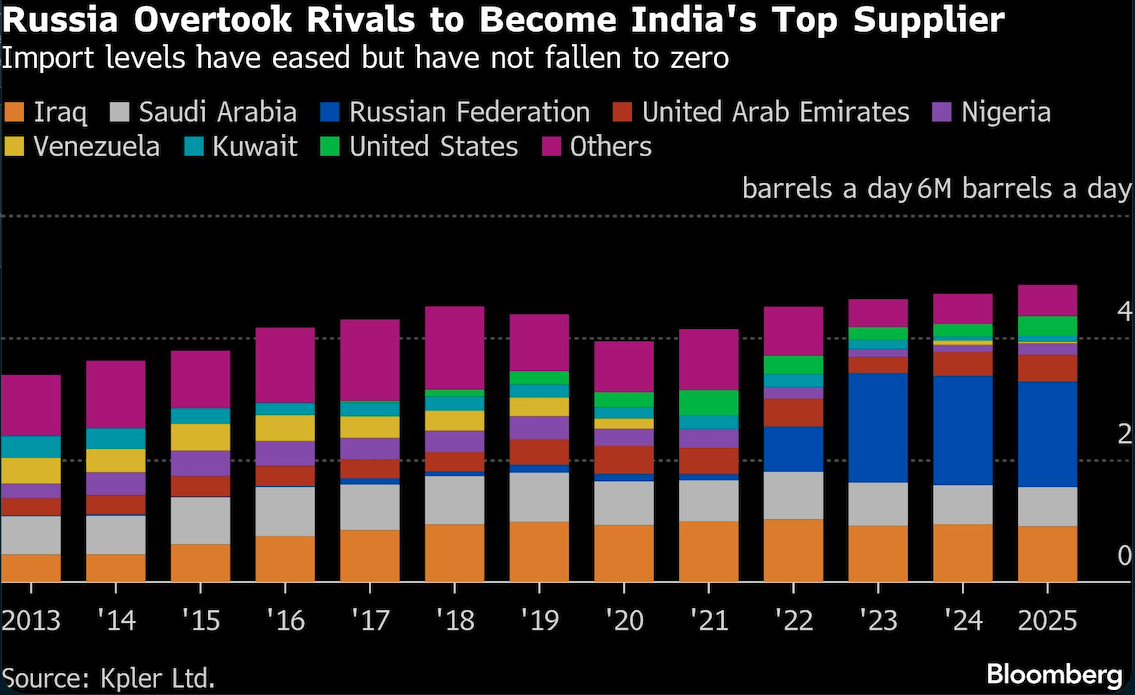
A major sticking point in the talks was India’s purchases of discounted Russian oil. Not traditionally an importer of Russian crude, India emerged as a key buyer after Moscow’s 2022 invasion of Ukraine upended trade flows and made discounted supplies attractive. Efforts by the Trump administration to curb those shipments have slowed the flow of oil to India, but not stopped it.
In his post on Monday, the US president said Modi agreed to buy more oil from the US and potentially Venezuela. New Delhi is yet to confirm those details.
The Kremlin said on Tuesday that it had not heard any statements from India about plans to stop purchasing oil from Russia.
India’s heavily protected agricultural sector also emerged as a hurdle. Neither side has said whether New Delhi would ease those protections, but the country is largely self-sufficient in many major crops, including wheat, and is the world’s leading rice exporter.
The South Asian nation also maintains strict limits on genetically-modified crops, which dominate US corn and soybean production. Washington pushed during the talks for greater access for genetically-modified crops, as well as entry for its dairy products — another industry that India closely guards.
India’s Commerce Minister Piyush Goyal told reporters on Tuesday that New Delhi had protected sensitive sectors such as agriculture and dairy in the deal. US Agriculture Secretary Brooke Rollins, meanwhile, said the agreement would send more American farm products to India and help narrow the US’s trade deficit in the sector. Neither side shared additional details.
The Trump agreement comes just days after India secured a landmark deal with the European Union, bringing the number of trade pacts New Delhi has signed since May to five. The flurry of deal-making is expected to lift competitiveness and further integrate India into global supply chains.
“The key tail risk of India’s geopolitical isolation about which investors were concerned has now been adequately addressed by the back-to-back deals with EU and US,” said Citigroup economists Samiran Chakraborty and Baqar Zaidi.
As I have said many times, President Trump genuinely considers Prime Minister Modi a great friend! Thrilled by the news of the trade deal this evening. The relationship between the United States and India has LIMITLESS POTENTIAL!
— Ambassador Sergio Gor (@USAmbIndia) February 2, 2026
India was among the first to open trade talks with the Trump administration last year, but ties soured after the US president repeatedly claimed credit for a ceasefire between India and Pakistan — an assertion that incensed officials in New Delhi — while the tariffs further eroded ties.
Signs of a thaw between the two economies emerged after Trump called Modi on his birthday in September, ratcheting down tensions and seeing the countries resume stalled trade talks. The US president in November said he could visit India at the urging of Modi.
A message from Advisor Perspectives and VettaFi: Discover something new! Click here to register for our upcoming webcasts.
Bloomberg News provided this article. For more articles like this please visit
bloomberg.com.