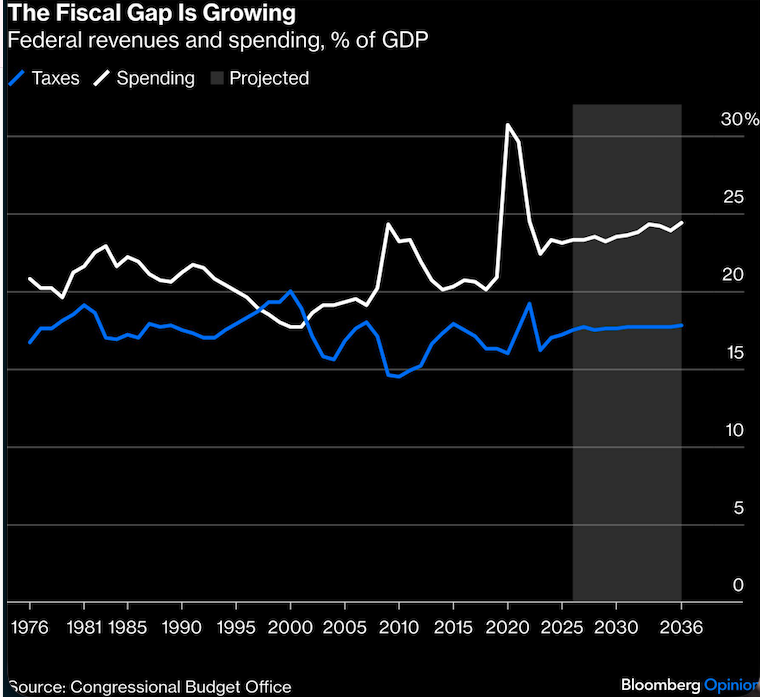
Less than two months ago, projections showed the US government on track to borrow some $2 trillion this year with budget deficits exceeding 5% of gross domestic product indefinitely. Since then, this dire outlook has worsened — thanks to the Supreme Court’s ruling on tariffs, the war with Iran, the prospect of slowing economic growth and rising interest rates.
What, you might wonder, is Washington proposing to do in response? It’s debating how to cut taxes.
The latest proposals come from Senators Chris Van Hollen and Cory Booker. Both want to lower taxes for the poor and middle class while raising them for businesses and the rich. Van Hollen’s plan would be broadly revenue-neutral, with cuts of $1.5 trillion over a decade roughly offset by surtaxes on very high incomes. Booker’s would cost about $5 trillion (not counting as-yet-unspecified increases in corporate taxes). Neither gives a moment’s thought to the need for substantially more revenue.
Van Hollen calls for a new “alternative maximum tax”: Qualifying taxpayers would pay no more than 25.5% of their income above a “cost of living exemption” set at $92,000 for married couples. This would raise after-tax pay in the middle of the income distribution by roughly 3%. (The poorest pay no tax as is, so they wouldn’t see any benefit.) To make up the shortfall, there’d be a surtax of 5% on incomes above $1.5 million, 10% above $3 million and 12% above $7.5 million. The resulting top rate of 49% would be a lot higher than its average European counterpart, though it would apply to a much narrower base.
Booker’s plan would more than double the standard deduction (to $75,000 from $32,200 for joint filers) while substantially increasing the child tax credit and earned income tax credit. This yields much bigger gains, of 5% or more, in after-tax income for all but the top quintile. But its tax hike for the richest (increasing the 35% rate to 41%, and the top rate of 37% to 43%) wouldn’t come close to covering the cost.
The US tax code badly needs reform, and Booker’s higher standard deduction does address one of its biggest failures: its infuriating, self-defeating complexity. But any such reform needs first and foremost to close the gap between government spending and revenue. Neither plan even attempts this — and Booker’s proposal makes things worse.
Fairness in taxation is crucial, but the US income tax is already progressive by global standards. To raise revenue without crushing the incentives to work and invest, broadening the base will therefore be essential. Reformers should focus on simplification — eliminating the code’s countless exemptions and preferences (including, not least, the treatment of capital gains at death) so receipts can be raised without increasing marginal rates any more than strictly necessary.
Both senators are right about one thing: A vigorous debate over taxes is urgently needed. But they and Congress as a whole must grasp that more revenue, alongside greater spending discipline, is paramount. Ignoring this fact won’t make it go away.
A message from Advisor Perspectives and VettaFi: Discover something new! Click here to register for our upcoming webcasts.
Bloomberg News provided this article. For more articles like this please visit
bloomberg.com.