Budget airlines are going broke. Spirit Airlines may go under or get a government bailout, and JetBlue is just barely avoiding bankruptcy this year. It didn’t need to be this way. They tried to merge in 2024, but the merger was blocked because President Joe Biden’s administration was concerned that greater consolidation would lead to higher prices.
Perhaps the merger would not have saved Spirit Aviation Holdings Inc. or JetBlue Airways Corp., but it would have given them a better shot. And it points to a misconception about the use of antitrust law to protect competition: Yes, more competition can lower prices. But in today’s economy, so can the ability to scale.
This poses a problem for politicians who want to improve affordability, which is just about all of them. If they care about the consumer — and again, just about all of them say they do — then the enemy used to be corporate power. Now it may be part of the solution.
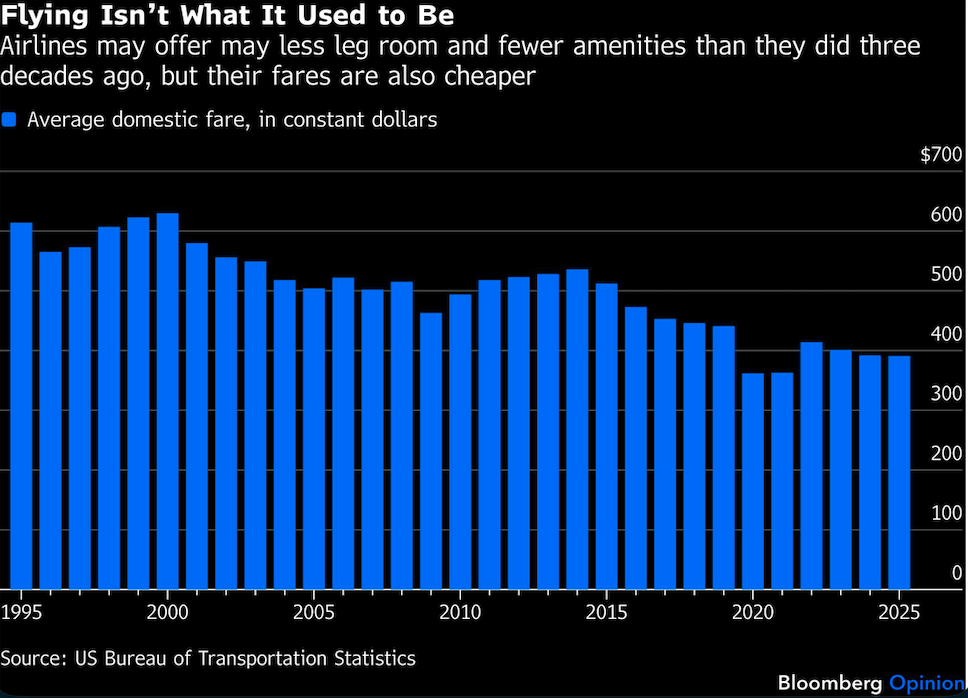
The airline industry is an interesting case study. There was a time when flying was a luxury only a few could afford. In the last several decades — with airline deregulation, advances in technology, and rising wealth and living standards — air travel has become much cheaper and more accessible.

That’s one reason the debate over the “affordability crisis” often includes references to airfares. But right now higher fuels costs are driving up prices, even as the ability to comparison shop means that pricing remains brutally competitive. The airline industry is a tough business, which is why airlines routinely file for bankruptcy — and why there is also scope to merge, not only for more market power but also to generate economies of scale. In fact, as my Bloomberg Opinion colleague Thomas Black suggests, maybe what the US market needs is one large low-cost airline.
Airlines are an extreme example of competition and pricing. The pressure to reduce prices, or just keep them from rising, has politicians of all persuasions scrambling for affordability solutions. The obvious villain is whoever sets the prices, especially if they have lots of market power. And many companies today have more power than ever. The economy is now dominated by big companies: Rather than heading out to the local hardware store, people might go to Home Depot or Walmart instead, or just order from Amazon.
Some economists have found evidence that companies with more market power have bigger markups on their products. But big companies also often charge lower prices overall because they have lower marginal costs to begin with. In a more global, technology-driven economy, the returns to scale are larger, which makes it harder for smaller companies to compete on price. Some of the deflationary pressure on prices in the 2010s was the effect of Amazon and other large online retailers.
Government investment in the private companies, as the Trump administration did with Intel and is considering with Spirit Airlines, is not the way to promote competition and affordability. Meanwhile, some Democrats are hoping antitrust enforcement — going after the big companies so many people have become so dependent on — is the key to making the economy more affordable.
If lack of competition were driving up prices, that might be the right approach. But higher prices today are not the result of market power. The more likely culprits are vulnerable supply chains, higher input costs, intrusive regulation and market fragmentation. These are all problems bigger companies can better manage.
Competition is still vital to the economy, of course. Big companies that face no competition can use their power to overcharge their customers, and they are at risk of becoming less innovative and wasteful. There is an undeniable tension in the economy between allowing scale and promoting competition. At least in the airline industry, a little more scale for budget carriers, and a little less competition, may have been just what consumers needed.
A message from Advisor Perspectives and VettaFi: Discover something new! Click here to register for our upcoming webcasts.
Bloomberg News provided this article. For more articles like this please visit
bloomberg.com.
Read more articles by Allison Schrager