If you want a blueprint for how countries can survive this era of great power rivalry, look no further than Vietnam.
A focus on economic growth and a determination to avoid dependence on any single power has transformed it into one of Asia’s most successful states. Hanoi offers a model for how nations straddling the line between the US and China can thrive even during uncertainty.
President To Lam is driving this agenda. He effectively became the communist regime’s strongman when he secured the role of president and head of state last month, a predictable outcome in the one-party state. Lam’s ascension has drawn parallels with China’s Xi Jinping because of the unusual concentration of power in one leader.
Hanoi has lessons to share, as we’ll hear when Lam delivers the keynote address at the Shangri-La Dialogue in Singapore on Friday. In the audience at Asia’s premier security forum will be US Defense Secretary Pete Hegseth, along with other ministers, generals and officials from a region worried about American unpredictability, China’s growing military might, and whether middle powers will have to do more to protect themselves from both.
I’ve argued that countries in the Indo-Pacific need to form closer security ties, the way that Japan and the Philippines have this week. This is sensible policy — there is strength in numbers. Vietnam’s strategy is unique in that it has built close links with the superpowers, but isn’t beholden to them. It has managed to do this by avoiding formal alliances, foreign military bases and alignment with any single bloc. The key difference now is how actively it’s pursuing ties with other nations.
This gives Lam greater room to achieve his ambitious economic goals. But to grow at least 10% annually over the next five years — significantly higher than regional peers such as Indonesia, Malaysia and Thailand — and to obtain its objective of developed country or high-income status by 2045, Hanoi needs a stable global environment. Last year, the export-dependent economy grew 8.02%, despite US tariff pressure. The White House initially threatened Vietnamese exports with a 46% tariff, before lowering them to 20%.
Lam has devoted significant political capital to cultivating ties with President Donald Trump. He’s upgraded the traditional “bamboo diplomacy” Hanoi has practiced for decades to manage relations with both the US and China — two countries it has fought wars with. Few nations understand the dangers of dependence on great powers better than Vietnam, which has spent centuries resisting domination by larger states while still finding ways to benefit from them economically.
That means creating a wide web of partners, notes Do Khuong Manh Linh, a researcher with the Ho Chi Minh National Academy of Politics. Lam’s diplomatic push in recent months reflects that. Besides Trump and Xi, he’s met with an enviable group of middle powers, including South Korea’s President Lee Jae-myung, Japan’s Prime Minister Sanae Takaichi, and India’s leader Narendra Modi. This week alone, he’s met Thailand’s Anutin Charnvirakul and is due to see the leaders of Singapore and the Philippines.
So far, the strategy seems to be working. According to the Lowy Institute’s 2025 Asia Power Index, Vietnam recorded the second-largest increase in overall influence in the region. It now ranks seventh in Asia for economic relationships, reflecting its growing integration into regional supply chains and expanding diplomatic reach.
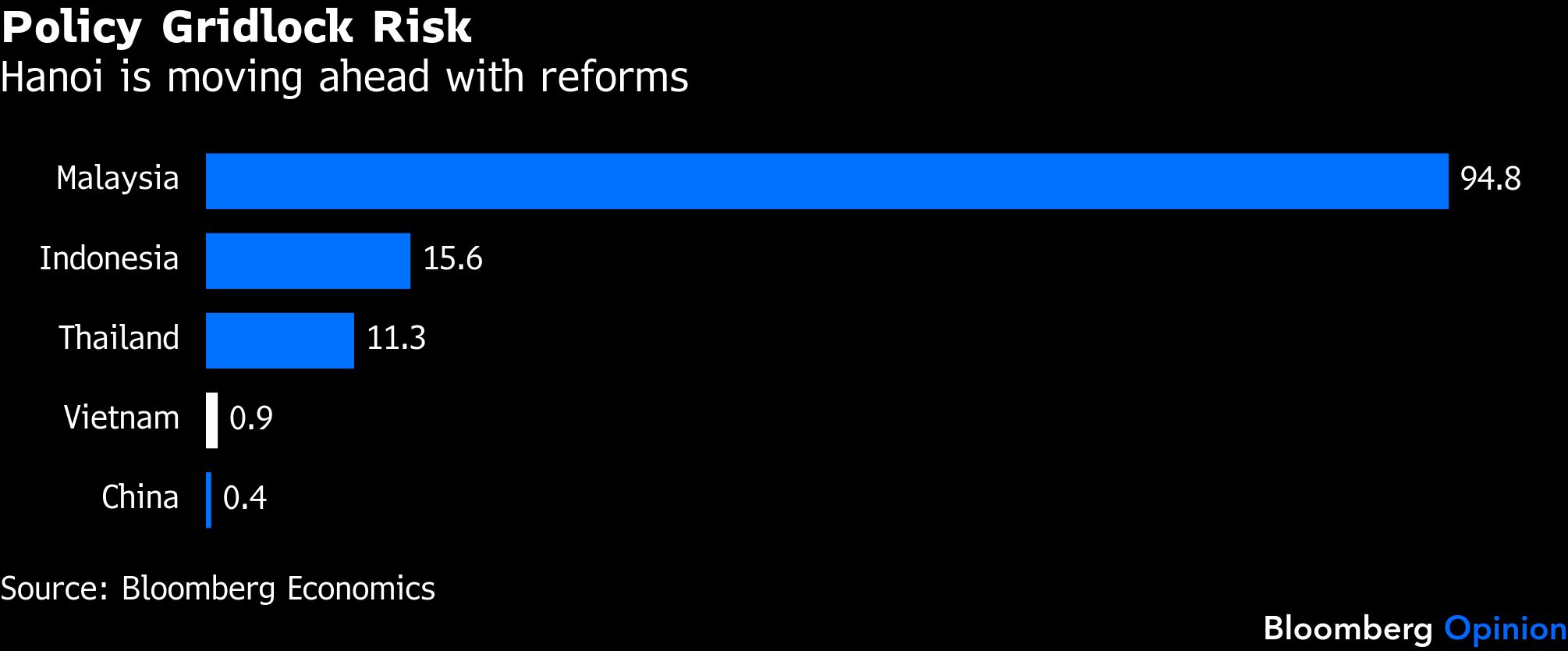
Other countries could learn from this. Lam is pushing through major administrative reforms aimed at speeding up decision-making and cutting bureaucracy. Plans include reducing the number of provinces and municipalities by almost half and restructuring ministries and agencies to make the system more efficient. That’s helped by one of the lowest risks of policy gridlock among emerging markets, second only to China, notes Bloomberg Economics, aided in no small part by the convenience of being a one-party state, where rules can be implemented and executed without pesky democratic wrangling.

These successes do not mean Vietnam’s model is risk-free. Higher fuel prices from the US-Israel war with Iran could derail Lam’s growth targets. Globalization is retreating and the rules-based international order is giving way to tariffs, industrial policy and economic blocs. Trump could still choose to enforce stricter punishment for his complaint that large numbers of Chinese goods are simply transiting through the country, escaping American tariffs. In that environment, Hanoi will have less room to maneuver.
Dangers could come from the relationship with Beijing, too. Despite warm public meetings between Lam and Xi, tensions remain over competing claims in the South China Sea, particularly around the Paracel and Spratly Islands. China claims most of the waterway through a disputed nine-dash line, based on a 1947 map that Beijing claims legitimizes its ownership. Vietnam says its stake dates back centuries.
A crisis over Taiwan or the South China Sea could eventually force Hanoi closer to one side. If Trump decided to impose more tariffs, that could also push Vietnam to diversify away from American markets faster than it want. The economy remains deeply connected to both superpowers in different ways — the US is a crucial export market, while China is a vital source of industrial inputs.
Still, Hanoi’s path reflects a broader shift underway in Asia, where countries are building their own networks to hedge against both Washington and Beijing. Vietnam may simply be further ahead.
A message from Advisor Perspectives and VettaFi: Discover something new! Click here to register for our upcoming webcasts.
Bloomberg News provided this article. For more articles like this please visit
bloomberg.com.
Read more articles by Karishma Vaswani