Artificial intelligence operates at speeds and levels of complexity that its human creators can’t match. So what happens when it’s unleashed on financial markets?
Nobody really knows. That needn’t be as scary as it sounds.
Automated, high-speed trading has long dominated markets such as stocks, futures and foreign exchange, and has at times generated or amplified accidents, such as the 2010 “flash crash” that sent major US equity indices plunging more than 5% in a matter of minutes.
AI will add a new dimension: Instead of following hard rules created and interpretable by humans, it will decide on its own how to pursue its designated objectives — by trial and error in the case of “Q-learning,” or by employing billions of parameters gleaned from training data in the case of large language models.
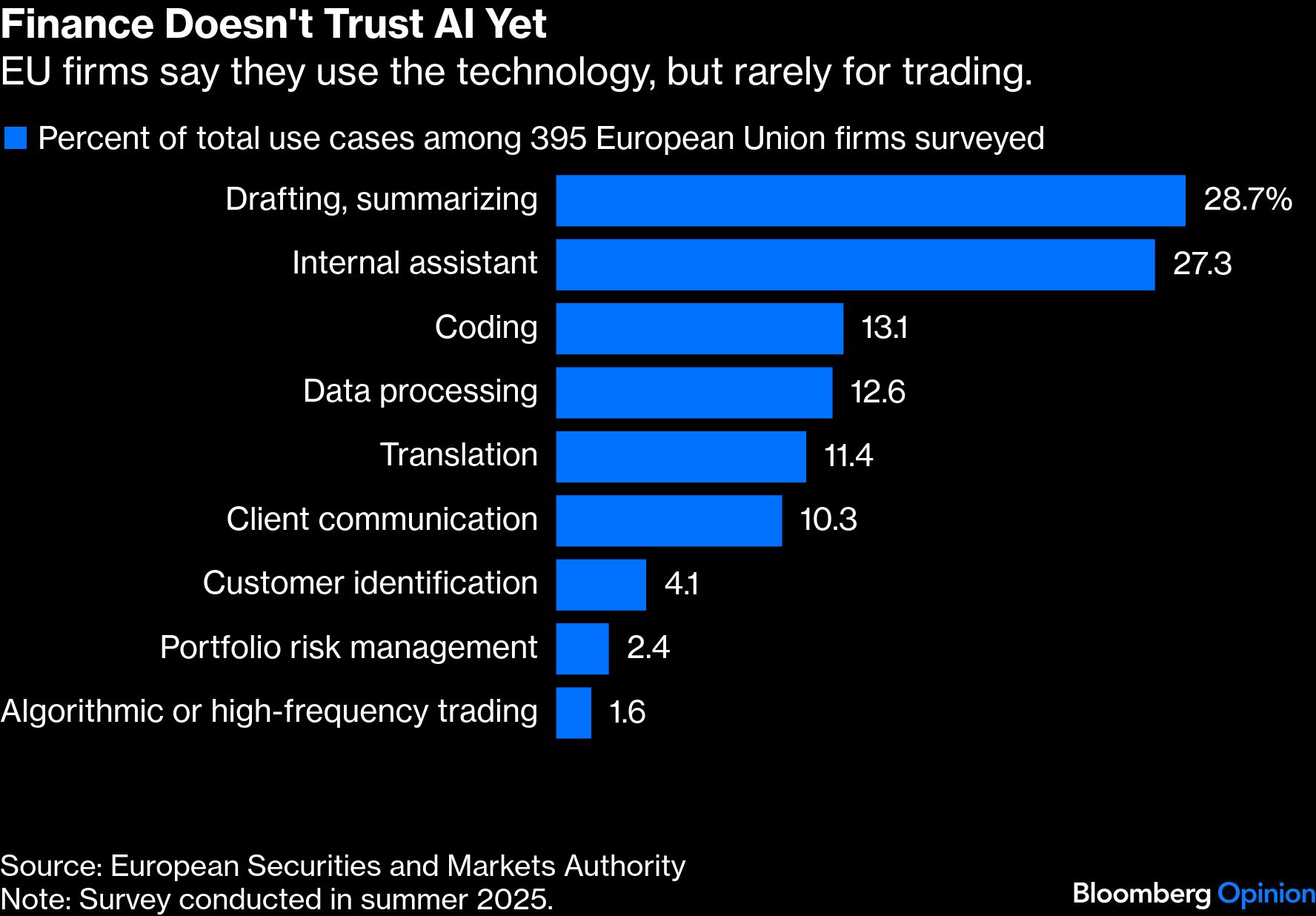
How that plays out is still anyone’s guess. Although major financial firms do employ AI to some extent, they’ve so far been reasonably hesitant to let it loose (as a Bank of England survey recently put it, “the potential risks … exceeded the potential gains”). Retail traders, for their part, can build their own and might be more adventurous, though their aggregate impact remains to be seen.
What’s known is that AI agents won’t act quite like humans. Some early research suggests they’ll be capable of colluding in ways that could be hard to detect, and of manipulating markets in ways that could threaten financial stability. Other research indicates they might act more rationally, which could actually make markets more efficient and reduce the risk of dangerous bubbles.
How, then, might authorities nudge developments in a desirable direction?
First, use AI. Unlike humans, AI agents can be made to participate in limitless market simulations, which can offer valuable insights into their probable real-world behavior. The Bank for International Settlements, for example, has already launched a project with European central banks to that end.
Next, transparency will be essential. Regulators should require enough information on AI agents’ objectives, testing and trading limits to demonstrate that they’re acting responsibly, and encourage the use of models that are better at explaining their actions. Meanwhile, and most likely with the help of AI, they should develop systems to monitor markets in real time for danger signs.
Similarly, automatic circuit breakers, such as those adopted after the flash crash, can provide humans with much-needed time to step in should AI-driven trading get out of hand. Regulators should consider requiring that certain guardrails be encoded into the models, to prevent trouble from arising in the first place.
They should also insist on resilience. Excessive borrowing, or leverage, makes markets fragile — and investors of all kinds have lately been borrowing a lot. Prudent limits would reduce AI agents’ capacity to build up dangerous positions and enhance the whole financial system’s ability to survive any accidents.Finally, officials need to tread carefully. Unduly severe constraints could hinder desirable growth and innovation. The technology is here to stay, evolving fast and achieving feats once thought impossible. The challenge is to get the best out of it.