Historical Asset Class Sensitivity to Inflation Shocks
In last quarter’s Inflation Update, we discussedthe reasons for pursuing a multi-asset class approach to hedging inflation, namely to provide diversification across both rising growth and falling growth inflationary environments and to achieve desired portfolio volatility by combining high volatility and low volatility asset classes.See [http://northpeakam.com/research/] to download a copy for review.
This quarter we would like to dig deeper into the historical performance of various asset classes in differing inflationary environments.We believe that markets tend to be predictive in nature,responding to deviations from expectations (i.e. 'shocks').Thus, the response of asset classes tochangesin inflation tendsto be more informativethanthe response to thelevelof inflation.
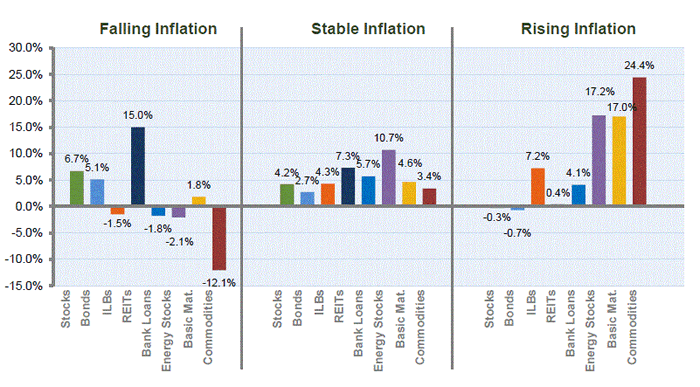
The bar chart above displays historical real returns in excess of3-Month T-Bill returns in three different inflationary environments for stocks, (nominal) bonds,inflation-linked bonds (ILBs), REITs, bank loans, energy stocks, basic materials stocks, and commodities.The left panel corresponds to falling inflationary environments, months where year-over-year inflation decreased by more than 0.20% .The center panel corresponds to stable inflation, months where year-over-year inflation changed by no more than 0.20%.The right panel corresponds to rising inflationary environments, months where year-over-year inflation increasedby more than 0.20%.Roughly, the left and right panels each account for about one quarter of the months from January 1974 to March 2013, while the center panel accounts for about half of the months.
We see that all of the asset classes have historically experienced positive excess returns in stable inflation environments.Stocks and nominal bonds have done better during falling inflation than during rising inflation.The asset classes that have historically been the best hedges against rising inflation are inflation-linked bonds, bankloans, natural resource stocks like energy and basic materials stocks, and commodities. As a result, we attempt to utilize these asset classes in our Inflation Hedges Strategy mutual fund.
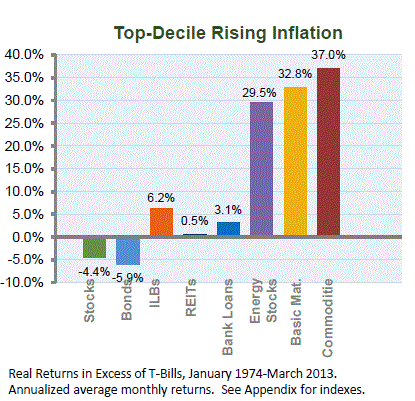
One final aside: as one might imagine, we try to read all sorts of inflation-related research, everything from monetary policy, to inflation-sensitive asset classes, to hyperinflation.We happened to notice a link at the Shadow Stats website [http://www.shadowstats.com] to their Hyperinflation Update Special Report, which we understand will be updated again soon.That got us thinking.While we didn’t see hyperinflation in the US during the Jan. 1974 to Mar. 2013 time period, we were curious as to what were the best performing asset classes during the top-decilerising inflation months thatwe did see during this period.
The average excess returns during those top-decile inflation months are shown in the chart above.By comparing this chart to the one on the previous page, we see that the best performers in these extreme rising inflation months were natural resource stocks and commodities.Mainstream stocks and nominal bonds performed even worse than in the normal rising inflation months.It’s also interesting to note that the increase in inflation during the top-decile months was a relatively modest 0.47% per month, suggesting that even slight increases in monthly inflation can have an outsized effect on the traditional asset classes that comprise the bulk of most portfolios:mainstream stocks and bonds.
Conclusion
As the above analyses demonstrate,historically the larger the increase inmonthly inflation, the worse mainstream stocks and nominal bonds perform.
© North Peak Asset Management
