It’s that time of year again when resolutions are supposed to be made. Typically this is a January 1st task as we face a new year and everything starts over again.
Resolutions are easy to make. Ask yourself what you need to change. Something will spring into your mind. It may be to save more, or to spend less or perhaps lose weight, or exercise more. Likely it will reflect the last problem you encountered or the last issue you discussed with friends. Behavioral studies show that the first thought on a subject often reflects recent exposure.
Financial market predictions are cut from the same cloth. And this is the time for all the market gurus to fill the airways with their latest round of predictions. Believe me I have trouble just wading through my emails at this time of year with all the predictions contained therein. Everyone wants to tell you their prediction of where the market is going to be next year, what the economy is going to do, and what will be the next hot stock.
Just as resolutions tend to reflect the recent past, so too do predictions. In years following a big market run-up, it’s my experience that most of the predictions are for more to come. In years after the market has tanked, most financial soothsayers foresee more gloom and doom. And you know, sometimes they are right… but often they are wrong.
Of course, it is the same with resolutions. Sometimes we carry through…but more often we don’t.
Why is that?
With resolutions, one reason often given is a lack of self-discipline. Many of us are always willing to blame ourselves. We probably shouldn’t be so hard on ourselves. Consider how the resolution originated. You made the resolution pretty easily. Something so easy to conjure up is probably not something that your mind really feels a high priority to apply precious self-discipline to complete.
So it is too with predictions. To stare into the future does not take a great deal of effort, and if you are just calling for an extension of the prevailing trend, not much effort is expended. And with predictions, no self-discipline needs to be expended going forward, anyway. I swear, most of the time these guesses are forgotten before the ink dries on the paper they are printed on.
Of course, self-discipline is important in trading the financial markets, predictable or not. But few investors really have the time, experience and inclination to apply self-discipline to their trading. And that’s where system trading comes in – a disciplined, computer-based trading strategy carried out by others who are motivated to follow the rules that research suggests have the highest probability for success.
But back on topic, if a lack of self-discipline is a) not the cause of a failure to keep the resolution, b) replaceable by a “system,” or c) not applicable to predictions anyway because once they are made the guru has no control over whether they come to pass, what is the reason most resolutions and predictions fail?
“Uncertainty.” This simple answer would have been no surprise to our ancestors. In ancient societies, whether agrarian or seafaring, the inhabitants were always at the mercy of the elements. There was very little they could do to insulate themselves from the weather, an illness, or simply what was beyond the never-visited horizon.
In today’s day and age, it’s different. We have tamed most of the old fears. We think in terms of probabilities. We try to keep the odds on the side of the choices that we make.
But we forget that probabilities have two sides. We say that an operation has a 75% chance of success, because that sounds better than saying there is a 25% chance you will not survive. Yes, one sounds better, but they are both true.
Probabilities cannot take all the risk out of life and certainly not out of the financial markets. As investors, in fact as humans, we consistently underweight uncertainty in planning for outcomes.
When you make a resolution, you can not anticipate all of the stresses, pressures, incidents, and events you will have to deal with in the future to keep that resolution. And when financial gurus make their predictions, there is no way that they can anticipate, either, all the surprises that will surface that the markets will have to absorb and respond to during the next year.
This is that time of year when newspapers and websites publish their lists of the most important stories of 2013. How many of these stories, whether on the front page or the business page, were predictable last year at this time? Maybe one or two, but, I’d wager, not most.
So what’s an investor to do? First, ignore the predictions. Second, use systematic investment strategies to supply the self-discipline and put the odds on your side.
Lastly, make sure that the systems you follow are not fragile or over-fit to a limited time period or asset class. They should be robust to deal with the future, rather than custom fit to represent the past.
Have you ever bought tight fitting clothes at the end of the summer or before the holidays? How’d that work out? Experience teaches it is often better to give yourself a little bit of room to deal with “change.”
So it is with your investment portfolio. Diversifying by assets and further by strategy is one way of gaining a little bit of room to deal with “change” in the financial markets. Using more than one set of tools, like adding active management and defensive tactics, instead of simply buying and holding, is another way.
Happy New Year!
All the best,
Jerry
P.S.
Speaking of the financial markets, this week marks the end of the most positive season for the stock market. It definitely has delivered a Santa Claus rally this year.
At the same time, the seasonal support tends to dry up in the first two weeks of the New Year and we often have a winter swoon during the last weeks of January. Some have even suggested that seasonal patterns in the second year of the election cycle tend to be sideways to negative now through September based on historical tendencies. Once again, however, those are just based on statistical probabilities.
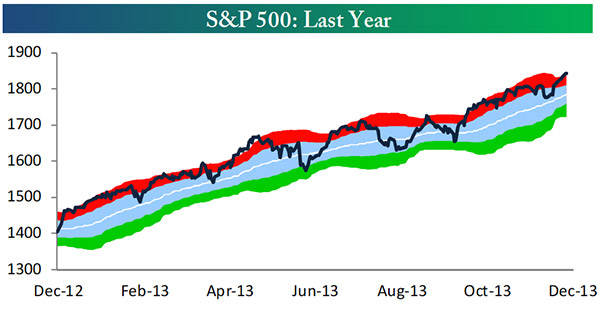
Similarly, when the markets go up sharply, as they have in 2013 at year’s end, the market is often called overbought. It’s gone up too far, too fast. That’s what the Bespoke chart below is indicating. We have moved into the red zone (Nerd Alert: up more than two standard deviations above the 50-day average price). In the past this has suggested a sideways to down market.
Source: Bespoke Investment Group
For those of you with more funds to commit to stocks, now is an especially good time to adopt actively managed strategies or those like FUSION that use such strategies, are reviewed monthly, and are deliberately configured to try best to deal with uncertainty.
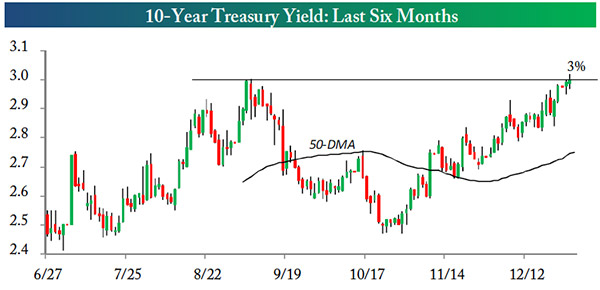
The rising interest rates lend further support to the argument that now is not the time for conventional strategies, as bonds provide no refuge when rates are moving higher.
Source: Bespoke Investment Group
While I am encouraged that economic indicators improved last week, and we continue to approach earnings reporting season, which has tended to provide support in recent years for the rally, history would suggest that there may be an increase in volatility in the near future.
Just as we have recommended sticking with this market rally all year, we also believe that investors need to be prepared for the worst. Strategic diversification with active strategies has been our answer. It lets us be invested when the market is rallying, while having a game plan for dealing with it when it is not.
From everyone here at Flexible Plan Investments, Ltd., our wish to you is for a safe, healthy, prosperous and Happy New Year! Thank you for your patience and trust. We work to live up to it daily.
© Flexible Plan Investments