Or better put, successful investing is hard.
So says author, speaker, and CIO Robert Seawright of Madison Avenue Securities in a recent series of “Investment Belief” columns on his award-winning blog, Above the Market.
And despite the last four-plus years of what has seemed to be a constant surge upwards for the equity markets, I doubt many reading this piece would disagree.
In one of the articles, Seawright makes a major point about the distractions of noise within the investing environment and what he terms “bias blindness.” This translates into a fatal flaw for many investors, as they are “blinded” either by external influences (crowd mentality) or their own closely held beliefs (personal bias) into making some ill-advised investment choices.
Seawright says:
Perhaps worst of all, because of our bias blindness, it is extremely difficult for us to see that there might be something wrong with our own analyses, perspectives and processes. Everybody else may be biased, but we remain convinced that we routinely come to a careful and objective conclusions for ourselves.
As the first quarter of 2014 draws to a positive close, certainly there have been several notable examples of “surprising” developments in the markets.
–Who would have thought that last year’s high-flying sectors of Internet stocks and biotechs would rapidly fall 10-15% below their peak prices of 2014, despite a generally higher overall market? According to Credit Suisse research, 24 of 2013’s top “momentum” stocks were off 19% as a group in March, losing $63 billion in market value (as of 3/28/14).
–While the consensus was strong that interest rates would creep up in 2014, even absent direct FOMC rate action, how many predicted that several long bond ETFs would be showing gains of close to 8%?
–Issues with the roll-out and economics of the Affordable Care Act were going to take down the health care sector, some analysts proclaimed early this year. While March was not favorable for the sector, it is still up about 4% on the year.
–The German DAX index was looking to be heading into correction territory, according to the experts, as uncertainty and risk concerning Russia’s Ukraine actions would supposedly hurt the export-heavy German economy. Since those predictions started to hit the business media, the DAX has rallied over 5%.
–And weren’t emerging markets about to fall off the investment map? The EEM is now down only 2% or so on the year and showing a dramatic technical reversal.
Seawright, and many other observers, including Warren Buffett, point out how such market “surprises” are routine and can often confound investors, professional and amateur alike.
Is it any wonder that research organization DALBAR, Inc. finds in its ongoing QAIB study that year after year, self-directed retail investors underperform broad market indices by about 50%? DALBAR’s president, Louis Harvey, has said, “Individual investors are brilliant at mistiming the markets.”
But Seawright takes this a step further in quoting author Simon Lack. Lack writes, “If all the money that’s ever been invested in hedge funds had been put in Treasury bills instead, the results would have been twice as good (when management fees are factored in).”
While not necessarily his intent, Seawright offers up a powerful rationale for the dynamic risk-managed investing approach of Flexible Plan Investments. At the core of FPI’s philosophy is the concept of taking emotion and market noise out of the equation, depending instead on highly sophisticated strategies and models. While no strategic approach is perfect, we think this makes a great deal more sense than trying to predict a largely unpredictable investment environment.
Turning to the markets last week, the major indices had a choppy week, with speculation on the future actions of global central banks fueling some of the volatility. By week’s end, the Dow was virtually unchanged and the SPX down 0.5%, but those hits to high-flying stocks took the NASDAQ Composite down a quite significant 2.8%.
Bespoke Research Group cautions that despite the generally healthy S&P 500 chart, investors should keep a watchful eye for turnarounds on the NASDAQ 100 and the Russell 2000 Indices, both of which broke below their 50-day moving averages last week. (Monday’s (today’s) bullish market action was beneficial for both of those charts.) On the other hand, Bespoke points out that the month of April has a strong seasonality bias working in its favor, and might be further aided by economic data that finally shakes off the effects of a brutal winter season. April has been by far the strongest month of the year for the DJIA over the last 50 and 20 years. Over both time periods, the Dow has averaged a gain of more than 2%.
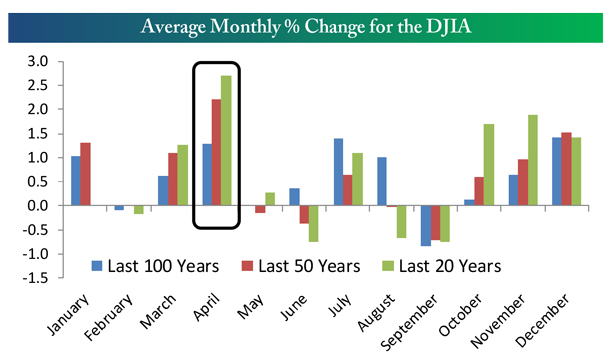
Source: Bespoke Investment Group
While it is encouraging to have market history on the side of the bulls for April, it is even better, I think, to have multiple strategy portfolios like Fusion on your side to help investors see their way through market uncertainty.
Have a great week.
David