Australia’s Terms of Trade: Implications For Credit Investors
Australia is contending with a multi-year decline in the terms of trade and a rebalancing toward the non-mining sectors of the economy.
For companies, the macroeconomic consequences of a downswing in the terms of trade provide both challenges and benefits.
For investors, it is important to find companies that have a clear, demonstrated understanding of the macro environment and can navigate the headwinds through operational efficiencies, cost control, market positioning and balance sheet management.
There has been ample analysis of the macroeconomic consequences of the terms-of-trade (ToT) shock that Australia has undergone as the resources investment boom has tapered. Australia now must contend with a multi year decline in the ToT and the required rebalancing towards the non-mining sectors of the economy as the country transitions from the investment phase to the export phase of the resource cycle. For investors, it is important to assess how these macroeconomic forces will affect the corporate sector in Australia and thereby identify which credits are better placed to navigate the challenges that lie ahead.
The ToT is the ratio of export prices to import prices, and it determines the purchasing power of domestic output. Typically, a rise in the ToT (i.e., a rise in export prices relative to import prices) represents an increase in purchasing power and national income that helps drive higher investment, consumption and, hence, domestic demand. On the flipside, a downswing in the ToT is generally associated with periods of falling national incomes, higher unemployment, constrained investment and lower consumption, resulting in below-average growth and inflation outcomes.
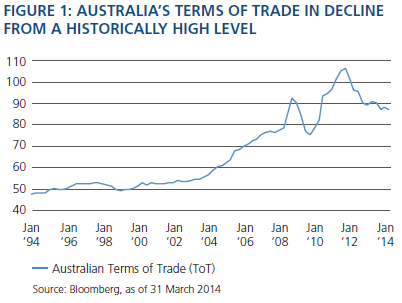
Figure 1 shows the extraordinary increase in Australia’s terms of trade as a result of the resources boom. However, since late 2011, the ToT has experienced a gradual decline which is set to continue as commodity prices moderate due to an increase in supply; the completion of mining-related projects comes at a time when China, Australia’s major trading partner, is set to adjust to a slower rate of growth.
 Â
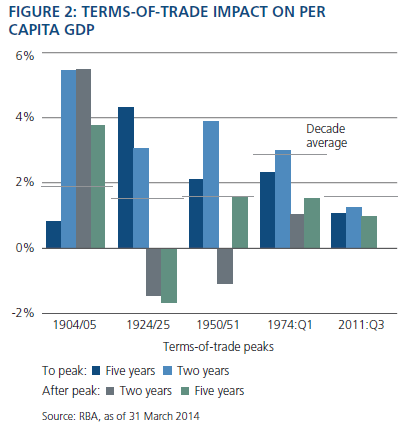
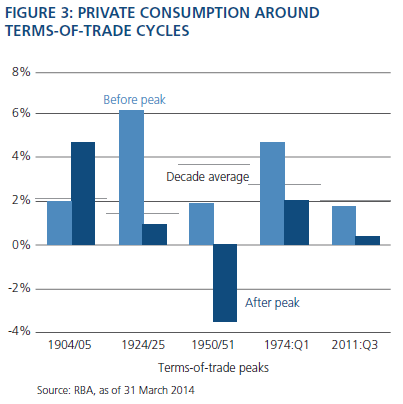
 Figures 2 and 3 show per-capita GDP and private consumption during ToT spikes in Australia’s history. With the exception of 1904-1905, there is a clear history of above-trend growth prior to the ToT peak followed by a period of sub-trend growth.
 Â
  Â
 Terms of trade from the corporate perspectiveÂ
For companies, the macroeconomic consequences of a downswing in terms of trade provide both challenges and benefits. The key for investors lies in identifying those firms that can best exploit the benefits and have the competitive stance to better withstand the challenges.
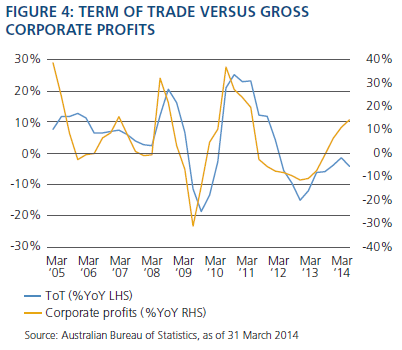
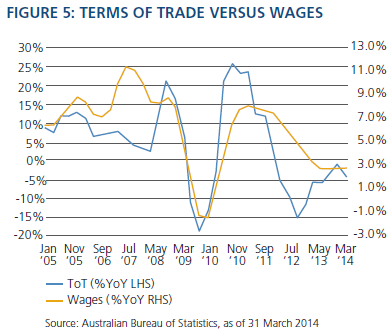
Simplistically, corporate profits are the difference between revenues (a function of output prices and volume) and costs (capital expenditure and wages). Clearly, the macro dynamics associated with a downswing in the terms of trade will weigh on revenue growth. In general, sub-trend domestic demand conditions will constrain volume growth and output prices. Figure 4 and Figure 5 demonstrate the relationship between changes in Australia’s ToT and gross corporate profit growth (led one quarter) as well as wage growth. Whilst a moderate ongoing decline in ToT in the coming quarters will constrain profit growth, there are some benefits that are often overlooked, which should help many Australian corporates maintain strong credit fundamentals and provide investors with a framework for sector and company selection.
 Â
 First, downswings in the terms of trade generally result in lower inflation. This will likely help contain wages, helping to maintain margins and cushion the fall in profit growth. Figure 5 shows that the most recent fall in ToT has kept wage growth at historically low levels.
 Â
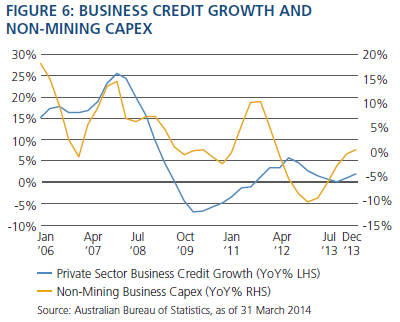
 The second important impact from a credit fundamentals perspective is that typically during the declining phase of a terms-of-trade cycle, business investment remains below-trend, ensuring that corporates keep leverage contained, and hence, credit fundamentals remain positive for investors. Figure 6 shows that both business credit growth and non-mining business investment remain historically low.
 Â
 Finally, as the benefit of the investment phase is realized, business productivity should begin to lift. The most recent report on productivity, from the first quarter of this year, offers some sign that productivity growth has stabilized and should start to improve.
In the current environment, currency appreciation is also a factor. Exogenous forces are keeping the Australian dollar more elevated than what fundamentals and the experience of prior terms-of-trade episodes would imply. As a result, the Reserve Bank of Australia (RBA) will likely have to lean more heavily on interest rates as a lever to help rebalance the economy. Indeed, in its recent communications, the RBA has gone to great lengths to reassure the public that stable monetary policy is just that: a stable cash rate over the cyclical horizon. This should help increase business confidence that interest costs will stay stable in an absolute sense.
Companies that optimize the mix of these offsetting dynamics and enhance productivity will be better able to withstand the headwinds to corporate profitability. Thus, in evaluating the Australian corporate landscape under the prevailing macro environment, we place great importance on identifying firms that possess these features:
- They hold oligopolistic or monopolistic positions that ensure greater pricing power and hence retain margins.
- They operate within their geographical footprints (whether domestically or internationally) on a competitive basis and are beneficiaries of supply and demand fundamentals.
- They focus on cost control, while improving efficiency, operational leverage and thus productivity.
Examining credit fundamentals
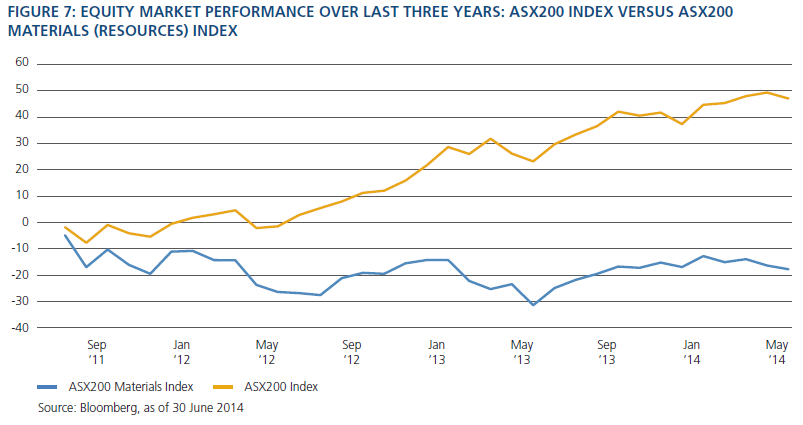
The end of the resources investment boom has not only affected Australia’s terms of trade, but also equity market performance over the last few years. Figure 7 shows the underperformance of the resource equity sector against the broader ASX200 Index.
When assessing potential investment opportunities we look for companies that show operational efficiencies and good cost control, and operate from strong market positions as they deal with economic headwinds. They should also have the benefit of offering bonds in multiple offshore currencies, which may provide better liquidity. (See the case studies for examples of what we would consider when assessing a company.)
 Â
 Accessing high quality Australian infrastructure assets which have monopolistic traits via publicly listed bond markets may be another potential source of attractive returns in Australia. PIMCO believes accessing these assets through liquid, publicly traded bond markets is a better option than the Australian private loan market, which can be illiquid. Transurban is an example of an issuer with such traits that has been an issuer in the local Australian domestic bond market and that last year completed its inaugural euro-denominated issue. Other monopolistic infrastructure assets that have also issued bonds in the global, publicly traded markets are Sydney Airport and Melbourne Airport (Australia Pacific Airports).
Demand strong for high quality Australian credit
Investor demand for high quality Australian credit has been astounding over the last year. The global backdrop of a slower growth outlook, allowing developed-market central banks to maintain lower interest rates, supports the continued high demand for quality, income-producing assets among global investors. Domestically, many investors are likely reacting to the drop in interest rates on bank term deposits by seeking higher-income assets, such as credit securities.
From the companies’ and banks’ perspectives, issuing into domestic and global bond markets has become a funding option of choice, given investors’ hunt for yield in the low-rate environment. Just recently, the newly formed Scentre Property Group (the restructured Westfield Retail Trust) was able to successfully issue €2 billion in bonds across several maturities, with reports of a staggering €5 billion in demand for the deal. It was the largest-ever European bond deal by an Australian company outside of banking and mining.
At PIMCO, our credit picks tend to be issuers in global funding markets that can provide offshore investors with diversification through high quality Australian credits. We draw on our network of credit portfolio managers and research analysts around the globe to select and gain exposure to high quality Australian credits.
In conclusion, the Australian economy is currently facing headwinds associated with a decline in the terms of trade. The challenge for credit investors is to find those companies that are able to navigate these headwinds competitively through superior operational efficiencies, cost control, strong market positioning and prudent balance sheet management. It is also important to find companies with a clear, demonstrated understanding of the macro environment in which their businesses are operating.
Somewhat mitigating the negative implications of a declining terms-of-trade environment is the current structural paradigm of lower interest rates globally, which has fueled demand for higher-yielding, high quality credit. The Australian corporate environment has proven to be supportive for these high quality credits and should continue to be, despite the macro headwinds.
Case study: Asciano (transportation)
Asciano Limited is a provider of essential transport services in the rail, ports and stevedoring industries in Australia, with a large component of its operations in the haulage of coal.
The end of the resources investment boom, coupled with slower global demand for commodities, particularly coal, created a challenging environment for the company.
Navigating a new landscape
The transportation of such bulk commodities in Australia is an industry that has relatively high barriers to entry. With its significant market positions and a strategy for taking long-term take-or-pay contracts in coal haulage, Asciano has greater pricing power which has helped it to retain margins.
Asciano’s response to the weaker resource demand environment was to increase the focus on cost control and operational efficiencies. For one initiative, the automation of terminals in Brisbane and the plans to automate Port Botany Sydney, the company expects to save an estimated A$50 million a year.
At the most recent quarterly operational update in March 2014, the company reported continued strong performance of its coal haulage division (volume of coal tonnes transported had increased 22% on March quarter 2013).
This case study is for illustrative purposes only and should not be considered investment advice or a recommendation.
Case Study: Brambles (commercial and professional services)
Brambles is an Australian company fully focused on pallet and container pooling services globally, with a unique business platform that relies heavily on its logistics and supply-chain operations – a model that competitors have not been able to replicate.
Brambles retains ownership of the pallets and containers, and the relationships with key retailers that have become totally reliant on the Brambles supply chain underpin the business.
In Australia, Brambles’ home market, the business has 80%-90% penetration, with its share of the pooled market (pooling of unit load equipment and associated services) being 75%-80%.
Even as Australian business investment remains below-trend, Brambles is considered a relatively defensive business, as the pallets and containers used across its supply chain primarily serve consumer staples customers. The financial profile of Brambles is also conservative: The balance sheet is geared conservatively for a credit rated within the triple-B range. (Brambles is currently rated BBB+ by Standard & Poor’s and Baa1 by Moody’s Investors Service.)
This case study is for illustrative purposes only and should not be considered investment advice or a recommendation.
Past performance is not a guarantee or a reliable indicator of future results. Investing in the bond market is subject to risks, including market, interest rate, issuer, credit, inflation risk, and liquidity risk. The value of most bonds and bond strategies are impacted by changes in interest rates. Bonds and bond strategies with longer durations tend to be more sensitive and volatile than those with shorter durations; bond prices generally fall as interest rates rise, and the current low interest rate environment increases this risk. Current reductions in bond counterparty capacity may contribute to decreased market liquidity and increased price volatility. Bond investments may be worth more or less than the original cost when redeemed. Corporate debt securities are subject to the risk of the issuer’s inability to meet principal and interest payments on the obligation and may also be subject to price volatility due to factors such as interest rate sensitivity, market perception of the creditworthiness of the issuer and general market liquidity. The credit quality of a particular security or group of securities does not ensure the stability or safety of the overall portfolio.
Â
Statements concerning financial market trends or portfolio strategies are based on current market conditions, which will fluctuate. There is no guarantee that these investment strategies will work under all market conditions or are suitable for all investors and each investor should evaluate their ability to invest for the long term, especially during periods of downturn in the market. References to specific securities and their issuers are not intended and should not be interpreted as recommendations to purchase, sell or hold such securities. PIMCO products and strategies may or may not include the securities referenced and, if such securities are included, no representation is being made that such securities will continue to be included. Investors should consult their investment professional prior to making an investment decision.
Â
This material contains the opinions of the authors but not necessarily those of PIMCO and such opinions are subject to change without notice. This material has been distributed for informational purposes only and should not be considered as investment advice or a recommendation of any particular security, strategy or investment product. Information contained herein has been obtained from sources believed to be reliable, but not guaranteed. No part of this material may be reproduced in any form, or referred to in any other publication, without express written permission. PIMCO and YOUR GLOBAL INVESTMENT AUTHORITY are trademarks or registered trademarks of Allianz Asset Management of America L.P. and Pacific Investment Management Company LLC, respectively, in the United States and throughout the world.
©2014, PIMCO.
© PIMCO
