The Emergence Of Divergence
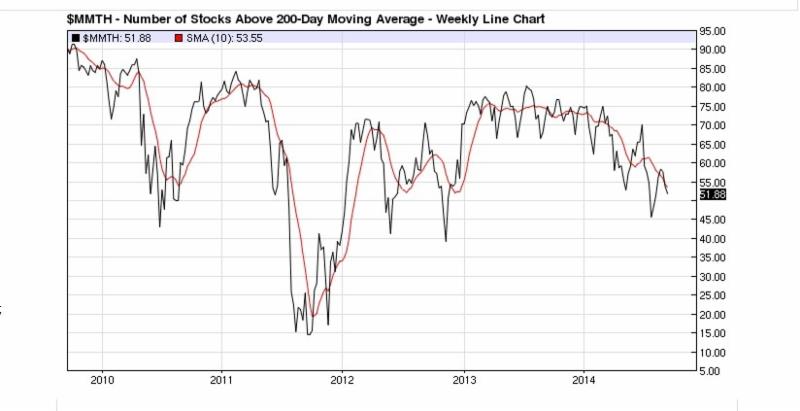
The word "divergence" has crept back into the market vocabulary lately, so let's take a closer look to see what all the fuss is about. The chart below shows the percentage of stocks above their 200-day moving average peaked in the summer of 2013 and has been rolling over ever since. After tagging the 80% line back in 2013, that percentage is now approaching just 50% of stocks. That clearly shows a divergence between the stock market recently hitting all-time highs and the average stock actually falling.
The Greatest Divergence Can Be Seen In Small Cap Stocks
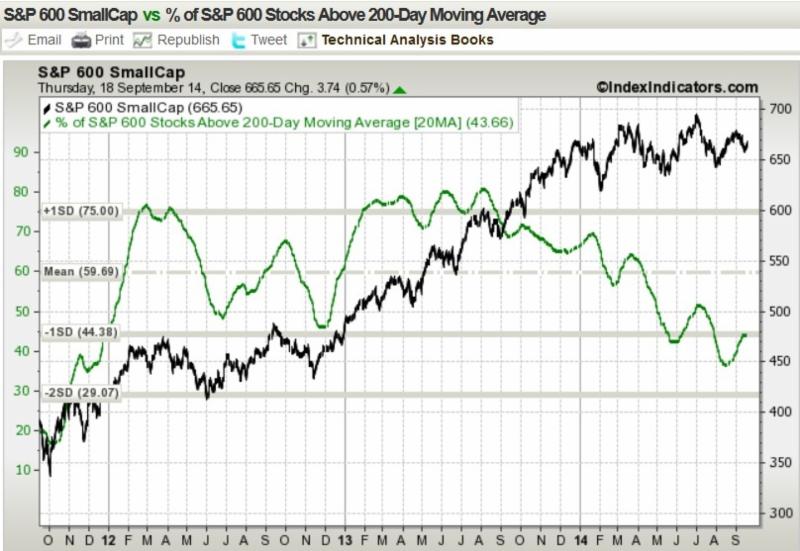
The chart below displays an even larger divergence. The black line is the S&P 600, with the index's % stocks above their 200-day moving average (green line). Same story of peaking in the summer of 2013 at around 80%, but is currently running just 45%. This is not showing market strength.
What Does It All Mean?
During raging bull markets, like the one we enjoyed from Spring 2009 until now, it's easy to forget just how fast the party can end. With only one semi-major correction (summer 2011) during that over 5-year run, complacency can easily find its way into our minds.
Then, out of blue-sky comes a wake-up call. Seemingly overnight, we are once again reminded that the markets don't always go straight up. In fact, a decent percentage of the time they actually fall.
We've been conditioned by Wall Street to believe that over the long haul, stocks do in fact go up. That is a undeniable fact. But when asked about the intermediate-term, we're told that there's no way of knowing which direction the market will go and that the best option is to just stay fully invested. We're told to just sit tight and "ride it out."
Using Tactical And Alternative Strategies May Help:
Like it or not, we're in a new investing environment that could be with us for years to come. The days of buy & hold, while effective during raging bull markets in stable environments, may not be dead, but they've taken a backseat to tactical strategies. While not built to "guarantee" you'll be able to dodge a bullet with your account, they do offer systematic, rules-based methodologies to avoid large drawdowns, while also being able to capture most of the upside in a bull market.
When markets start to roll over, we're not saying that tactical strategies can "know" that markets are going to continue to fall. However, by using a proper mix of strategic and tactical/alternative strategies, at least you'll have the peace of mind knowing that you have some downside risk protection for your account.
The performance results shown include the reinvestment of dividends and other earnings. Comparison of the Optimus Advisory Group Programs to any other indices is for illustrative purposes only and the volatility of the indices used for comparison may be materially different from the volatility of the Optimus Advisory Group Programs due to varying degrees of diversification and/or other factors. Different types of investments involve varying degrees of risk and there can be no assurance that any specific investment will be profitable. Optimus Advisory Group does not make any representation that the Optimus Advisory Group Programs will or are likely to achieve returns similar to those shown in the performance results in this presentation. Optimus Advisory Group reserves the right to trade different funds within their models.
Past performance may not be indicative of future results. Therefore, no current or prospective client should assume that future performance will be profitable, or equal to any corresponding historical index. The S&P 500 Composite Index (the "S&P") is a market capitalization-weighted index of 500 widely held stocks often used as a proxy for the stock market. Standard & Poor's chooses the member companies for the S&P based on market size, liquidity, and industry group representation. Included are the common stocks of industrial, financial, utility, and transportation companies. The historical performance results of the S&P (and those of all indices) do not reflect the deduction of transaction and custodial charges, nor the deduction of an investment management fee, the incurrence of which would have the effect of decreasing indicated historical performance results. The S&P is not an index into which an investor can directly invest. The historical S&P performance results (and those of all other indices and index funds used as proxies for indices) are provided exclusively for comparison purposes only, so as to provide general comparative information to assist an individual client or prospective client in determining whether the performance of the Optimus' portfolio meets, or continues to meet, his/her investment objective(s). It should not be assumed that any Optimus portfolio holdings will correspond directly to any such comparative index.
Different types of investments and/or investment strategies involve varying levels of risk, and there can be no assurance that any specific investment or investment strategy (including the investment strategies devised or undertaken by Optimus Advisory Group) will be profitable for a client's or prospective client's portfolio. All performance results have been compiled solely by Optimus Advisory Group and have not been independently verified.
The Optimus performance results do not reflect the impact of taxes.