Our firm is built around the core principle of always seeking to put the odds on the side of our clients’ investment success. And yet ...
Two weeks ago I was at my 50 th high school class reunion. I was sitting talking with some classmates of long ago. Suddenly, there was a hand on my shoulder. A firm squeeze and I swiveled around. There was Carl.
I had known Carl for about 60 years, ever since we met in the then-tiny city of Farmington, Michigan. We both had been uprooted from our birth homes, and moved from the city to the suburbs, leaving lifelong friends behind.
We struck it off immediately, as young boys often do, each feeding off the other’s love of baseball and music. He was a terrific catcher, who would spend hours catching my weird assortment of sidearm fastball, curve, and fork ball. He went on to great success on the high school team, I soon became a spectator.
Together we were in the school band. He was first chair saxophone. He could play most everything. I was a distant second chair trombonist. But we still had fun practicing together.
We were both college prep in high school, and were in all of the advanced math and science classes together. When high school ended, however, he pursued the hard sciences, I was pre-law. Our paths diverged.
At our 10-year high school reunion, I learned Carl had gone into dentistry. He became my dentist, of course.
Later, it became apparent that Dr. Carl Misch had become one of the pioneers in implant dentistry. With several books, many patents, and having taught implant science to legions of dentists worldwide, it was no wonder the American Dental Association had awarded him its 2014 Distinguished Service Award. You can read more about his career on Wikipedia.
Thirty-eight weeks before our 50th reunion, Carl was diagnosed with inoperable lymphoma of the brain.
He moved to Miami to be close to the clinic of doctors that specialized in the disease. He was told that despite all of their expertise the longest anyone had lived with his specific condition was ... 38 weeks.
As he stood there before me, Carl was doing what he always had done, exceeding all expectations. “I’m setting a record with each breath I take,” he shared. He looked great. He smiled a weary smile that somehow told of the ordeal he had been through without having to detail it.
We hugged and took the obligatory picture. We celebrated that night our past together, successes and difficulties (he claims I have the hardest jaw bone he ever encountered), and spoke of beating the odds.
For stock market bulls, the odds began to turn in August. After recovering from a near 20% slide in 2011, the stock market had moved steadily higher. In fact a new all-time high was registered by the S&P in mid- July.
Yet, internally the market was sending different signals. While a few large cap brand names were carrying the index higher, it was a different market environment for others. Most stocks were already down more than 20% from their high watermarks.
As 2015 began, I was warning that the odds favored a correction (defined as 10%-20% decline) this year. But the primary trend remained strong and despite the likelihood of such a correction, given three years with nothing more than 5% retracements, it did not appear.
But in August, the first signs that it was coming surfaced. Strategy after strategy of ours began first to move into defensive issues, then into ever-higher percentages of bonds and money market funds (cash) and, finally, inverse positions that profit from stock market declines were being taken.
As I related in earlier hotline messages, the probability of a period of falling prices just kept increasing. The biggest part of the ensuing decline occurred on August 24, but volatility has remained high ever since, and high volatility has high probability of leading to even lower stock prices to come.
Much of the decline has been placed on the Federal Reserve’s deliberations over raising interest rates. Supposedly, market bulls got what they wanted when the Fed refused to change rates a week ago last Thursday. Yet since that time, every major stock index in the world has retreated in value. Generally, only bond and gold investors show profits since that time. That’s not much of an endorsement of Fed policy.
While the US stock market indexes have fallen 2.36% to 5.04% post Fed, the average foreign exchange has suffered even greater losses—2.35% to 10.05% in one report. Other than precious metals, commodities have not been spared in the red reports, and individual S&P 500 sectors have all declined with the worst result being Health Care, which had fallen over 7%. All of this occurred in just a few days and does not count today’s (9/28) decline.
However, putting it in some, albeit, limited perspective, observers must note that the indexes, until today, were
actually up since the August 24th drop. But unfortunately the brief rally since then did not change the negative probabilities suggested by our strategy indicators.
I still believe that this is a correction, and that we will not hit the magic 20% decline level that the industry uses as the demarcation between a bull market and a bear market.
That, too, is based on probabilities. The odds only favor a bear market when a recession is on the horizon. Employment statistics, housing, manufacturing, service, and inflation data do not suggest that such an economic event is on our near-term horizon. While recessionary indicators often call for a recession when one does not ultimately occur, it is rare for a bear to occur without such a warning.
Instead, this looks like 2011, when we came within a fraction of a percent of a 20% decline in the S&P 500. The charts even resemble each other:
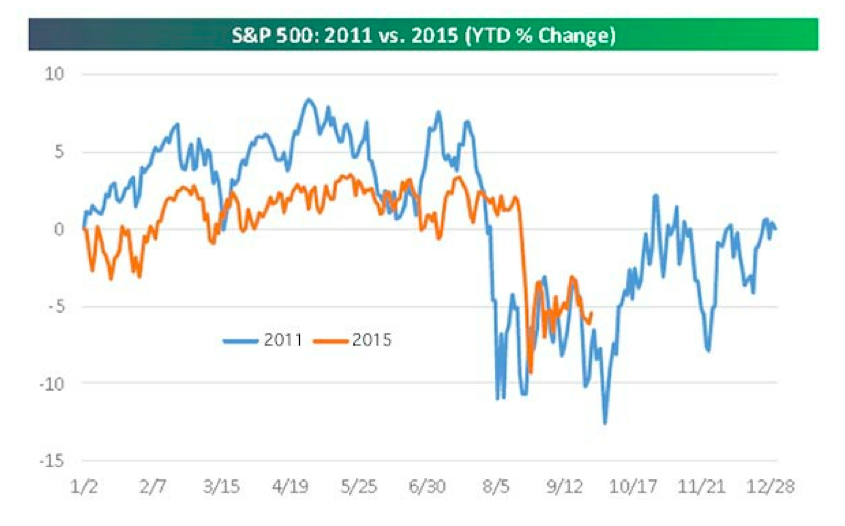
Source: Bespoke Investment Group
Still, most of our strategies have us already positioned to ride out a bear market if the declines exceed last October’s lows, which we expect to be the extent of this decline. But even though this has already been taken care of for you well before today’s secondary plunge, there are things you can do during this correction:
1) First and foremost, realize that you don’t have to do anything. With an active, dynamic, risk manager managing your account, we have already taken the steps to position you defensively.
2) Now is a good time to reevaluate your investment suitability profile. Retake the suitability questionnaire and see whether the recent volatility has caused you to have a fuller appreciation of the risk that you are comfortable taking. This is especially recommended if any of your financial circumstances have changed.
3) Use this opportunity to rebalance your account back to the original or new strategy allocation percentages. In a prolonged bull market like we have had, the appropriate percentages can get out of whack.
4) Consider adding mean reversion and/or gold strategies to your portfolio. These tend to do well in volatile and declining markets, and can help shelter you from the unexpected. Flexible Plan offers many of these strategies:
- Contrarian S&P Trading
- Gold Equities Trading
- Hedged Gold Bullion
- S&P Tactical Patterns
- Third Day Tactical Blend
- Third Day Tactical Blend Balanced
- TVA Gold
- Tri-vantage Leveraged/Unleveraged
5) Talk with our client service representatives and/or your financial advisor to discuss your account and any concerns you may have.
6) Finally, it is important not to abandon your strategies, which are already defensively positioned, just because of what is happening to buy-and-hold investors. Stick to the strategies, sooner or later stocks will be the place to be invested in again. Just as your active strategies moved most of you out of stocks, they are programmed to make the decision for you of when to return. Both decisions are required of investors, and Flexible Plan provides the discipline to take both of these actions automatically and unemotionally for you.
Most of us are able to take all of these steps without the added pressure of having to watch our portfolio values slip further away, as the buy-and-hold investors are experiencing. This is because our strategies are designed to play the odds rather than beat the odds.
The 50-year reunion is over. Carl has returned to Miami. He says he has a whole host of support in his battle – the doctors, his friends, colleagues from around the world, and his six children.
After almost 40 years of playing the odds to place them on my clients’ side in their investments, it is my hope and prayer that this time someone will beat the odds, and that that someone will be my dear friend Carl. God be with you, Carl.
All the best,
Jerry