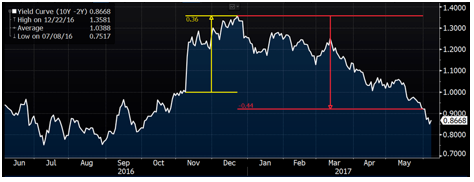
The outcome of the November 2016 Election reshaped expectations of economic growth, leading to an investor repositioning commonly referred to as “The Trump Trade”. Although US and Global Economic Indicators started to bottom out in the middle of 2016, positioning for an accelerating US economy really gathered momentum after the election. Expectations of a large fiscal stimulus, deregulation and infrastructure spending shifted prospects for economic growth into a higher gear, leading to a sharp steepening of the yield curve (10 year treasury yield – 2 year treasury yield) as shown in Figure 1 below.
Figure 1: Yield Curve

Source: Bloomberg
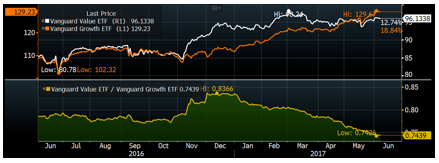
Further, it lead to substantial relative outperformance by economically sensitive sectors and by the Value component of the Equity market, as compared to Growth Equities (please see Figure 2).
Figure 2: Growth vs. Value
Source: Bloomberg
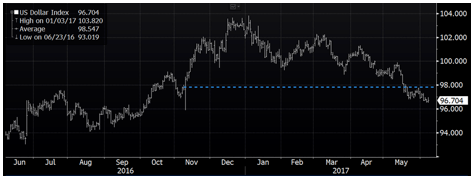
The uptick in economic optimism and prospects for US equities also spurred capital inflows leading to a sharp spike in the US dollar (Figure 3).
Figure 3: US Dollar Index
Source: Bloomberg
Ironically, “The Trump Trade” started to unwind right around the time of the Presidential Inauguration in January 2017. Increasingly, a perception started to take hold that the agenda of fiscal expansion through tax reforms, health care legislation, deregulation, and infrastructure spending would get delayed to 2018 at the very least if not abandoned altogether. As a result “The Trump Trade” was more than completely unwound by the end of May 2017. During this time frame, the yield curve ended flatter than it was at the time of the election. Value Equities, after giving up almost 600 bps of outperformance relative to Growth Equities, underperformed by another 640 bps. Even the Dollar has given up all of its gains since the election, as measured by the DXY US Dollar Index.
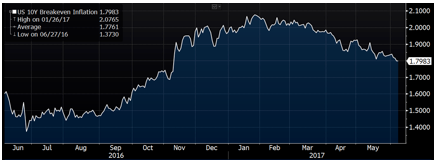
The reasons for this rapid reversal go well beyond disappointment with the pace of enactment of the fiscal and reform agendas. Economic surprises in the US have weakened, especially in the second quarter, even though they have stayed strong in Europe and China. Figure 4 shows how inflation expectations have also unwound, although not as dramatically as other indicators of “The Trump Trade”.
Figure 4: US 10 Year Breakeven Inflation
Source: Bloomberg
Perceptions of a reversion to the post-Financial Crisis environment of 2% GDP growth with tepid inflation have led to a crowding into secular, growers be it Technology stocks or Consumer Staples on the one hand and income plays such as Utilities on the other, leaving Materials, Industrials, Financials and of course, Energy far behind. Investor
expectations of any policy action are now so low that any movement in the fiscal or reform agenda is likely to be a positive surprise. We are only one legislative action away from a resumption of a pro-cyclical move. Additionally, softer inflation expectations and economic data are likely to put the Federal Reserve on a gentler glide path to monetary policy normalization. That would imply between one and two rate hikes this year, and slow if any movement in the direction of shrinking the Fed’s balance sheet. The weaker dollar also contributes to an easing of financial conditions, while simultaneously boosting domestic demand, and raises inflation expectations. In a self -correcting way, this sows the seeds for relative outperformance by cyclical and value sectors.
The improvement in inflation and growth dynamics in the Eurozone is also likely to lead to a curtailment of quantitative easing by the ECB later this year, causing German Bund yields to rise and putting more downward pressure on the Dollar. European sovereign yields have exerted a gravitational pull on US Treasury note yields. Any concomitant lifting of treasury yields and curve steepening is likely to alter the perceptions of investors, who have heretofore been looking at Treasury note yields to infer the underlying strength of the US economy, and have been positioning more defensively. Another major catalyst for a rebound in Treasury note yields and for curve steepening in the US, is the potential balance sheet reduction by the Federal Reserve from the current level of $4.5 trillion to closer to $2.5 trillion, as part of its goal of normalization of monetary policy. Going by the recent statements of Fed Governors Jerome Powell and Patrick Harker the process could commence as early as the end of 2017.
The sharp divergence in relative valuation of Value Equities vs Growth Equities this year compared with their historical relative valuation certainly argues for a tilt towards value. On the other hand, continued softness in economic data and the absence of progress on the fiscal agenda could exacerbate the crowding into secular growers especially in the tech sector, which is exposed to such fundamental shifts such as Cloud computing, AI and Machine Learning, Virtual Reality and Autonomous Mobility. These portions of the market are still not overvalued given their sustainable growth rates and the level of interest rates. Against this backdrop, we believe a barbell approach is warranted. Such an approach would simultaneously seek opportunities in cyclical sectors such as Industrials and Financials that would benefit from improved progress on the fiscal agenda and an economic uptick on the one hand, while looking for opportunities among secular growers that would continue to draw investor attention in the absence of fiscal progress or an economic acceleration.
SSI Investment Management Inc. believes all the information contained in the report to be accurate but we do not guarantee its accuracy. The analyst(s) principally responsible for the preparation of this research report certify that the views expressed in this research report accurately reflect his/her (their) personal views about the subject security (ies) or issuer(s) and that his/her (their) compensation was not, is not, or will not be directly or indirectly related to the specific recommendations or views contained in this research report. None of the information reported or opinions expressed constitute a solicitation of the purchase or sale of securities or any commodities.
© 2017 SSI Investment Management
Read more commentaries by SSI Investment Management