Some politicians were granted extra innings while others faced more political intrigue. While not the grueling battle between the LA Dodgers and Houston Astros in the World Series, the 19th National Party Congress still resulted in extra innings – for President Xi, who was granted a second five-year term. His legacy as one of the most powerful leaders since Mao was cemented as the party wrote his name into the constitution, a departure from the consensus approach to Chinese rule over the last three decades. Extended play also occurred in Japan, where voters delivered a two-thirds supermajority to the parliamentary coalition of incumbent Prime Minister Abe. In Europe, Spain was thrust into a political crisis as a legally contested independence referendum in Catalonia led to an abrupt crackdown by the Spanish government. Meanwhile, populist-leaning candidates won key elections in the Czech Republic and Austria. To cap off a busy political month, the latest turn in the U.S. political saga featured criminal charges for two campaign advisors to President Donald Trump, including his former campaign manager. The indictments came days before Trump and Congress members advanced plans for a large-scale tax overhaul.
A solid fundamental backdrop provided room for a “dovish taper.”U.S. growth measures came in ahead of expectations for the third quarter despite two major hurricanes: The economy expanded at a 3.0% annualized pace, marking the fastest two consecutive quarters of growth since 2014. The eurozone also registered solid growth, expanding 0.6% in the same period. Flash releases for manufacturing PMIs (Purchasing Managers’ Indexes) in the eurozone reached near seven-year highs, supported by record hiring. The same survey measures in the U.S. also indicated a robust expansion in activity. Meanwhile, U.S. consumer and euro-area economic confidence rose to their highest levels in almost 17 years, and German businesses were more upbeat about future conditions than at any time since 2010. Against this backdrop, the ECB extended its quantitative easing (QE) program until at least September 2018, while cutting monthly asset purchases in half to €30 billion. President Draghi, however, struck a dovish note by emphasizing the continued reinvestment of proceeds and a commitment to keeping rates low beyond the end of QE. Meanwhile, the Fed reaffirmed the likelihood of a December rate hikein its September minutes.
Encouraging economic data helped push stock markets to new highs, though there were indications that the rally may be in extra innings as well. Global equities edged higher, led by Japan’s Nikkei Index soaring 8.1% to its highest level in over 20 years on Prime Minister Abe’s landslide victory in the general election. U.S. equity markets also set records with all three major indices registering all-time highs, in part due to a solid start to third-quarter earnings and optimism for passage of a tax reform bill. Most notably, technology stocks within the S&P 500 were up 7.8% for the month. Tax reform, coupled with a Fed that appeared on track for a December rate hike, sent rates higher across the yield curve and the dollar strengthened against most developed market peers for the second month in a row. Outside of the U.S., interest rates generally fell as the ECB unveiled a slightly more dovish tapering plan than expected. The euro fell on the announcement and had its worst performance since February, ending the month down 1.4%. Of note, crude oil prices rose above $60 per barrel to their highest level in two years on declining global inventories and a slowdown in U.S. production growth.
Going, Going … Gone
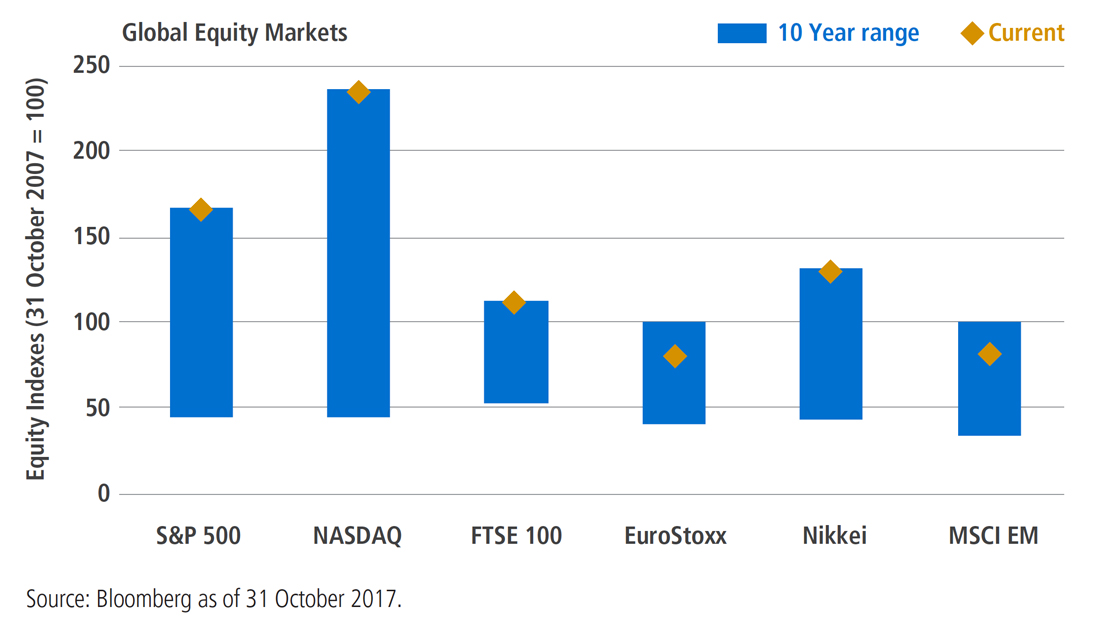
As headlines in recent weeks have well documented, a host of global equity indexes have reached record highs. Looking back over a 10-year horizon helps put into context the wide range of valuations since 2007 – and importantly, the fresh highs at which indexes in the U.S., UK, and Japan stand today. Low yields within developed markets have nudged investors out on the risk spectrum, driving up equity valuations, which by some measures appear stretched. For instance, large cap U.S. equities have a cyclically adjusted price-to-earnings (CAPE) ratio of 30.6, which is in the 97th percentile historically. While valuations are at the higher end of the historical range, robust risk appetite has been underpinned by strong corporate earnings, steady global growth, and a supportive policy mix.
In the markets
Backwardated Brent
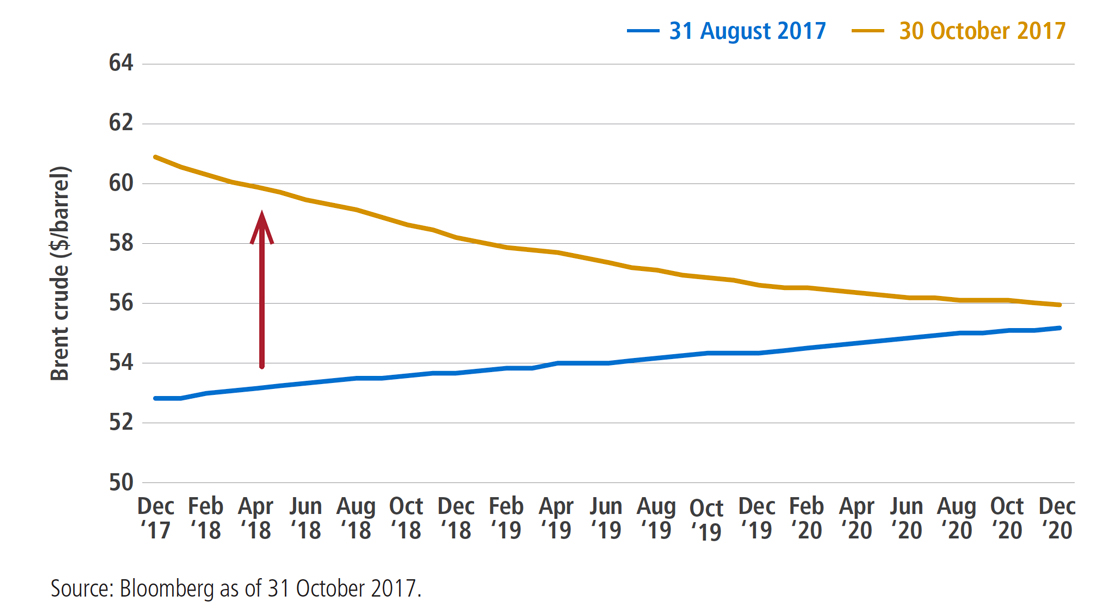
Brent crude oil prices recently topped $60 per barrel, a two-year high that led the oil forward curve to shift into backwardation. The opposite of a contango market, backwardation happens when the spot price is higher than prices for futures contracts. The downward sloping curve is in part a testament to the success of OPEC’s production quotas in reducing the inventory overhang and lifting current delivery prices. Talk of a possible extension of OPEC’s quotas beyond March has supported prices further. Importantly, the curve’s shift may have positive implications for investors, including enhanced roll yield opportunities – that is, the ability to generate returns by rolling a short-term contract into a longer-term contract.
EQUITIES
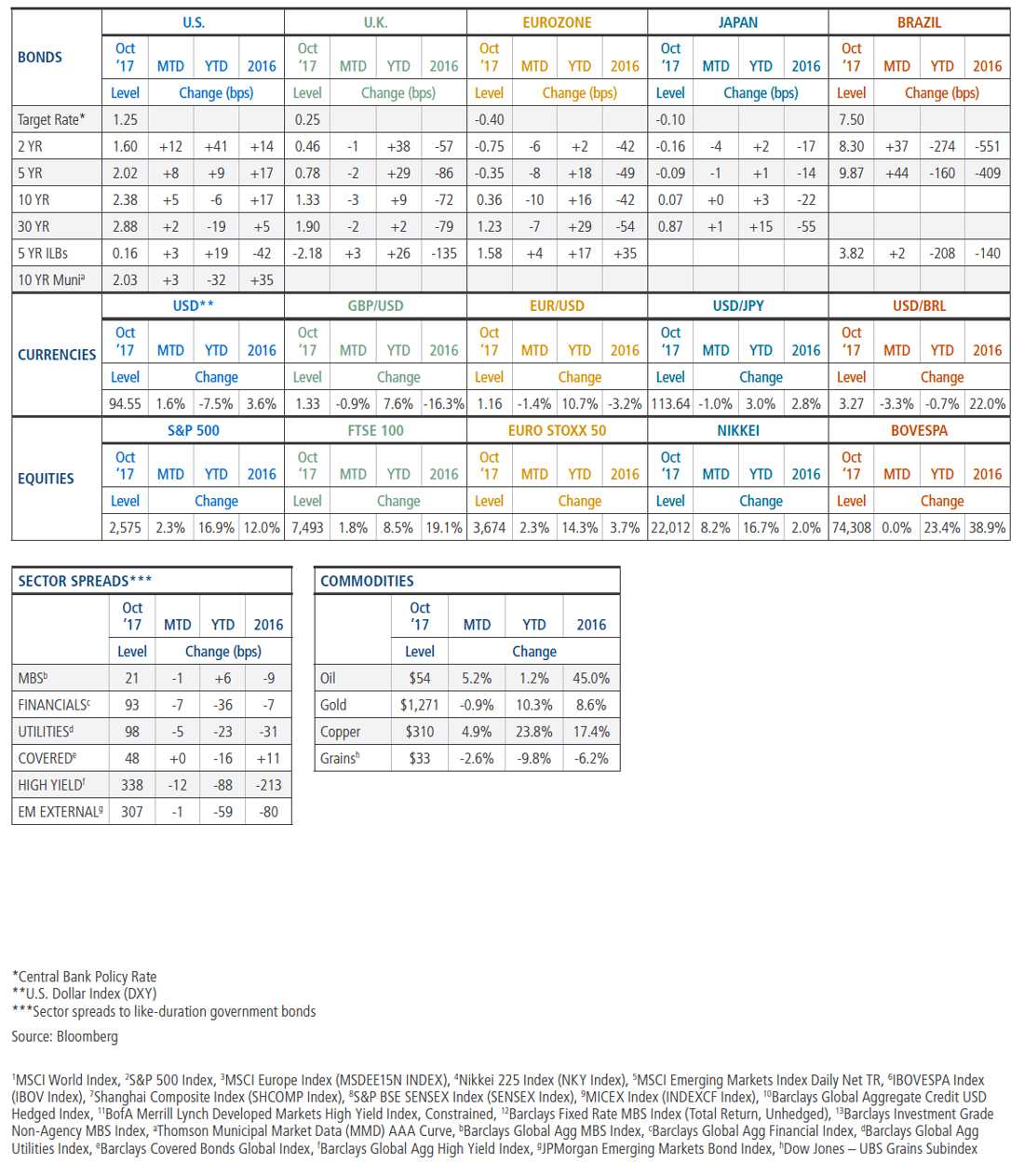
Generally strong fundamentals supported robust risk sentiment, and developed market stocks1 returned 1.9%. U.S. equities2 climbed to a fresh high, returning 2.3% amid a tech-fueled rally. European stocks3returned 2.0%, buoyed by strong economic growth, an improving labor market and positive sentiment. In the run-up to snap parliamentary elections, Japanese equities4 rose 8.1%; Prime Minister Shinzo Abe’s victory pointed toward the continuation of easy monetary policy.
In emerging markets,5 stocks benefitted from relatively stable global market conditions and a strong technical backdrop to return 3.5%. In Brazil,6 stocks ended the month flat after a split in President Michel Temer’s coalition government threatened to hamper his ability to pass growth-oriented reform. Chinese stocks7 made steady gains during the 19th National Communist Party Congress, returning 1.3%. Investors cheered both India’s multi-billion-dollar bank recapitalization plan and strong corporate earnings, and Indian stocks8 rallied 6.3%. Russian stocks9 fell 0.2% on weak corporate earnings.
DEVELOPED MARKET DEBT
Even as global central banks remained on a path toward less accommodative policy, interest rates generally fell outside the U.S. In the eurozone, the German 10-year bund rate ended the month 10 basis points (bps) lower at 0.36% despite the European Central Bank’s (ECB) announcement of a tapering in its quantitative easing (QE) program. The Bank of Canada left its policy rate unchanged, contributing to a 15 bps fall in the Canadian 10-year bond yield to 1.95%. Meanwhile, the growing prospect of tax reform in the U.S., along with the expectation of a Federal Reserve rate hike in December, helped push the U.S. 10-year bond yield 5 bps higher to end the month at 2.38%.
INFLATION-LINKED DEBT
Global inflation-linked bonds (ILBs) gained overall and outperformed comparable nominal bonds across most major markets. In the U.S., real yields rose with the yield curve flattening, fueled by the prospect for future tax cuts and uncertainty around who would replace Janet Yellen as Fed Chair when her term ends in February. Breakeven inflation (BEI) rates moved higher, supported by rising oil prices, which resulted from reports of lower inventories and expectations that producers will extend OPEC-led output cuts. In the UK, inflation expectations moved lower when the Retail Price Index (RPI) came in weaker than expected and the annual rate remained unchanged at a 5-year high of 3.9%. European linkers gained across countries, as the ECB announced it will reduce its monthly bond purchases but extended the program until the end of September.
CREDIT
Global investment grade credit spreads10 tightened 5 bps, outperforming like-duration global government bonds by 0.46%. Strong corporate earnings, as well as the rise in Treasury yields, drove the compression in spreads. Despite recent tight spreads, demand for global investment grade credit increased as investors continued to look for stable yield above that of global government bonds.
Despite a sell-off in government bonds, global high yield bonds11posted positive returns alongside the strong performance in equity markets and a sharp increase in oil prices. While global high yield bond yields increased by 6 bps to 4.8%, they did not keep pace with the rise in government rates, which kept spreads marginally lower. Total return for the broader global high yield universe was up 0.6% in October.
EMERGING MARKET DEBT
Local and external emerging market (EM) debt returns diverged again in October. Local currency debt posted negative returns as EM index yields followed developed-market yields higher and EM currencies weakened amid broad U.S. dollar strength. Turkish local rates meaningfully lagged the index while diplomatic tensions between the U.S. and Turkey escalated. External sovereign and corporate debt finished in positive territory as spread tightening more than offset the move higher in U.S. Treasury yields. Argentina was a notable outperformer on the external side: President Mauricio Macri’s Cambiemos coalition surpassed expectations in October’s legislative elections and S&P upgraded Argentina’s credit rating.
MORTGAGE-BACKED SECURITIES
Agency MBS12 returned –0.03% and outperformed like-duration Treasuries by 4 bps. The Fed began tapering its balance sheet in October, but additional demand from mortgage real estate investment trusts (REITs) helped offset this additional MBS supply. As interest rates increased, lower coupons outperformed higher coupons and 30-year MBS outperformed 15-year MBS, while Ginnie Mae MBS marginally underperformed conventional MBS. Gross MBS issuance was in line with September levels, while prepayment speeds decreased 10%. Non-agency MBS prices generally rose amid continued strength in the U.S. housing market. Non-agency commercial MBS13 returned 0.55% and outperformed like-duration Treasuries by 71 bps.
MUNICIPAL BONDS Municipals posted positive returns in October: The Bloomberg Barclays Municipal Bond Index returned 0.24%, bringing year-to-date returns to 4.92%. Muni rates were varied over the month: Long and intermediate maturities outperformed the front end and the yield curve flattened, similar to Treasury yields. Municipal bond mutual fund demand remained positive, with $500 million of inflows during the month, bringing year-to-date inflows to $10.5 billion. The U.S. Senate narrowly adopted a budget resolution in October, paving the way for tax reform, which remained top-of-mind for municipal investors. Also of note, Puerto Rico’s debt prices fell to new lows during the month as the island struggled to deal with the devastating impact of Hurricane Maria.
CURRENCIES
The U.S. dollar broadly outperformed both developed and emerging market (EM) currencies boosted by increasing optimism surrounding tax reform in the U.S. after Congress passed a budget resolution. Meanwhile, the British pound, which struggled for the first half of the month on political uncertainties, regained some ground in the wake of hawkish sentiment from the Bank of England. In Japan, Prime Minister Abe’s snap election victory promised the continuation of easy monetary policy and helped weaken the yen. Tepid growth in Canada encouraged the Bank of Canada to leave interest rates unchanged and the dovish tilt helped drive the Canadian dollar down more than 3% against the U.S. dollar. In emerging markets, President Trump’s continued threats to pull out of the North American Free Trade Agreement (NAFTA) cast doubt on future trade relations between Mexico and the U.S. and hurt the peso, which fell by almost 5%.
COMMODITIES
October was a positive month for broad commodities. In energy, crude oil continued its climb, supported by declining global inventories and a recent slowdown in U.S. production growth. OPEC’s compliance with its crude oil production agreement remained high, and investors were optimistic that OPEC would continue to rein in output. Natural gas posted negative returns amid a dip in LNG exports, strong supply growth and one of the warmest Octobers on record. Wheat and corn returns came under pressure following a bearish world agricultural supply and demand estimates (WASDE) report. Soybeans posted marginal gains: The U.S. Department of Agriculture’s cut to inventories exceeded expectations and exports continued to be strong. Industrial metals resumed their climb after pausing in September, supported by expectations for an improved macro picture in China and market technicals. In precious metals, gold was down slightly on a stronger U.S. dollar, which was in turn supported by the ECB’s plan to extend its QE program.
Outlook**
Based on PIMCO’s cyclical outlook from September 2017.
Overall, we see a low near-term risk of recession, a moderate pickup in underlying inflation in the advanced economies, mildly supportive fiscal policies and only a gradual removal of accommodative central bank policy. However, we do see risks that could upset the calm: the aging U.S. expansion, the coming end of central bank balance sheet expansion, and China’s course following its 19th National Communist Party Congress in October.
In the U.S., we see growth below-consensus at 1.75%–2.25% in 2018,albeit still above trend, as the U.S. expansion matures and slack in the labor market keeps eroding. The disappearing slack should make it difficult to sustain the current pace of job and output growth, and we also don’t expect a significant acceleration of productivity growth. We forecast core inflation to increase to 2% over the course of 2018, with some upward pressure on wages. The Fed will likely continue along its trajectory of gradual tightening with two or three rate hikes between now and the end of 2018.
For the eurozone, we expect growth will be in a range of 1.75%‒2.25% in 2018, significantly above trend. A key risk for the outlook is the Italian elections in the first half of 2018, although the political risk looks more contained than earlier this year, as the euroskeptical parties have toned down their rhetoric. We think core inflation will make only moderate progress toward the European Central Bank’s (ECB) target of “below but close to 2%” and forecast inflation in a range of 1.0%–1.5% for 2018. The ECB will gradually taper its bond purchases over 2018 and will likely keep policy rates at record lows until well into 2019.
In the U.K., we expect growth to be in the range of 1.25%–1.75% for the balance of 2017 and into early 2018. Our base case is that a transitional arrangement will smooth the UK’s separation from the European Union and that growth will reaccelerate as business confidence picks up. We see inflation returning to the 2% target by the end of 2018, earlier than consensus and the Bank of England (BoE) expect. Having raised rates already in 2017, the BoE will likely follow a very gradual path higher in coming years .
Japan’s GDP growth is expected to moderate somewhat to 0.75%–1.25% in 2018 but remain above trend, reflecting ongoing fiscal and monetary support as well as decent global growth. We think inflation will creep up toward 1% over the next year as wage growth accelerates, but the 2% inflation target is likely to remain out of reach. A key swing factor will be the succession of BOJ governor Haruhiko Kuroda. We expect the Bank of Japan (BOJ) to nudge its yield target for 10-year Japanese government bonds 20 to 30 basis points higher from the current 0% in the second half of 2018.
In China, we expect growth to decelerate in 2018 from the current 6.6% pace. Our wide forecast range of 5.5%–6.5% reflects uncertainty about the leadership’s prospective stance on financial stability, deleveraging and economic growth following the Party Congress. If the leadership continues to focus on suppressing volatility, growth could hold up at higher levels, but if policy pivots, the changes could weigh heavily on growth and lead to greater tolerance for a depreciating Chinese yuan.
In the emerging markets (EM) of Brazil, Russia, India and Mexico, we expect growth to rise to 4% in 2018, slightly above consensus, as recoveries in Brazil and Russia become more entrenched. Overall, most emerging economies are at a different stage of the economic cycle than developed economies and should still benefit from relatively easy global policy conditions. We expect continued disinflation, with headline CPIs falling to around 4.2% in 2018.
** Note that PIMCO’s next cyclical forum is in December 2017 and all published forecasts for growth and inflation will be re-evaluated then.
In sight
‘TINA’ to Abe
Japan’s Prime Minister Shinzo Abe proved with his victory on 22 October that “there is no alternative” (‘TINA’) to him – or simply no need for one. The governing coalition of Abe’s Liberal Democratic Party (LDP) and the smaller Komeito Party staged a big win, securing two-thirds of the 465 seats in the lower house.
What does the victory mean for economic policies? We think the BOJ’s framework of quantitative and qualitative easing and yield curve control is very likely to remain in place; fiscal policy will also likely remain loose and focus on helping labor and younger generations as well as enhancing productivity.
Policy continuity should be supportive for Japanese stocks and keep Japanese bond yields and spreads compressed. However, the continuation of the policy framework does not mean policy will stay the same: Japan’s core inflation is likely to reach 1%, which could prompt the BOJ to adjust its yield curve targets higher (most likely the 10-year rate). We expect the BOJ will also take a more flexible approach toward its 2% inflation target and start to calibrate yield curve targets based on economic and financial conditions.
Appendix
DISCLOSURES
Past performance is not a guarantee or a reliable indicator of future results. All investments contain risk and may lose value. Investing in the bond market is subject to risks, including market, interest rate, issuer, credit, inflation risk and liquidity risk. The value of most bonds and bond strategies is impacted by changes in interest rates. Bonds and bond strategies with longer durations tend to be more sensitive and volatile than those with shorter durations; bond prices generally fall as interest rates rise, and the current low interest rate environment increases this risk. Current reductions in bond counterparty capacity may contribute to decreased market liquidity and increased price volatility. Bond investments may be worth more or less than the original cost when redeemed. Investing in foreign denominatedand/or -domiciled securities may involve heightened risk due to currency fluctuations, and economic and political risks, which may be enhanced in emerging markets. Currency rates may fluctuate significantly over short periods of time and may reduce the returns of a portfolio. Mortgage- and asset-backed securities may be sensitive to changes in interest rates, subject to early repayment risk, and while generally supported by a government, government-agency or private guarantor, there is no assurance that the guarantor will meet its obligations. Sovereign securities are generally backed by the issuing government. Obligations of U.S. government agencies and authorities are supported by varying degrees, but are generally not backed by the full faith of the U.S. government. Portfolios that invest in such securities are not guaranteed and will fluctuate in value. Income from municipal bonds may be subject to state and local taxes and at times the alternative minimum tax; a strategy concentrating in a single or limited number of states is subject to greater risk of adverse economic conditions and regulatory changes. Inflation-linked bonds (ILBs) issued by a government are fixed income securities whose principal value is periodically adjusted according to the rate of inflation; ILBs decline in value when real interest rates rise. Treasury Inflation- Protected Securities (TIPS) are ILBs issued by the U.S. government. Income from municipal bonds may be subject to state and local taxes and at times the alternative minimum tax. Corporate debt securities are subject to the risk of the issuer’s inability to meet principal and interest payments on the obligation and may also be subject to price volatility due to factors such as interest rate sensitivity, market perception of the creditworthiness of the issuer and general market liquidity. Equities may decline in value due to both real and perceived general market, economic and industry conditions. Commodities contain heightened risk, including market, political, regulatory and natural conditions, and may not be suitable for all investors. It is not possible to invest directly in an unmanaged index.
This material contains the opinions of the manager and such opinions are subject to change without notice. This material has been distributed for informational purposes only. Forecasts, estimates and certain information contained herein are based upon proprietary research and should not be considered as investment advice or a recommendation of any particular security, strategy or investment product. Information contained herein has been obtained from sources believed to be reliable, but not guaranteed. No part of this material may be reproduced in any form, or referred to in any other publication, without express written permission. PIMCO is a trademark of Allianz Asset Management of America L.P. in the United States and throughout the world.