A recent visit to the United Arab Emirates (UAE), Oman and Bahrain showed just how much the region’s fortunes are still levered to oil prices, despite the efforts of several countries to diversify. And even though oil prices have recovered significantly over the past year, we think the six countries in the Gulf Cooperation Council (GCC) will still need to tighten their belts to improve, and in some cases even maintain, their current fiscal health.
Bonds from Middle Eastern countries make up an ever greater portion of emerging market debt issuance, and how these countries adjust to their fiscal challenges will be crucial for investors.
The ‘haves’ and the ‘have-nots’
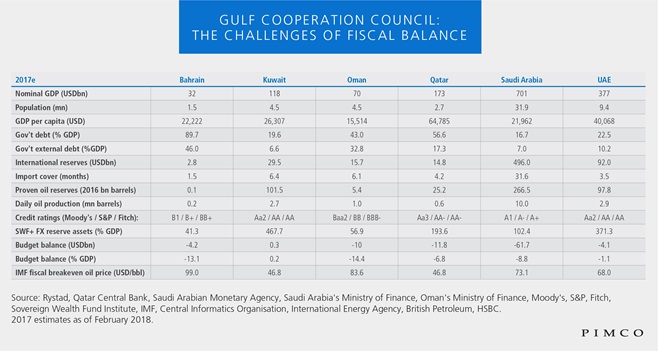
The GCC can be divided into the “haves” ‒ those with significant oil reserves and sovereign wealth funds, namely Saudi Arabia, the UAE and Kuwait ‒ and the “have-nots” ‒ those with more limited resources and in need of fiscal restraint, including Oman and Bahrain. The recent recovery in oil prices plays into the hands of the GCC, but also distracts it from the path of fiscal adjustment that is still necessary (see table).
Most countries have taken some positive steps. The UAE and Kuwait have used a reasonable oil price of $50/barrel in their budgeting, for example, which may take some pressure off, and lead to lower debt issuance if oil stays in the $60 neighborhood or higher. The recent introduction of a 5% value-added tax (VAT) in both the UAE and Saudi Arabia should further solidify their fiscal positions as long as it’s not offset by too many “handouts.” And although the conflict that erupted in June 2017 between Qatar and several GCC states is likely to be long-lasting, the country has built a large kitty of reserves (and quality art) that should allow it to survive the Saudi-led blockade.
Finally, the fiscally strongest countries in the GCC could well benefit from improved transparency, and we see concerted efforts by Saudi Arabia, the UAE and Kuwait to improve investor relations and reporting standards.
UAE: build it and they will come
Past Ferrari World in the UAE capital of Abu Dhabi lies the new Louvre, the stunning new structure by Jean Nouvel that serves as an anchor for international tourists and demonstrates Abu Dhabi’s focus on culture and its forward thinking.
But with so many places in the Middle East building opulent venues to attract tourism, can all of them be successful at the same time? The attempt to diversify beyond oil is prudent, but Dubai leads in showmanship, and its neighbors will likely find it difficult to close the gap.
So despite their diversification efforts, without high oil prices to lean on, we think even the GCC elite, including the UAE, will have to stomach some belt-tightening.
Oman: short versus long terms
Oman’s natural beauty and friendly people suggest a sense of calm, at least to this author. Does this calm extend to its fiscal policy? With five billion barrels of oil in the ground (close to 15 years of production at the current pace), the government is willing to invest in long-dated projects like the Duqm Special Economic Zone, a 25-year plan to develop the port town of Duqm. However, there seems to be less focus on more immediate issues: electricity and water subsidies, a porous debt “ceiling,” and the introduction of a VAT. Higher oil prices lately may be allowing policymakers to take their feet off the austerity pedal.
Oman’s foreign policy deftly cultivates good relationships with its regional neighbors, which would be a natural hedge against financial woes; yet the country also has an independent streak that could discourage reliance on the GCC, let alone the IMF.
Bahrain: considerations of the international community
Bahrain has maintained a reserves/import coverage ratio of just one month, versus the IMF’s recommendation of at least three months. While its GCC neighbors have multiple ways (and reasons) for assisting Bahrain if necessary, the exact timing or path of this potential support is unclear.
Will aid materialize without fiscal tightening measures from Bahrain first? Past experience suggests the GCC states will do their utmost to avoid breaking currency pegs in any member country, for fear of contagion to the region. A U.S. naval base and emphasis on defense purchases also suggest Bahrain is aligned with U.S. interests. Bond investors, however, may still seek evidence of fiscal consolidation to keep funding the country.
Bright future?
Countries in the GCC vary widely in how they are adjusting to the current price range for oil and the need for fiscal restraint. With a large pipeline of bond issuance from the region expected this year, we think selective positioning in GCC sovereign names that are making the appropriate adjustments could potentially generate alpha for investors. Such sovereigns generally are not included in emerging market indexes and thus not likely to be reflected in passive investment vehicles.
Looking ahead, what we find refreshing in the Middle East is the cadre of young, competent policymakers coming up the ranks, many of whom are female. With this generation of future financial leaders, the GCC may have another card up its sleeve.

Yacov Arnopolin is an emerging markets portfolio manager in PIMCO’s London office and a contributor to the PIMCO Blog.
DISCLOSURES
Investing in foreign-denominated and/or -domiciled securities may involve heightened risk due to currency fluctuations, and economic and political risks, which may be enhanced in emerging markets. Investing in the bond market is subject to risks, including market, interest rate, issuer, credit, inflation risk, and liquidity risk. The value of most bonds and bond strategies are impacted by changes in interest rates. Bonds and bond strategies with longer durations tend to be more sensitive and volatile than those with shorter durations; bond prices generally fall as interest rates rise, and the current low interest rate environment increases this risk. Current reductions in bond counterparty capacity may contribute to decreased market liquidity and increased price volatility. Bond investments may be worth more or less than the original cost when redeemed. All investments contain risk and may lose value. There is no guarantee that these investment strategies will work under all market conditions or are suitable for all investors and each investor should evaluate their ability to invest long-term, especially during periods of downturn in the market. Investors should consult their investment professional prior to making an investment decision.
© PIMCO
© PIMCO
Read more commentaries by PIMCO