While not all countries were able to face each other in the World Cup, global tensions escalated off the field. President Donald Trump’s imposition of steel and aluminum tariffs made for an acrimonious G-7 summit and put the U.S. at odds with its traditional allies. Meanwhile, the administration made overtures to unlikely allies: North Korean leader Kim Jong Un, whom Trump met in Singapore in an attempt to align goals, and Russian President Vladimir Putin, who agreed to meet Trump in their first bilateral summit. Tensions between the U.S. and China ratcheted higher after the U.S. tariffs were announced, prompting tit-for-tat retaliations that weighed on risk sentiment in the markets. Immigration policies added to the contentious month: Trump reversed an unpopular policy that had resulted in the separation of families entering the U.S. at the Mexican border, German Chancellor Angela Merkel’s coalition came under threat after the Christian Social Union (CSU) took a hard-line stance against her migration policy, and Italy refused to allow a migrant rescue boat to dock on its shores. In Spain, a socialist-led opposition ousted Prime Minister Mariano Rajoy in a no-confidence vote, Turkey re-elected President Recep Tayyip Erdoğan, and Colombian voters chose conservative Ivan Duque to become the country’s youngest president.
Diverging growth momentum across major economies set the stage for less synchronized central bank activity. In the U.S., the Federal Reserve lifted its target rate range by another quarter-point to 1.75% to 2.00% and signaled two more increases in 2018. The widely expected hike came as labor markets continued to tighten and prices firmed. Employers added 223,000 jobs in May, sending the unemployment rate to a multi-decade low of 3.8%, while the core Personal Consumption Expenditures index (PCE), the Fed’s preferred inflation measure, hit the elusive 2% target for the first time in six years. Across the Atlantic, the European Central Bank (ECB) announced plans to wind down its asset purchase program but indicated that rates would likely remain unchanged until at least summer 2019. The ECB’s decision came on the heels of somewhat slower growth momentum in the 19-member currency union: The eurozone manufacturing Purchasing Managers’ Index (PMI) continued to soften, though it remained well in expansionary territory at 54.3. Core eurozone inflation also fell to 1.0% in June, down slightly from 1.1% and well below target. In China, the People’s Bank of China (PBOC) also took a dovish turn, easing policy against the backdrop of U.S. dollar strength, falling equity markets and the possibility of a trade war with the U.S.
Geopolitical events jostled the markets. Solid growth and buoyant sentiment helped push global equities and high yield bonds higher to start the month, with U.S. rates rising. However, escalating trade tensions between the U.S. and China weighed on risk appetite and upended the early-month trend. In global equities, defensive holdings such as utilities and REITs outperformed while industrials and financials came for sale. By the end of the month, equities had generally retreated and this reversal from the early-month trend characterized movements for most asset classes. Oil markets were volatile after OPEC, along with Russia and other partners, agreed to boost output. The U.S. dollar remained well supported against a broad basket of global currencies as the Fed’s continued normalization of rates contrasted with the softer stances from other central banks. Emerging markets remained under pressure due to the stronger dollar, trade policy uncertainty and waning risk sentiment.
Offside in the second half After a strong start to the month, markets were caught offside in the second half as trade frictions weighed on risk sentiment. Risk assets, led by U.S. equities and high yield bonds, generally rose in early June on the back of solid employment data and robust sentiment. Global stocks also moved higher while developed market yields rose. In a mid-month reversal, however, concerns over escalating trade tensions between the U.S. and China unsettled markets: President Donald Trump announced tariffs on $50 billion of Chinese imports and followed with threats of levies on an additional $200 billion, driving stocks lower and credit spreads wider. High quality assets saw “safe-haven” demand, meanwhile, which pushed government yields back down. The deteriorating trade backdrop proved especially challenging for emerging markets, where stocks dropped for the fifth consecutive month this year.
Market snapshot
EQUITIES
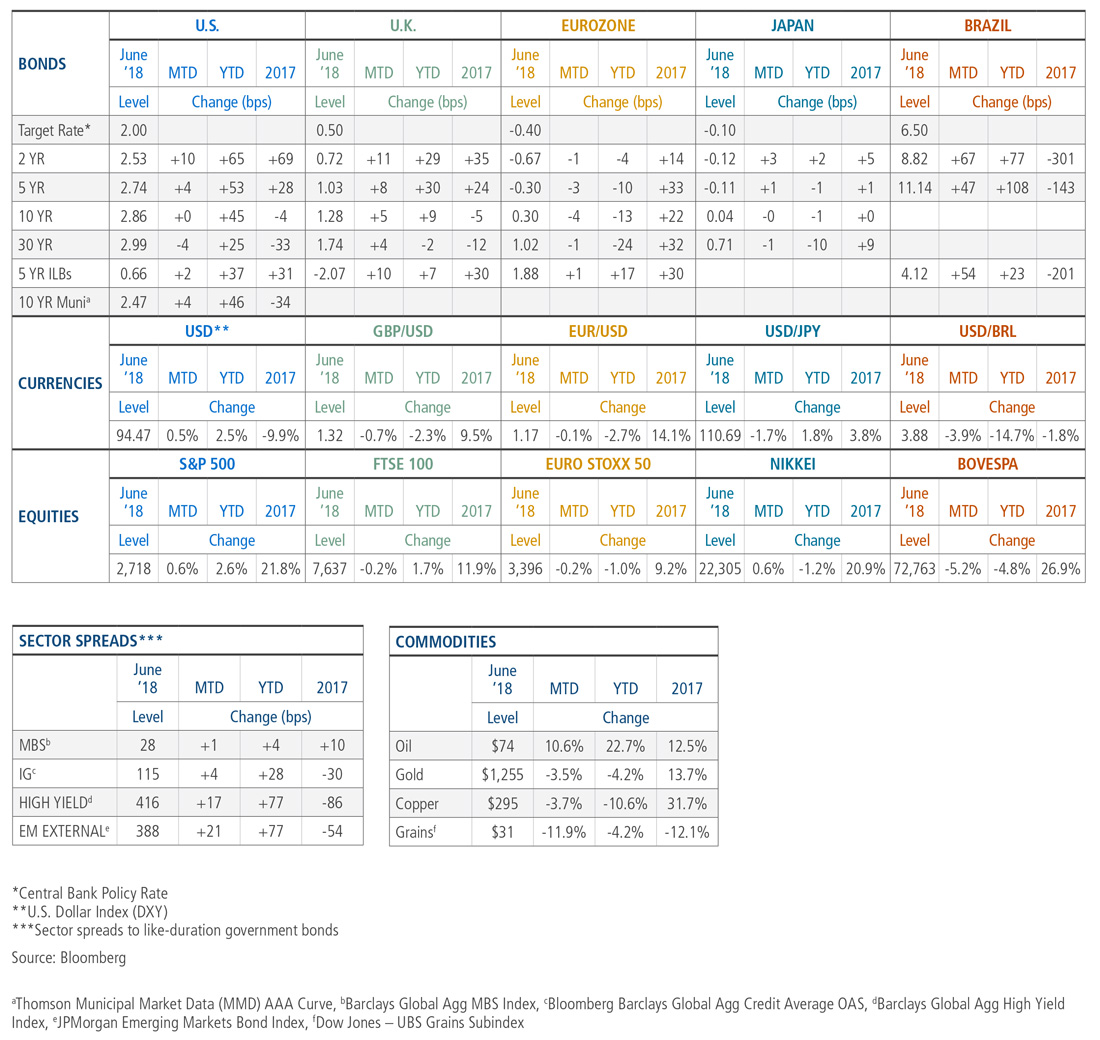
Solid fundamentals offset concerns related to geopolitics and trade, and developed market stocks1 were flat over the month. After a strong start, gains in both U.S. and Japanese stocks2,4 were limited to 0.6% as trade fears weighed on investor sentiment in the second half of the month. European equities3 declined 0.7%, under pressure due to uncertainty over EU immigration issues and global trade tensions.
Overall, emerging market5 stocks lost 4.2% in June, primarily driven by global trade fears and U.S. dollar strength. In Brazil6, stocks fell 5.2% due to broader EM weakness, continued Brazilian real depreciation, and uncertainty ahead of presidential elections in October. Chinese7 equities declined 7.3%, driven by ongoing geopolitical tensions, a sharp depreciation of the Chinese yuan, and weaker-than-expected economic data. By contrast, Indian8 stocks rose 0.5% after the Reserve Bank of India (RBI) raised policy rates by 0.25%, citing its confidence in India’s growth recovery and also noting firming inflation pressures. In Russia9, stocks rose 0.9%; rising oil prices and stable economic data helped insulate Russian markets from broader EM volatility.
DEVELOPED MARKET DEBT
In the U.S., the Federal Reserve delivered a widely expected policy rate increase, but the markets interpreted an additional 2018 hike in the Fed’s so-called “dot plot” forecast as marginally hawkish, which contributed to a jump of 10 basis points (bps) in the U.S. two-year Treasury yield to 2.53%. Despite solid economic data and rising inflation, the 10-year Treasury yield was about unchanged at 2.86% amid escalating trade tensions, which resulted in a flatter yield curve. In the eurozone, the European Central Bank (ECB) announced plans to end its bond-buying program by year-end, but it pushed back expectations for rate hikes until at least summer 2019, which helped drive 10-year bund yields 4 bps lower to 0.30%. In the UK, the Bank of England (BOE) left its policy rate unchanged, though improving economic data increased the odds of a hike in August and the UK 2-year rate rose 11 bps to 0.72%.
INFLATION-LINKED DEBT
Global inflation-linked bonds (ILBs) posted positive returns overall and generally outperformed comparable nominal sovereign bonds as a late-month rebound in oil prices and firm inflation data across the major economies supported global breakeven inflation (BEI) rates. U.S. Treasury Inflation Protected Securities (TIPS) returned 0.40%, as represented by the Bloomberg Barclays U.S. TIPS Index. The persistent flattening of the real yield curve continued unabated in June, fueled by stronger jobs data and a slightly hawkish tilt to the Fed’s statement after its meeting in June. U.S. break-even rates moved higher for the month as tariff/trade chatter intensified and oil prices rallied in the wake of the OPEC meeting. Real yields in the UK and eurozone began the month sharply higher on concerns of a near-term unwinding of the ECB’s Asset Purchase Programme, but they retreated when the ECB signaled that rate hikes would not occur until well after the end of asset purchases. Italian ILBs notably outperformed for the month, recovering a portion of their sharp losses in May amid political uncertainty.
CREDIT
Global investment grade (IG) credit10 spreads widened 4 bps in June, and the sector returned -0.38%, underperforming like-duration global government bonds by -0.27%. Moderating inflows and recent volatility associated with U.S. trade policy, weakness in Italian and emerging market debt, and pending mergers-and-acquisitions related issuance all led to modest spread weakness during the month.
Global high yield bond11 prices were volatile in June amid swings in equities, Treasuries, oil prices and increasing concern surrounding global trade. Spreads rose to their highest levels year-to-date, yet global high yield bonds managed to post modest positive returns, with lower quality triple-C-rated bonds outperforming.
EMERGING MARKET DEBT
Emerging market (EM) debt posted negative returns in June, including all sub-sectors. Negative local debt performance was driven by EM currency depreciation and higher index yields, as the U.S. dollar continued to strengthen and U.S. rates were volatile. On the external debt side, widening spreads and generally higher underlying U.S. Treasury yields drove returns. Argentina was a notable underperformer in both external and local debt, as a sliding peso and a severe drought took their toll. South Africa also meaningfully lagged the local debt index; a large current account deficit, steeply negative first-quarter economic data and overall bearish sentiment severely weakened the rand.
MORTGAGE-BACKED SECURITIES
Agency MBS12 returned 0.05% and outperformed like-duration Treasuries by 3 bps during the month. Although the Fed’s unwinding of its asset purchase program and organic origination weighed on the sector, the return of demand from banks, low volatility and strong cash flows were all supportive of Agency MBS. The 4.0% and 4.5% coupons underperformed the 3.0% and 3.5% coupons, Ginnie Mae MBS outperformed conventional MBS, and 15-year MBS outperformed their 30-year counterparts. Gross MBS issuance and prepayment speeds increased in June. Non-agency residential MBS underperformed like-duration Treasuries during the month, while non-agency commercial MBS13 returned -0.14%, underperforming like-duration Treasuries by 11 bps.
MUNICIPAL BONDS
The Bloomberg Barclays Municipal Bond Index returned 0.09% in June, bringing the year-to-date return to -0.25%. Munis slightly outperformed Treasuries, and lower credit quality outperformed higher credit quality as the Bloomberg Barclays High Yield Municipal Bond Index returned 0.50%, bringing the year-to-date return to 3.66%. June supply was in line with the previous month at $31 billion, although year-to-date supply is still down 21%, as expected given the supply increase in late 2017 in anticipation of tax reform. Over the next few months, we expect the supply-demand dynamic to be favorable for munis: Seasonally high redemptions will likely be met with continued subdued supply.
CURRENCIES
The U.S. dollar rally continued in June as policy rate divergence between the Fed and other global central banks kept pressure on most other G10 currencies. Monetary policy was a key driver of both the euro and the yen; the euro weakened on dovish rate guidance from the ECB, and the yen weakened after the Bank of Japan (BOJ) cut its inflation forecast, despite interest in the currency as a “safe haven” as trade tensions escalated. The British pound fell 0.7% when political concerns won against a shift at the BOE that lifted the probability of a rate hike in August. Among emerging markets, the Chinese yuan weakened 3.2% amid rumors of official dollar-buying and an incrementally looser policy stance as the threat of tariffs from the U.S. loomed large.
COMMODITIES
Commodities posted mixed returns in June. In energy, crude oil rallied even though OPEC, Russia and other producers agreed to boost output by 700,000‒1 million barrels per day. Crude prices were further supported by uncertainty around Libyan exports and the Trump Administration’s push for allies to end all imports of Iranian oil. Natural gas briefly touched $3 per million Btu in anticipation of hot weather and higher demand but later pared gains on strong production and moderating weather forecasts. The agricultural sector posted steep losses as fresh tariffs announced by the U.S. and China stoked fears of a trade war between the world’s two largest economies. The oilseed complex led the decline, with spot soybean futures almost touching a 10-year low while grains also came under pressure. Base metals fell due to concerns over trade and Chinese growth, while platinum underperformed gold and silver on unfavorable supply-demand dynamics.
Outlook
Based on PIMCO’s cyclical outlook from March 2018.
PIMCO expects world GDP growth to remain above-trend at 3.0%‒3.5% in 2018, with low but gently rising inflation. Still-favorable fiscal support suggests that solid growth will continue for the rest of 2018. Compared with our December forecast, we see marginally higher 2018 GDP growth in the U.S., eurozone, U.K. and China, while we lowered our estimates for Mexico and India. The causes of the stronger expansion are more uncertain and could affect its durability beyond 2018. Our inflation forecasts for 2018 have also risen slightly since our December forecast in response to a higher oil price trajectory.
In the U.S., we look for above-consensus growth of 2.25%–2.75% in 2018. Household and corporate tax cuts should boost growth by 0.3 percentage point in 2018, with another 0.3 percentage point coming from higher federal government spending resulting from the two-year budget deal. With unemployment dropping below 4%, we expect some upward pressure on wages and consumer prices, and core inflation to be above 2% over the course of 2018. Under new leadership, the Federal Reserve is expected to continue tightening gradually; we expect three rate hikes this year, with a fourth likely if economic and financial conditions are favorable.
For the eurozone, we expect growth will be in a range of 2.25%‒2.75% this year, about the same pace as 2017. The expansion has been broad-based across the region, but political challenges highlight some fragility. Core inflation, though, is expected to remain very low, creeping only marginally above 1%this year due to low wage pressures and the appreciation of the euro in 2017. We expect the European Central Bank to end its bond purchase program this year, though maturing bonds will be reinvested for some time. We do not foresee the first rate increase until mid-2019.
In the U.K., we expect above-consensus growth in the range of 1.5%–2.0% in 2018. Our base case is for a relatively smooth separation from the European Union, which would contribute to business confidence and investment picking up. After seven years of austerity, we also see some scope for stronger government spending. Inflation should fall back toward the 2% target by year-end, with the effect of sterling’s depreciation in 2017 fading. The Bank of England will likely follow a very gradual path higher.
Japan’s GDP growth is expected to remain firm at 1.0%–1.5% in 2018. Fiscal policy should remain supportive ahead of the planned value-added tax hike in 2019. With unemployment below 3% and job growth accelerating, wage growth should pick up further, helping core inflation rise over the year to slightly below 1%. With the appreciating yen providing disinflationary headwinds and the newly appointed deputy governors tilting the Bank of Japan leadership somewhat more dovish, the BOJ may not tweak its yield curve control policy until 2019.
In China, we expect a controlled deceleration in growth to 6.0%–7.0% this year, from 6.8% in 2017. The authorities’ focus is likely to be on controlling financial excesses, particularly in the shadow banking system, and on some fiscal consolidation, chiefly by local governments. We expect inflation to accelerate to 2.5% on stronger core inflation and higher oil prices. We are broadly neutral on the yuan and generally expect the authorities to control capital flows tightly to keep exchange rate volatility low.
In Brazil, Russia, India and Mexico, we expect growth to collectively rise to 4% in 2018, slightly above consensus, with modest upside risk from the growth rebound in India. Emerging markets are catching up to the recovery in developed markets, with improving fundamentals and greater differentiation among countries. This recovery is likely to be shallower and slower than others, however, and a deteriorating external backdrop could weigh on the asset class; EM potential growth has fallen, and key political events are likely to keep investors cautious. We expect inflation to stabilize around 4.1%, also above consensus, as most of the decline in EM inflation thus far appears cyclical rather than structural.