After years of relative calm, bond investors are suddenly facing the reality of rising interest rates in 2018. The portfolio management team for the PIMCO Income Fund, Daniel Ivascyn and Alfred Murata, discuss the implications for investors.
Q: What would you say to bond investors who are worried about rising interest rates?
Ivascyn: That is a very good question, and it’s on the minds of our investors, given that interest rates have risen for most of this year.
At PIMCO, we believe interest rates may continue to go a little higher, but we don’t think a major increase in interest rates is very likely over the next few years. In fact, U.S. bond yields have already risen to the point that we think certain bonds offer attractive value for investors today, especially when considering that a diversified bond portfolio can provide income absent default and may help protect the portfolio against volatility in stocks.
We have constructed the Income Fund with the aim of being resilient in a rising interest rate environment, but we also have to consider other scenarios − in particular, an environment where slower economic growth may lead to interest rates falling, rather than rising. In such a scenario, having some exposure to interest rates would be expected to benefit investors. Thus, we have some exposure to interest rates as a way
Q: How has the Income Fund been navigating rising interest rates?
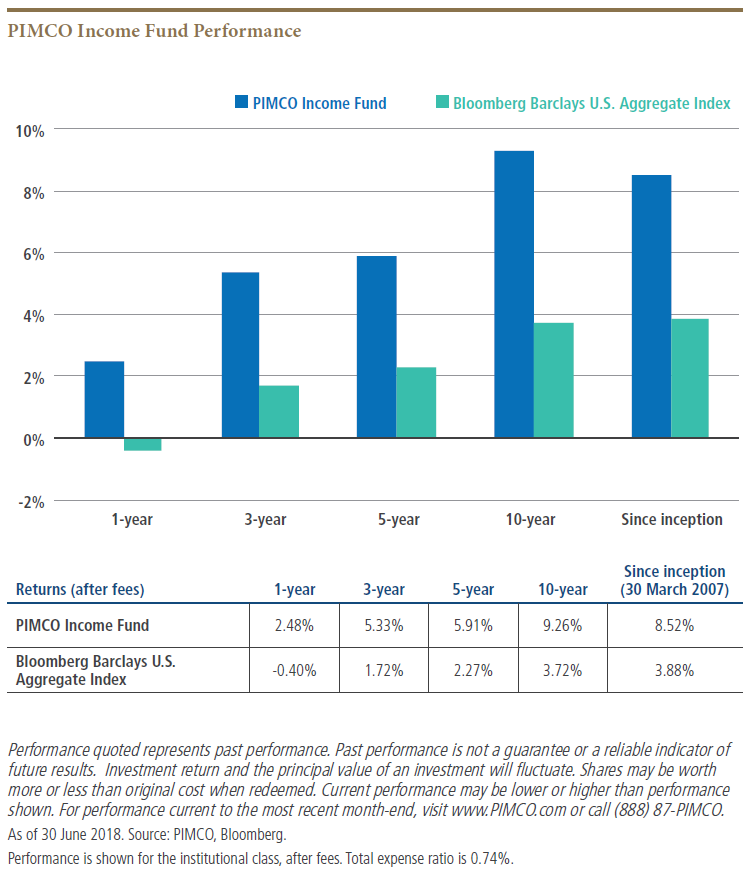
Ivascyn: PIMCO’s Income Fund has continued to focus on delivering consistent income and has performed well versus traditional, broad fixed income benchmarks like the Bloomberg Barclays U.S. and Global Aggregate Indexes.
We believe the Income Fund has the tools to be resilient in the face of rising interest rates. We have great flexibility to shift the strategy’s overall exposure to interest rates. Our current interest rate exposure is still cautious, mainly because our shorter-term view on the economy is constructive, and we think the Federal Reserve is therefore likely to continue gradually raising interest rates.
We also devote a portion of the Fund to high quality bonds, such as U.S. Treasuries, as a way to help protect the portfolio against economic weakness and other unexpected events that could lead to a sell-off in higher risk assets, like stocks. We just saw this type of “flight to quality” in June, when Italy formed a new populist government.
We expect the Income Fund to continue to use its flexibility to navigate different interest rate environments, and we remain keenly aware of the potential for “surprises” when positioning the Fund.

Q: The 10-year U.S. Treasury yield has risen to around 3% so far this year. What’s your forecast for interest rates from here?
Ivascyn: We believe long-term forces like rapid technological change, aging demographics and globalization will keep bond yields relatively range-bound.
Still, we do expect the Fed to continue raising its target short- term interest rate during the remainder of 2018 and even into 2019. Most likely, we think interest rates will be higher 12 months from now. But we also think there are possible scenarios in which interest rates could fall due to a slowdown in the global economy or changes in policy and politics.
Q: The Income Fund has weathered challenging markets since its inception over 10 years ago. How have you been able to deliver consistent income to investors?
Ivascyn: It’s hard to imagine a more challenging decade for income investors than the past 10 years – starting with the global financial crisis in 2008. Bond yields remained at historically low levels through the European debt crisis, the taper tantrum, the slowdown in China, and Brexit.
To successfully navigate events like these and continue to seek to deliver consistent income, the Income Fund takes what we call a “bend-but-don’t-break” approach: The Fund has the flexibility to invest across a broad spectrum of bonds, and active management allows us to manage exposures to interest rates and different sectors of the bond market to help keep the portfolio diversified.
Significant resources are required to seek opportunities across the global bond markets. That’s where PIMCO’s scale comes into play. With portfolio managers and trading desks around the world, we have the ability to invest across all sectors of the $100 trillion global bond market.
Q: Mortgage-backed securities have been a big component of the Income Fund. Do you still find these bonds attractive?
Murata: Yes. We think the underlying credit fundamentals in the U.S. housing sector are very strong. In particular, we see value in non-agency bonds issued before the financial crisis. Even if housing prices were to drop, we would still expect higher yields from non-agency mortgage-backed securities than U.S. Treasury bonds.
Also, new opportunities continue to arise in the mortgage market, and we can aim to use PIMCO’s size and resources to advantage in this market.
Q: What is your view on emerging markets for the Fund?
Ivascyn: We like emerging markets for diversification. However, we do not have a large concentration in emerging markets because they can be quite volatile. Still, significant price changes can present opportunities. For example, Mexican assets were very volatile after the U.S. election in late 2016, which we found to be a good buying opportunity.
Q: Looking ahead, what risks are you watching for and how do you think the strategy would perform under different conditions?
Ivascyn: We think global economic growth is likely to be healthy over the short term. But with the economic expansion in its 10th year and the Fed, and perhaps other central banks, looking to reverse course after many years of keeping rates very low, we have been gradually reducing risk in the Income Fund. We are not rushing to cash or to high quality bonds. We are simply becoming more cautious as many asset prices remain a little stretched from a historical perspective.
Murata: And to take a step back, as we think about managing the Income Fund, we generally think about investing roughly half the portfolio in high quality bond sectors, including U.S. Treasuries, and the other half in higher-yielding sectors like corporate bonds, emerging market bonds and non-agency mortgage securities. Over time, this balance between high quality and higher yielding sectors has helped the Fund navigate a variety of market environments. The Fund remains broadly diversified, but we’ve been gradually tilting the portfolio toward the higher quality component.
Ivascyn: Right. Rising rates may mean some pressure on bond returns. But the Income Fund is designed to be flexible and resilient, drawing on PIMCO’s best investment ideas from our portfolio managers and credit analysts around the world.
© PIMCO
© PIMCO
Read more commentaries by PIMCO