SUMMARY
- While we do not view a recession as imminent, we think investors should be prepared for the cycle to turn over the next three to five years.
- When thinking about their fixed income allocations late in this cycle, investors should consider the risks posed by higher interest rates, an uptick in inflation and stretched valuations, among others.
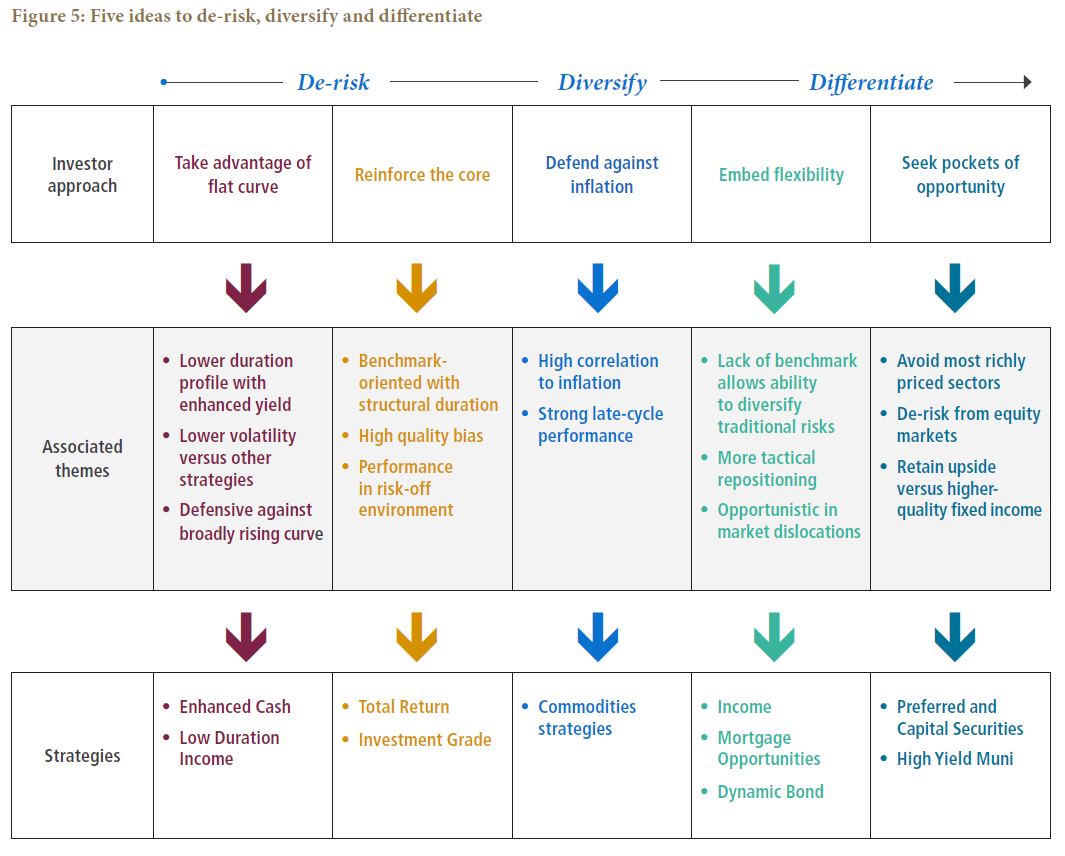
- We believe fixed income investors can seek to de-risk, diversify and differentiate their portfolios by 1) taking advantage of the flat yield curve; 2) reinforcing the core; 3) defending against inflation; 4) increasing portfolio flexibility; and 5) seeking pockets of opportunity in stretched credit markets.
Is it time for fixed income investors to start thinking about the next turn in the economic cycle?
We are now in the 10th year of the U.S. economic expansion, one that would mark the longest in modern U.S. history if it continues past July 2019. The expansion thus far has been characterized by large central bank flows and financial repression, which in turn have damped volatility and contributed to solid returns for most asset classes. A traditional 60/40 portfolio of equities and debt, for example, would have returned about 7.2% over the past decade (as proxied by the S&P 500 and the Bloomberg Barclays U.S. Aggregate Bond Index).
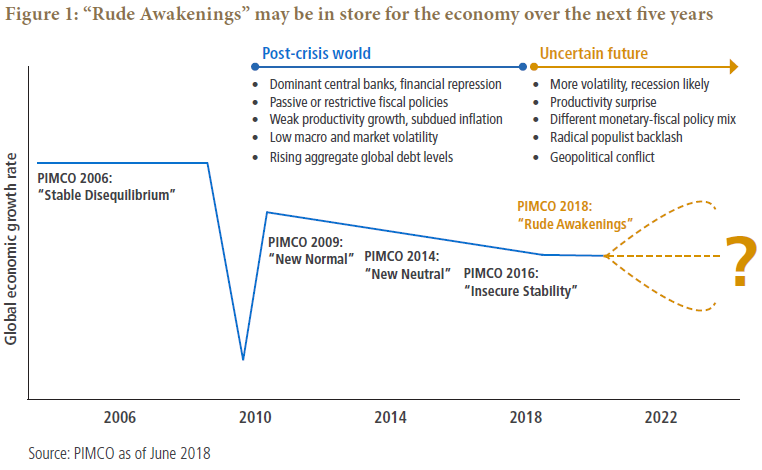
However, we at PIMCO think the next five years may look very different for the economy and markets, with the potential for several “Rude Awakenings” highlighting a very different macro landscape – for better or worse – in the years ahead (see Figure 1).

With this in mind, we believe fixed income investors should be asking a few critical questions as the expansion lengthens: Is a recession imminent? If not, how far down the road is the next one? Is an increase in volatility likely going forward? Are rising rates something to be concerned about? And what about inflation – how high will it go?
Investors contemplating these questions may consider whether some adjustments could be warranted, including de-risking their portfolios, diversifying potentially concentrated risks and differentiating among opportunities to more selectively go on offense in a world of rising uncertainties.
Watching for recession
While we do not view a recession as imminent (barring any shock), we think the cycle will likely turn over the next three to five years. We are already seeing some signs of late-cycle dynamics. Looking across the fixed income markets, we view many sectors as fairly or fully valued at current levels. In addition, trade policy and geopolitical headlines have spurred an uptick in volatility to more normal levels, in line with historical averages.
That said, we remain constructive on many fixed income segments, as strong consumer sentiment, robust corporate balance sheets, relatively benign inflation and the lack of commodity price shocks continue to benefit the economy (and keep a recession at bay, for now). The U.S. just turned in a particularly impressive earnings season, with 80% of companies in the S&P 500 beating earnings expectations in the second quarter – one of the strongest results since 2008. And despite some potential inflationary pressures that bear watching, we do not envision runaway inflation in our base case. Moreover, while valuations are elevated, a typical late-cycle phenomenon, they are not near the highest levels we have seen historically.
All told, we view recession as probable over the secular horizon, and the lack of overheating (so far) in the economy suggests that the next one may be shallower but longer than past downturns. A range of uncertainties in the global economy also heighten the risk of the unexpected in the next recession.
Breaking down the risks
Taking all this into account, how should investors think about their fixed income allocations? Let’s start by walking through a few key risks:
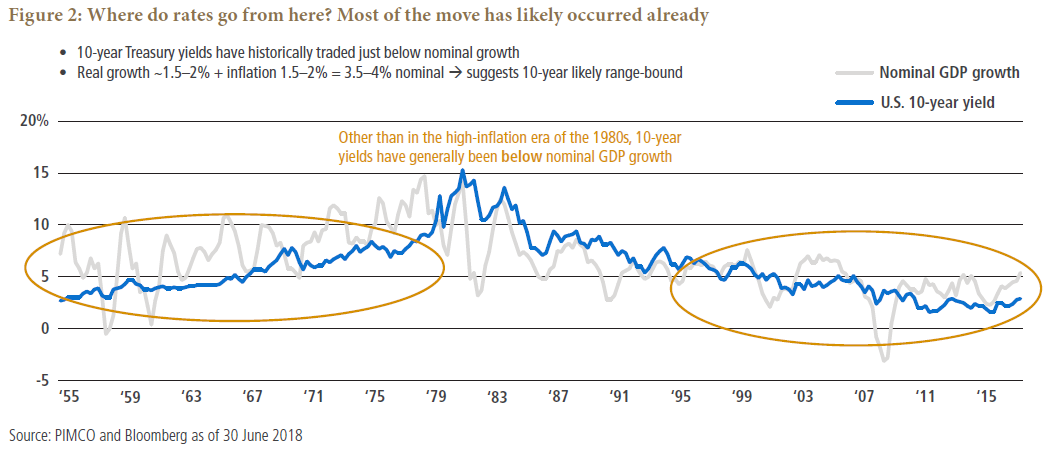
Higher interest rates. In recent months, rising rates and the potential for the U.S. Treasury curve to move higher have been top-of-mind for many investors. However, we believe rates will remain range-bound. Historical data show that interest rates have largely been anchored by nominal growth – a relationship that makes intuitive sense considering that over time, one would expect to earn more from investing in the economy than from lending money to the government (see Figure 2). Given the outlook for lower trend growth in light of debt overhangs, an aging population and relatively low productivity, we don’t expect substantially higher rates in the near term.
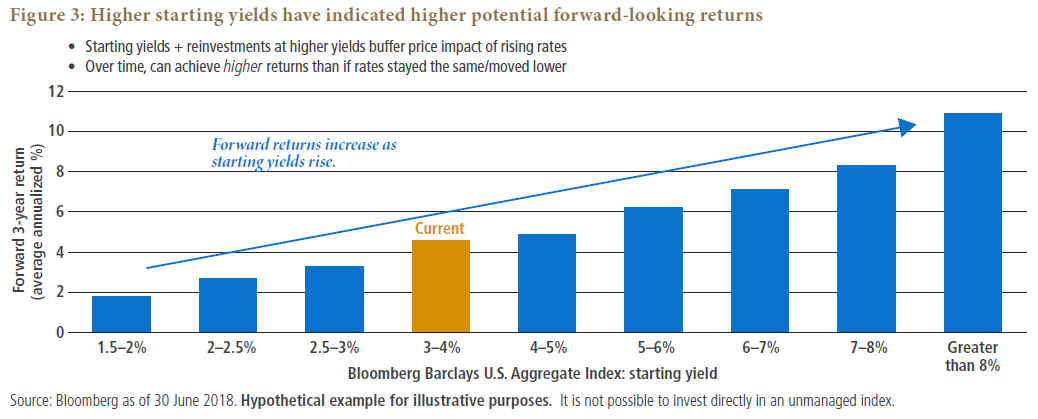
The good news? Yields have reset higher. Across fixed income, starting yields have been a good indicator of forward-looking returns. Currently, the Bloomberg Barclays U.S. Aggregate Index yields about 3.3% (as of 31 August 2018). Looking at past periods when the index was yielding 3%–4%, the forward three-year returns averaged 4.6% (see Figure 3). Of course, past performance is not a guarantee of future results.
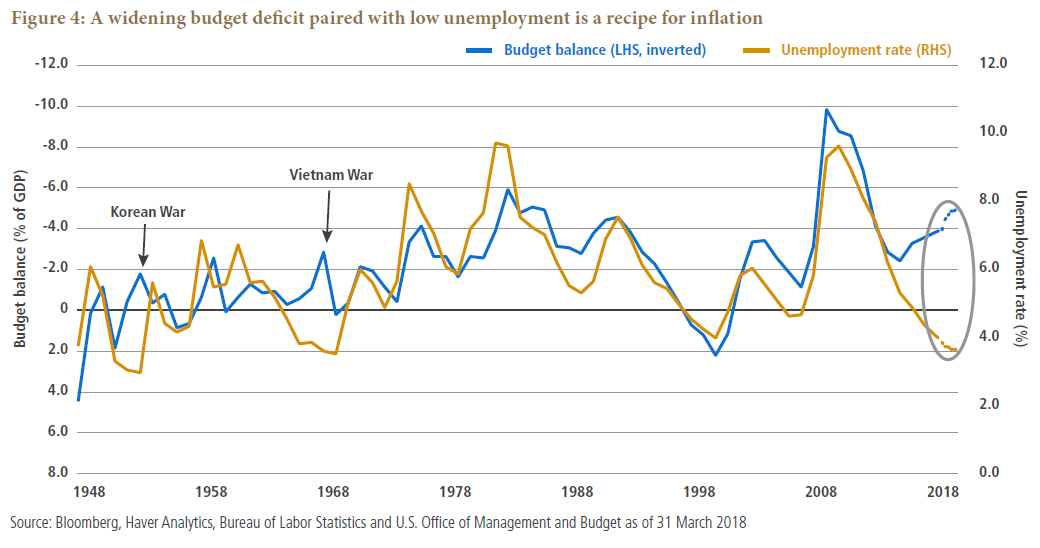
An uptick in inflation. We are currently seeing modest increases in inflation, consistent with the typical pattern late in an economic cycle. A significant breakout of inflation is not our base case over the next three to five years. However, we see greater inflation risk than in the recent past. Factors pointing to higher inflation include fiscal stimulus and a widening budget balance at a time when unemployment is low and spare capacity in the economy is limited (see Figure 4). All told, we believe many investors may be underestimating the possibility of a longer-term inflation surprise and should consider whether they are adequately protected.
A flattening yield curve. The two-year Treasury yield has increased over 1.5% since the current Federal Reserve hiking cycle began in December 2015, while the 30-year Treasury rate has been flat and the 10-year is up about 60 basis points. Historically, an inversion in the yield curve – as measured by the spread between three-month and 10-year interest rates – has served as a recession indicator. However, we do not think the current flattening will necessarily bring volatility, especially given that the Fed could “yield to the yield curve” by pausing its hiking cycle. Inflationary pressures and reduced monetary support globally could also cause long-term rates to rise, steepening the long end of the yield curve. Moreover, the flatter curve creates opportunity in shorter-dated maturities given the compressed term premium.
Stretched credit valuations. Many parts of the credit market and generic credit betas are fully valued, in our view. However, we are still finding attractive opportunities in some areas of the credit markets, generally higher-quality “bend but don’t break” credits with structural seniority. We also find certain segments, such as mortgages and investment grade credit, attractive given their traditional utility as late-cycle diversifiers to equities. In the current environment of tight valuations, we view active management and careful bottom-up analysis as critical in seeking to generate superior risk-adjusted returns.
Five actionable investment ideas to de-risk, diversify and differentiate
How can investors respond? Here we discuss five potential action items that investors may consider in the context of their investment objectives (see Figure 5).
De-risk
1. Take advantage of the flat curve
With a flatter yield curve, it is possible to get similar yields with a lower duration profile when moving to shorter-term investments. This offers the potential to de-risk or decrease volatility as a defensive strategy against the risk of a substantial rise in rates.
2. Reinforce the core
A structural allocation to high quality bonds can offer capital preservation and diversification from equities with the potential for an attractive yield. While shorter-term investments offer the potential for less risk and volatility, traditional interest rate exposure tends to provide diversification in times of adverse conditions in risk markets like equities. Strategies that utilize a benchmark with higher interest rate exposure today offer several key benefits: an attractive entry point given higher yields, historically strong diversification from equities in the event of a price dislocation or recession, and with active management, the ability to shift positions into areas where the interest rate curve may be less affected by rate increases.
Diversify
3. Defend against inflation
Inflation tends to pick up late in the cycle, and while we are not calling for a large rise, inflation could pose a significant risk to investors who aren’t properly protected. Strategies designed to take advantage of an increase in inflation – generally built around commodities and other real assets, such as inflation-linked bonds – may outperform in inflationary environments while being less correlated to traditional credit and interest rate exposures.
Differentiate
4. Increase portfolio flexibility
As we approach a potential turn in the business cycle, a more flexible portfolio mandate may be of value to investors. Historically, benchmark-agnostic strategies have enabled clients to diversify against traditional risks (such as credit and interest rate risk), particularly when generic betas may be less attractive. A diversified and flexible mandate may also allow for tactical allocation shifts to areas where mispricing or dislocation present opportunity in the event of a downturn.
5. Seek pockets of opportunity
Even in an environment of tight valuations, we continue to find opportunities in the market that can serve as a means to de-risk from equities while offering some upside versus higher-quality fixed income. Some examples include:
-
Bank capital. This potentially higher-yielding segment offers concentrated exposure to banks and other financial companies, an area of the global opportunity set where we find value. These credits have benefited from regulatory de-risking, which has led to the strongest bank fundamentals in years.
-
High yield municipals. With default rates lower than those for traditional high yield corporate bonds and the benefit of preferred tax treatment, for those who can accept heightened credit risk, high yield munis offer investors significant upside potential, in our view.
DISCLOSURES
Past performance is not a guarantee or a reliable indicator of future results. All investments contain risk and may lose value. Investing in the bond market is subject to risks, including market, interest rate, issuer, credit, inflation risk, and liquidity risk. The value of most bonds and bond strategies are impacted by changes in interest rates. Bonds and bond strategies with longer durations tend to be more sensitive and volatile than those with shorter durations; bond prices generally fall as interest rates rise, and the current low interest rate environment increases this risk. Current reductions in bond counterparty capacity may contribute to decreased market liquidity and increased price volatility. Bond investments may be worth more or less than the original cost when redeemed. Commodities contain heightened risk, including market, political, regulatory and natural conditions, and may not be suitable for all investors. Equities may decline in value due to both real and perceived general market, economic and industry conditions. High yield, lower-rated securities involve greater risk than higher-rated securities; portfolios that invest in them may be subject to greater levels of credit and liquidity risk than portfolios that do not. Inflation-linked bonds (ILBs) issued by a government are fixed income securities whose principal value is periodically adjusted according to the rate of inflation; ILBs decline in value when real interest rates rise. Income from municipal bonds may be subject to state and local taxes and at times the alternative minimum tax. The credit quality of a particular security or group of securities does not ensure the stability or safety of the overall portfolio. Derivatives may involve certain costs and risks, such as liquidity, interest rate, market, credit, management and the risk that a position could not be closed when most advantageous. Investing in derivatives could lose more than the amount invested. Diversification does not ensure against loss. Management risk is the risk that the investment techniques and risk analyses applied by the manager will not produce the desired results, and that certain policies or developments may affect the investment techniques available in connection with managing a strategy.
Hypothetical and simulated examples have many inherent limitations and are generally prepared with the benefit of hindsight. There are frequently sharp differences between simulated results and the actual results. There are numerous factors related to the markets in general or the implementation of any specific investment strategy, which cannot be fully accounted for in the preparation of simulated results and all of which can adversely affect actual results. No guarantee is being made that the stated results will be achieved.
The Bloomberg Barclays U.S. Aggregate Index represents securities that are SEC-registered, taxable, and dollar denominated. The index covers the U.S. investment grade fixed rate bond market, with index components for government and corporate securities, mortgage pass-through securities, and asset-backed securities. These major sectors are subdivided into more specific indices that are calculated and reported on a regular basis. It is not possible to invest directly in an unmanaged index.
Statements concerning financial market trends are based on current market conditions, which will fluctuate. There is no guarantee that these investment strategies will work under all market conditions or are suitable for all investors and each investor should evaluate their ability to invest long-term, especially during periods of downturn in the market. No representation is being made that any account, product, or strategy will or is likely to achieve profits, losses, or results similar to those shown. Investors should consult their investment professional prior to making an investment decision.
This material contains the opinions of the manager and such opinions are subject to change without notice. This material has been distributed for informational purposes only and should not be considered as investment advice or a recommendation of any particular security, strategy or investment product. Information contained herein has been obtained from sources believed to be reliable, but not guaranteed. No part of this material may be reproduced in any form, or referred to in any other publication, without express written permission. PIMCO is a trademark of Allianz Asset Management of America L.P. in the United States and throughout the world.
©2018, PIMCO.
CMR2018-0904-352891
© PIMCO
Read more commentaries by PIMCO