SUMMARY
- Amid heightened volatility and low prospective returns for traditional portfolios, multi-strategy alternative funds have been gaining favor as a way to improve a portfolio’s overall risk and return characteristics.
- However, investors should scrutinize potential allocations carefully: Performance and exposures among funds have varied markedly, particularly during periods of market stress.
- PIMCO Multi-Strategy Alternative Fund emphasizes diversification of core portfolio holdings and mitigation of downside risk during corrections in equity and bond markets – all while seeking attractive risk-adjusted returns.
Today’s late-cycle environment gives investors an opportunity to re-evaluate the risk and return potential of their portfolios. Since the depth of the financial crisis, core stock and bond allocations have delivered exceptional returns with modest volatility. But future returns will likely be muted even as risk increases.
Multi-strategy alternative funds have gained favor as a way to improve a portfolio’s overall risk and return characteristics. They allocate across a range of alternative strategies, such as equity long/short and managed futures, which have the potential to deliver attractive risk-adjusted returns across a variety of market environments. Indeed, these benefits helped boost assets in the category from about $5 billion in 2008 to over $50 billion today.¹
However, investors should scrutinize potential allocations carefully: Performance and exposures among funds have varied markedly, particularly during periods of market stress.
PIMCO Multi-Strategy Alternative Fund is designed for the prospective environment. It emphasizes diversification of core portfolio holdings and mitigation of downside risk during corrections in equity and bond markets – all while seeking attractive risk-adjusted returns.
Let’s take a closer look at key considerations and PIMCO’s strategy in more detail.2
Overview of multi-strategy alternative funds
Alternative strategies offer many potential benefits compared to traditional approaches. These include access to a broader opportunity set, greater tactical flexibility and the ability to use additional investment levers such as shorting. However, not all investors have the willingness to lock-up capital, the ability to meet minimum investment thresholds or the resources to evaluate multiple managers.
For these reasons, multi-strategy mutual funds can be an attractive, comprehensive option. They offer daily liquidity at net asset value (NAV), provide multi-manager due diligence and actively reallocate among a range of diverse strategies. However, the past several years show a significant variation in styles across managers and substantial differences in overall returns and diversification against equity market drawdowns.

Diversification potential
Equity diversification potential is vital for many investors as overall portfolio risk is typically concentrated in equities. Equity beta, which measures the magnitude and direction of a fund’s movement with the equity markets, is a useful metric to gauge a fund’s sensitivity to equity market gyrations. On average, funds with negative or low equity beta, tend to be better equity diversifiers.
As Figure 1 shows, one in four multi-strategy managers has an equity beta higher than 0.3, whereby a 10% decline in equities is likely to cause the fund to lose 3% or more. Much of this differentiation can be attributed to the selection of underlying strategies. For example, even though equity long/short strategies use short positions to reduce broad equity exposure, these strategies often have meaningful equity beta. Therefore, it’s important to evaluate the characteristics of the underlying strategies that comprise a multi-strategy fund to gauge its diversification potential. Moreover, if underlying strategies are highly correlated, the potential for larger drawdowns can increase. Having a diverse mix of strategies is essential.
In particular, it’s important to consider a manager’s ability to provide diversification during equity market drawdowns. Figure 2 shows the performance of managers in the category when equity markets fell by more than 5% after the inception of PIMCO’s Multi-Strategy Alternative Fund in December 2014. For many investors seeking diversification through multi-strategy alternative funds, these drawdown levels may be unacceptable.
In contrast to some peers, PIMCO seeks to provide diversification against sell-offs in both equity and bond markets. Since inception the fund has delivered an equity beta of 0.14 and an average duration of 1.5 years, limiting comovement with the key risks in most investors’ portfolios – equity risk and interest rate risk.
A major reason for these results, in our opinion, is that PIMCO is one of the few managers with a broad suite of distinct alternative mutual fund strategies managed in-house. With full look-through into the investment positions of strategies that we manage, we are able to monitor changes in risk exposures and liquidity in real time and moderate the overall equity and interest rate risk in our portfolios in seeking to provide strong diversification benefits for our investors (see Figure 3).
Performance comparison
While diversification is important, it’s critical to evaluate returns. As Figure 4 shows, performance dispersion across managers can be large. For example, returns for multi-strategy funds delivered by the 20th and 80th percentile managers differed on average by close to four percentage points annualized over the past three years. Put simply, investors were rewarded with only a subset of managers, and some managers delivered superior performance.
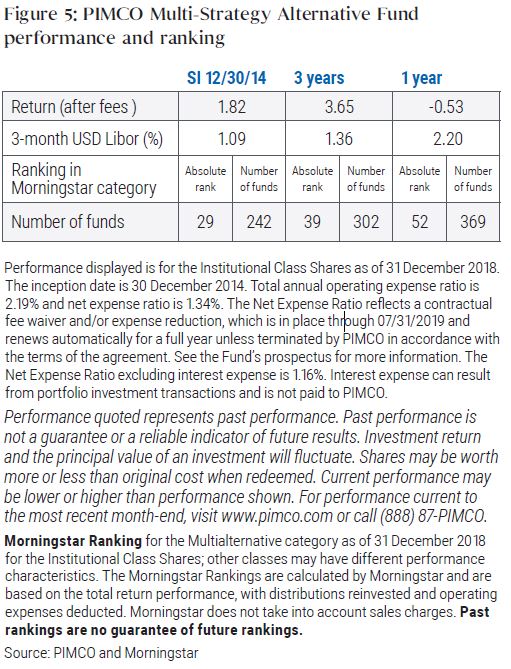
Of the 133 funds in the Morningstar Multialternative category, the PIMCO Multi-Strategy Alternative Fund has delivered top-quartile performance over the most recent one- and three-year periods (see Figure 5). Our performance has been supported in part by our focus on diversifying sources of risk and return across a number of strategies with low correlations to each other, such that no one strategy can dominate portfolio risk.
In fact, the cross-correlations of the underlying strategies have been just 0.06 since inception,³ underscoring the broad and diverse opportunity set of the Fund. An added benefit of managing the majority of the underlying strategies in-house is our ability to avoid multiple layers of fees that may occur when managers largely allocate to third-party strategies.
Recent market volatility has reminded investors to re-evaluate the risk and return potential of their portfolios. While performance over the past decade been strong for traditional portfolios built around core stock and bond allocations, the aging expansion is giving many investors pause about forward-looking returns and increased risk. PIMCO Multi-Strategy Alternative Fund provides an attractive way to increase a portfolio’s tactical flexibility across a range of diverse strategies in an effort to improve risk-adjusted returns, diversify core portfolio holdings and limit downside risk during corrections in both equity and bond markets.
1 Morningstar as of 31 December 2018. Based on the Morningstar multi-alternative category.
2 For evaluation purposes we focus on the past four years since the inception of PIMCO Multi-Strategy Alternative Fund on 30 December 2014.
3 Average of monthly correlations of each underlying strategy since the inception of the fund on 30 December 2018 or since the inception of the underlying strategy if started after the fund’s launch.
DISCLOSURES
Investors should consider the investment objectives, risks, charges and expenses of the funds carefully before investing. This and other information are contained in the fund’s prospectus and summary prospectus, if available, which may be obtained by contacting your investment professional or PIMCO representative or by visiting www.pimco.com. Please read them carefully before you invest or send money.
Past performance is not a guarantee or a reliable indicator of future results. The performance figures presented reflect the total return performance for the Institutional Class shares (after fees) and reflect changes in share price and reinvestment of dividend and capital gain distributions. All periods longer than one year are annualized. The minimum initial investment for Institutional class shares is $1 million; however, it may be modified for certain financial intermediaries who submit trades on behalf of eligible investors.
Investments made by a Fund and the results achieved by a Fund are not expected to be the same as those made by any other PIMCO-advised Fund, including those with a similar name, investment objective or policies. A new or smaller Fund’s performance may not represent how the Fund is expected to or may perform in the long-term. New Funds have limited operating histories for investors to evaluate and new and smaller Funds may not attract sufficient assets to achieve investment and trading efficiencies. A Fund may be forced to sell a comparatively large portion of its portfolio to meet significant shareholder redemptions for cash, or hold a comparatively large portion of its portfolio in cash due to significant share purchases for cash, in each case when the Fund otherwise would not seek to do so, which may adversely affect performance.
Differences in the Fund’s performance versus the index and related attribution information with respect to particular categories of securities or individual positions may be attributable, in part, to differences in the pricing methodologies used by the Fund and the index.
There is no assurance that any fund, including any fund that has experienced high or unusual performance for one or more periods, will experience similar levels of performance in the future. High performance is defined as a significant increase in either 1) a fund’s total return in excess of that of the fund’s benchmark between reporting periods or 2) a fund’s total return in excess of the fund’s historical returns between reporting periods. Unusual performance is defined as a significant change in a fund’s performance as compared to one or more previous reporting periods.
A word about risk:
The Fund invests in other funds and performance is subject to underlying investment weightings which will vary. The cost of investing in the Fund will generally be higher than the cost of investing in a fund that invests directly in individual stocks and bonds. Absolute return portfolios may not fully participate in strong positive market rallies. Investing in the bond market is subject to risks, including market, interest rate, issuer, credit, inflation risk, and liquidity risk. The value of most bonds and bond strategies are impacted by changes in interest rates. Bonds and bond strategies with longer durations tend to be more sensitive and volatile than those with shorter durations; bond prices generally fall as interest rates rise, and the current low interest rate environment increases this risk. Current reductions in bond counterparty capacity may contribute to decreased market liquidity and increased price volatility. Bond investments may be worth more or less than the original cost when redeemed. Investing in foreign denominated and/or domiciled securities may involve heightened risk due to currency fluctuations, and economic and political risks, which may be enhanced in emerging markets. High-yield, lower-rated, securities involve greater risk than higher-rated securities; portfolios that invest in them may be subject to greater levels of credit and liquidity risk than portfolios that do not. Equities may decline in value due to both real and perceived general market, economic, and industry conditions. Mortgage and asset-backed securities may be sensitive to changes in interest rates, subject to early repayment risk, and their value may fluctuate in response to the market’s perception of issuer creditworthiness; while generally supported by some form of government or private guarantee there is no assurance that private guarantors will meet their obligations. Commodities contain heightened risk including market, political, regulatory, and natural conditions, and may not be suitable for all investors. Derivatives may involve certain costs and risks, such as liquidity, interest rate, market, credit, management and the risk that a position could not be closed when most advantageous. Investing in derivatives could lose more than the amount invested. Diversification does not ensure against loss.
There is no guarantee that these investment strategies will work under all market conditions or are suitable for all investors and each investor should evaluate their ability to invest long-term, especially during periods of downturn in the market. Investors should consult their investment professional prior to making an investment decision.
The Morningstar Fixed Income Fund Manager of the Year award (U.S.) is based on the strength of the manager, performance, strategy and firm's stewardship.
Correlation is a statistical measure of how two securities move in relation to each other. The correlation of various indexes or securities against one another or against inflation is based upon data over a certain time period. These correlations may vary substantially in the future or over different time periods that can result in greater volatility.
The 3 Month USD LIBOR (London Interbank Offered Rate) Index is an average interest rate, determined by the ICE Benchmark Administration, that banks charge one another for the use of short-term money (3 months) in England's Eurodollar market. It is not possible to invest in an unmanaged index.
This material contains the opinions of the manager and such opinions are subject to change without notice. This material has been distributed for informational purposes only and should not be considered as investment advice or a recommendation of any particular security, strategy or investment product. Information contained herein has been obtained from sources believed to be reliable, but not guaranteed. No part of this material may be reproduced in any form, or referred to in any other publication, without express written permission. PIMCO is a trademark of Allianz Asset Management of America L.P. in the United States and throughout the world. ©2019, PIMCO.
PIMCO Investments LLC, distributor, 1633 Broadway, New York, NY, 10019 is a company of PIMCO.
CMR2019-0115-376187
© PIMCO
© PIMCO
Read more commentaries by PIMCO