SUMMARY
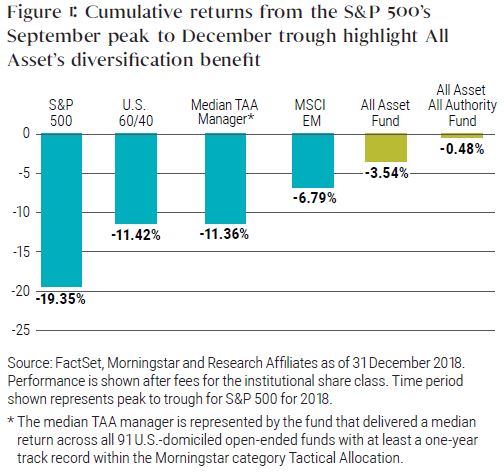
- The sharp correction late last year revealed flaws in the conventional narrative that emerging market (EM) stock losses are always magnified relative to U.S. losses: As U.S. stocks plunged 19.4% from their record high on 21 September 2018 to their 24 December low for the year, EM stocks declined just 6.8%.
- In our view, current valuations suggest that EM assets could fall less than U.S. assets in a bear market for U.S. stocks, and could even stage an impressive recovery if the U.S. avoids a bear market.
- Recent regulatory guidance requiring ’40 Act mutual funds to include “interest expense” in their expense ratios has raised questions by investors. However, the fee structures for the All Asset funds, including the fees payable to PIMCO as fund manager, have not changed.
Rob Arnott, founding chairman and head of Research Affiliates, discusses why corresponding declines in emerging markets stemming from a potential bear market for U.S. stocks may not follow patterns seen in the past, while John Cavalieri, PIMCO asset allocation strategist, sheds light on questions about interest expense reporting arising from a recent change in regulatory guidance. As always, their insights are in the context of the PIMCO All Asset and All Asset All Authority funds.
Q: If U.S. stocks enter a bear market, will there be sympathy declines in other areas, such as emerging market (EM) assets?
Arnott: Very likely, in our view. It bears mention, however, that unlike in past cycles, such as 2008–2009, other developed markets and especially emerging markets are priced at deep discounts to U.S. stocks (proxied by the MSCI EAFE, MSCI EM and S&P 500 indices, respectively). Consider emerging markets: With cheap valuations appearing to offer a margin of error on the downside, we believe EM assets could fall less than the U.S. in a bear market and even stage an impressive recovery if the U.S. manages to avoid a bear market.
Take what happened last quarter: As U.S. stocks plunged 19.4% from their record high on 21 September 2018 to their 24 December low for the year, EM stocks fared much better, with a decline of just 6.8%.
Where did this sharp correction leave us? The All Asset suite benefited over this span from a meaningful allocation to what we view as sensibly priced EM stocks.1 Compared with the conventional 60/40 stock/bond mix (proxied by the S&P 500 and the Bloomberg Barclays U.S. Aggregate Bond Index), cumulative losses were 7.88 percentage points lower for All Asset and 10.94 percentage points lower for All Authority (see Figure 1). Of note, the median manager in the Morningstar Tactical Allocation category over the same time span (21 September–24 December 2018) roughly matched the cumulative 11.36% loss of the 60/40 mix. Our All Asset strategies are designed to deliver downside mitigation and diversification benefits at times when diversification is most needed.

A natural question may follow: Do you believe the U.S. equity bull market – already the longest ever, and one of the largest – is mature (or over), or do you think it has a long way to run? If the former, diversification is more desirable now than it has been in many years.
Even after their recent decline, U.S. equities are among the most expensive in the world. As of 31 December 2018, the S&P 500 traded at a cyclically adjusted price-to-earnings (CAPE) ratio of 29.0x.2 Recall that this ratio has only topped 30x twice in the history of the capital markets: just before the 1929 crash and during the tech bubble of the early 2000s. In contrast, EAFE (Europe, Australasia and Far East) stocks are trading at a CAPE ratio of 15.5x, near their cheapest historical quartile since 1982 and at a 46% discount versus U.S. stocks. Levels are even more compelling for EM stocks, which are trading at a CAPE ratio of 12.5x, reflecting a near 60% discount versus U.S. stocks.
Contrast this with before the 2008–2009 cycle, when both developed and EM equities were trading at a premium relative to U.S. stocks. At year-end 2007, U.S. stocks were priced at a CAPE ratio of 25.9x, while EAFE stocks traded at 28.6x and EM stocks at 34.7x. With premium valuation levels of 10% over U.S. stocks for EAFE stocks and 34% for EM stocks, U.S. stocks fared better than these peers, falling 51.5% cumulatively from their peak on 19 May 2008 to their trough on 9 March 2009, compared with declines of 57.5% for EAFE and 60.0% for EM. These relative valuation levels stand in sharp contrast to today’s.
The sharp correction late last year revealed flaws in the conventional narrative that EM stock losses are always magnified relative to the level of U.S. losses during U.S. bear markets. EM stocks fared much better than U.S. stocks during the recent decline, while in the financial crisis of 2008-2009 they fared much worse. What’s the difference? At the start of 2008, EM stocks were priced at a 34% premium to U.S. stocks; in September 2018, when the S&P 500 hit its record high, they were trading at nearly a 60% discount.
Yes, the U.S. may be among the healthiest economies in the developed world, but we believe this is amply reflected in current valuations. It’s hard to make a case that economic growth is about to accelerate or that earnings will soar from current near-record levels (as a share of GDP or any other measure). We also think it’s worth considering another nuance that tends to be far under-appreciated in our industry: the relationship between economic strength and stock market performance.
The conventional wisdom is that economic growth and stock market returns go hand-in-hand. While this tends to be true over very long spans, it’s not necessarily the case in the short term. Why? Markets tend to look to the future, so even slowing (but still positive) growth can trigger a bear market. New enterprises (start-ups) and established companies are in competition for investment capital, a dynamic that has very different implications for the stock market and economic growth. Entrepreneurial capitalism, the creation of start-ups and risk-bearing enterprises, is a key driver of long-term economic growth. But in the short run, entrepreneurs often fund these new initiatives by liquidating existing “old economy” stocks and bonds. The desire to tap into these assets to fund new initiatives can cause prices to fall. As the “old economy” markets falter, they become priced to offer better prospective returns. So, bear markets can happen for a host of reasons.
Q: Why do the fees for the All Asset and All Asset All Authority Funds appear to have risen when viewed on Morningstar’s platform and on PIMCO’s website?
Cavalieri: The fee structure for the two funds has not changed, and the fees paid to PIMCO as the fund manager have not increased. The source of confusion affecting the All Asset funds – and many other funds in the industry similarly registered under the Investment Company Act of 1940 – is recent regulatory guidance requiring that interest expense from certain portfolio transactions be included in the Total Expense Ratio (TER) and Net Expense Ratio (NER) of those funds. These are not new expenses, and they are not fees payable to the fund manager; however, this disclosure requirement can create the appearance of an increase in fees.
Specifically, interest expense for the All Asset funds relates to certain return-seeking investment transactions within the funds or within the underlying PIMCO funds they hold. These transactions typically have two elements: a financing leg, which generates interest expense, and an associated long position, which seeks return in excess of the interest expense. So although interest expense is incurred as part of an investment strategy aimed to increase net returns to investors, the requirement to include interest expense in the funds’ TER and NER creates the appearance of elevated expenses without making as prominent the associated return potential.
The reporting requirement may be particularly notable for the PIMCO All Asset All Authority Fund, which is allowed by prospectus guidelines to employ leverage (up to 1.5x) and regularly does so. The interest expense from the borrowed cash is required to be included in the fund’s TER and NER. As of the most recent prospectus, interest expense from such borrowing activity increased the All Asset All Authority’s TER and NER by 91 basis points (0.91%). That would certainly get the attention of any investor! Again, however, that expense does not represent compensation to PIMCO; it was incurred as part of underlying two-legged investment transactions in All Asset and All Asset All Authority. Of course, if an investor is not aware that a fund’s TER and NER figures are comprised of multiple elements, they may understandably assume the observed TER/NER increase was the result of the fund manager increasing fees.
PIMCO agrees with Morningstar’s perspective as it relates to these disclosure requirements. Prior to July 2018, Morningstar had excluded these investment-related interest expenses from its published Net Expense Ratio, on the view that such expenses “are trading costs that are intrinsic to the fund’s strategy,” consistent “with [Morningstar’s] exclusion of brokerage costs from the calculation.”3 However, regulators now require this interest expense to be included in both the TER and NER on fund materials and web content.
To help investors distinguish management fees charged by PIMCO from other investment-related expenses, we recently added a footnote to our published TERs and NERs, which provides a Net Expense Ratio that excludes “interest expense” (when applicable). Other fund managers and industry participants have begun to take a similar approach.
These disclosure requirements may seem confusing, but PIMCO is committed to using our full toolkit of strategies in seeking maximum risk-prudent returns for our clients, net of all fees and expenses. We are similarly committed to working with clients to ensure they understand our investment strategies, their intended benefits and their associated reporting requirements.
The All Asset strategies represent a joint effort between PIMCO and Research Affiliates. PIMCO provides the broad range of underlying strategies – spanning global stocks, global bonds, commodities, real estate and liquid alternative strategies – each actively managed to maximize potential alpha. Research Affiliates, an investment advisory firm founded in 2002 by Rob Arnott and a global leader in asset allocation, serves as the sub-advisor responsible for the asset allocation decisions. Research Affiliates uses their deep research focus to develop a series of value-oriented, contrarian models that determine the appropriate mix of underlying PIMCO strategies in seeking All Asset’s return and risk goals.
1 Will we always have substantial positions in EM asset classes? Not necessarily. We have had as little as 11% in EM stocks, bonds and currencies combined in both All Asset and All Authority (at the end of 2010). We opportunistically focus on whatever is cheapest and offers what we view as the best long-term forward-looking return potential, among assets that provide an inflation hedge and a real-returns bias. Today, EM stocks and bonds are among the cheapest such assets.
2 At an earnings trough, the market is typically cheaper than it seems, because the “E” in the P/E ratio is artificially low, while at an earnings peak the market is more expensive than it seems. Looking at the CAPE ratio, or Shiller PE, is one way to address this problem. The CAPE compares today’s real stock market level with 10-year average real earnings. In so doing, it uses sustainable average earnings and avoids the distortions of peak or trough earnings.
3 See related Morningstar news release, “Changes to Prospectus Net Expense Ratio and Annual Report Net Expense Ratio – Effective July 31, 2018,” published May 25, 2018.
DISCLOSURES
Investors should consider the investment objectives, risks, charges and expenses of the funds carefully before investing. This and other information are contained in the fund’s prospectus and summary prospectus, if available, which may be obtained by contacting your investment professional or PIMCO representative or by visiting www.pimco.com. Please read them carefully before you invest or send money.
Past performance is not a guarantee or a reliable indicator of future results. The performance figures presented reflect the total return performance for the Institutional Class shares (after fees) and reflect changes in share price and reinvestment of dividend and capital gain distributions. All periods longer than one year are annualized. The minimum initial investment for Institutional class shares is $1 million; however, it may be modified for certain financial intermediaries who submit trades on behalf of eligible investors.
Investments made by a Fund and the results achieved by a Fund are not expected to be the same as those made by any other PIMCO-advised Fund, including those with a similar name, investment objective or policies. A new or smaller Fund’s performance may not represent how the Fund is expected to or may perform in the long-term. New Funds have limited operating histories for investors to evaluate and new and smaller Funds may not attract sufficient assets to achieve investment and trading efficiencies. A Fund may be forced to sell a comparatively large portion of its portfolio to meet significant shareholder redemptions for cash, or hold a comparatively large portion of its portfolio in cash due to significant share purchases for cash, in each case when the Fund otherwise would not seek to do so, which may adversely affect performance.
Differences in the Fund’s performance versus the index and related attribution information with respect to particular categories of securities or individual positions may be attributable, in part, to differences in the pricing methodologies used by the Fund and the index.
There is no assurance that any fund, including any fund that has experienced high or unusual performance for one or more periods, will experience similar levels of performance in the future. High performance is defined as a significant increase in either 1) a fund’s total return in excess of that of the fund’s benchmark between reporting periods or 2) a fund’s total return in excess of the fund’s historical returns between reporting periods. Unusual performance is defined as a significant change in a fund’s performance as compared to one or more previous reporting periods.
A word about risk:
The fund invests in other PIMCO funds and performance is subject to underlying investment weightings which will vary. Investing in the bond market is subject to risks, including market, interest rate, issuer, credit, inflation risk, and liquidity risk. The value of most bonds and bond strategies are impacted by changes in interest rates. Bonds and bond strategies with longer durations tend to be more sensitive and volatile than those with shorter durations; bond prices generally fall as interest rates rise, and the current low interest rate environment increases this risk. Current reductions in bond counterparty capacity may contribute to decreased market liquidity and increased price volatility. Bond investments may be worth more or less than the original cost when redeemed. Investing in foreign denominated and/or domiciled securities may involve heightened risk due to currency fluctuations, and economic and political risks, which may be enhanced in emerging markets. Commodities contain heightened risk including market, political, regulatory, and natural conditions, and may not be suitable for all investors. Mortgage and asset-backed securities may be sensitive to changes in interest rates, subject to early repayment risk, and their value may fluctuate in response to the market’s perception of issuer creditworthiness; while generally supported by some form of government or private guarantee there is no assurance that private guarantors will meet their obligations. High-yield, lower-rated, securities involve greater risk than higher-rated securities; portfolios that invest in them may be subject to greater levels of credit and liquidity risk than portfolios that do not. Investing in securities of smaller companies tends to be more volatile and less liquid than securities of larger companies. Inflation-linked bonds (ILBs) issued by a government are fixed-income securities whose principal value is periodically adjusted according to the rate of inflation; ILBs decline in value when real interest rates rise. Equities may decline in value due to both real and perceived general market, economic, and industry conditions. Entering into short sales includes the potential for loss of more money than the actual cost of the investment, and the risk that the third party to the short sale may fail to honor its contract terms, causing a loss to the portfolio. The use of leverage may cause a portfolio to liquidate positions when it may not be advantageous to do so to satisfy its obligations or to meet segregation requirements. Leverage, including borrowing, may cause a portfolio to be more volatile than if the portfolio had not been leveraged. Derivatives and commodity-linked derivatives may involve certain costs and risks such as liquidity, interest rate, market, credit, management and the risk that a position could not be closed when most advantageous. Commodity-linked derivative instruments may involve additional costs and risks such as changes in commodity index volatility or factors affecting a particular industry or commodity, such as drought, floods, weather, livestock disease, embargoes, tariffs and international economic, political and regulatory developments. Investing in derivatives could lose more than the amount invested. The cost of investing in the Fund will generally be higher than the cost of investing in a fund that invests directly in individual stocks and bonds. Diversification does not ensure against loss.
There is no guarantee that these investment strategies will work under all market conditions or are suitable for all investors and each investor should evaluate their ability to invest long-term, especially during periods of downturn in the market. Investors should consult their investment professional prior to making an investment decision.
Past rankings are no guarantee of future rankings. Morningstar Ranking for the Tactical Allocation category as of 31 January 2019 for the Institutional Class Shares; other classes may have different performance characteristics. The Morningstar Rankings are calculated by Morningstar and are based on the total return performance, with distributions reinvested and operating expenses deducted. Morningstar does not take into account sales charges.
Bloomberg Barclays U.S. Aggregate Index represents securities that are SEC-registered, taxable, and dollar denominated. The index covers the U.S. investment grade fixed rate bond market, with index components for government and corporate securities, mortgage pass-through securities, and asset-backed securities. These major sectors are subdivided into more specific indices that are calculated and reported on a regular basis.The S&P 500 Index is an unmanaged market index generally considered representative of the stock market as a whole. The index focuses on the Large-Cap segment of the U.S. equities market. It is not possible to invest directly in an unmanaged index. The MSCI EAFE Index (Europe, Australasia, Far East) is a free float-adjusted market capitalization index that is designed to measure the equity market performance of developed markets, excluding the US & Canada. The MSCI EAFE Index consists of the following 22 developed market country indices: Australia, Austria, Belgium, Denmark, Finland, France, Germany, Greece, Hong Kong, Ireland, Israel, Italy, Japan, the Netherlands, New Zealand, Norway, Portugal, Singapore, Spain, Sweden, Switzerland, and the United Kingdom. The MSCI Emerging Markets Index is a free float-adjusted market capitalization index that is designed to measure equity market performance of emerging markets. The MSCI Emerging Markets Index consists of the following 21 emerging market country indices: Brazil, Chile, China, Colombia, Czech Republic, Egypt, Hungary, India, Indonesia, Korea, Malaysia, Mexico, Morocco, Peru, Philippines, Poland, Russia, South Africa, Taiwan, Thailand, and Turkey.
This material contains the opinions of the manager and such opinions are subject to change without notice. This material has been distributed for informational purposes only and should not be considered as investment advice or a recommendation of any particular security, strategy or investment product. Information contained herein has been obtained from sources believed to be reliable, but not guaranteed. No part of this material may be reproduced in any form, or referred to in any other publication, without express written permission. PIMCO is a trademark of Allianz Asset Management of America L.P. in the United States and throughout the world.
©2019, PIMCO.
PIMCO Investments LLC, distributor, 1633 Broadway, New York, NY, 10019 is a company of PIMCO.
CMR2019-0131-378729
© PIMCO
Read more commentaries by PIMCO