SUMMARY
- For credit investors, the equity market can be an important source of information about growth expectations, and at times can serve as a leading indicator.
- However, recent developments in some defensive sectors – traditionally favored by equity and credit investors alike during periods of slowing growth – have led to a decline in credit quality, while some cyclical sectors, which are typically favored in higher-growth environments, have improved in credit quality.
- As a result, we think bond investors need to be very selective on sectors and individual companies at this late stage in the business cycle.
For credit investors, the equity market can be an important source of information about growth expectations, and at times can serve as a leading indicator. However, recent developments in some defensive sectors – traditionally favored by equity and credit investors alike during periods of slowing growth – have led to a decline in credit quality. At the same time, some cyclical sectors, which are typically favored in higher-growth environments, have improved in credit quality.
As a result, we think bond investors need to be very selective on sectors and individual companies at this late stage in the business cycle.
Rising concerns over economic and profit growth
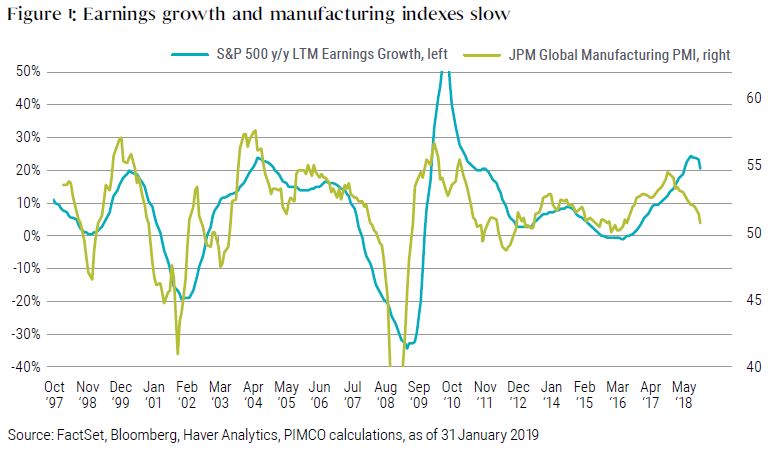
For much of the last two years, equity markets have enjoyed the tailwind of rising profit growth, but 2019 brings a more challenging, slower-growth backdrop, as recent global manufacturing surveys and negative earnings revisions have shown (see Figure 1). PIMCO forecasts slowing global GDP growth into 2020, and our models suggest flat profit growth this year, with risks mildly skewed to the downside. Lagged effects from tighter financial conditions, more difficult year-over-year comparisons due to the fiscal-stimulus-driven bump in the U.S. last year, as well as trade protectionism are all concerns in 2019.

This slower-growth environment does not necessarily mean negative market returns, but it can mean lower, more volatile returns as investors gauge the severity and duration of the slowdown, particularly as fear of recession periodically emerges.
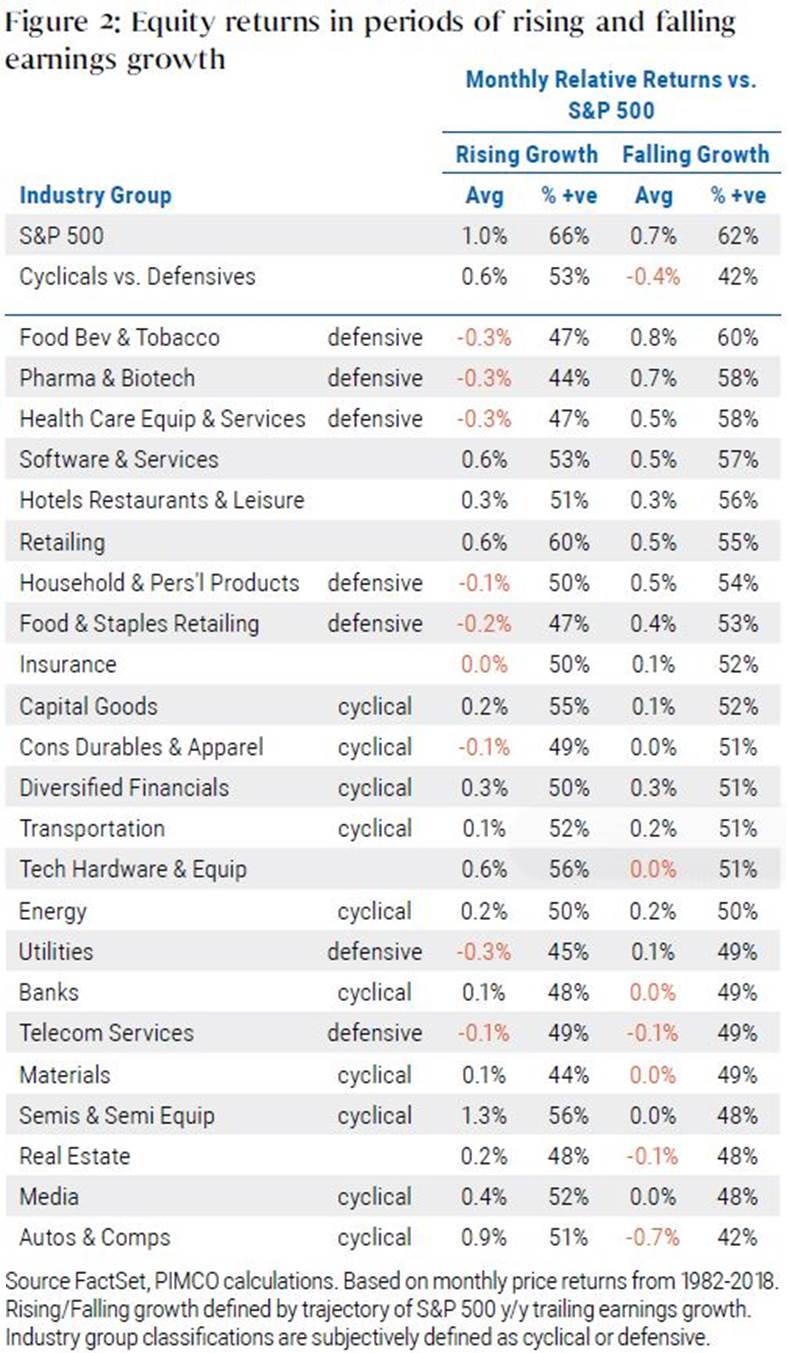
For investors, slowing growth environments may require more active management and dynamic positioning. Figure 2 shows average monthly equity returns by sector during past periods of rising and falling S&P 500 earnings growth. With the profit growth cycle peaking and expected to decelerate through 2019, historical returns suggest that tilting an equity portfolio toward less volatile, defensive groups could potentially benefit investors, while cyclical groups may not fare as well.
With volatility expected to continue as we enter 2019, a defensive allocation would typically favor high quality large capitalization companies over less liquid, more volatile small caps. However, most equity investors put greater emphasis on earnings growth rates in forecasting expected value, whereas bondholders tend to focus more on the current and future quality of the balance sheet. This is an important distinction today because recently many companies in defensive industry groups have become more aggressive in utilizing their balance sheets via mergers and acquisitions (M&A) and/or debt-financed stock buybacks.
Credit market implications
As a result of these changes, what may appear to be a defensive investment from a traditional equity standpoint is no longer necessarily defensive from the viewpoint of a bondholder. In fact, the lines between defensive and cyclical companies have become increasingly blurred for bondholders.
One interesting example of a traditionally defensive sector that has undergone rapid change from a credit perspective is the consumer noncyclical sector, which had the highest notional amount of credit rating downgrades from A- to BBB of any sector in 2018, based on a Credit Suisse study. Elevated M&A activity was a key driver: Increased M&A-driven issuance, while offering attractive potential returns, has also increased corporate leverage ratios and pushed several companies to the verge of downgrade.
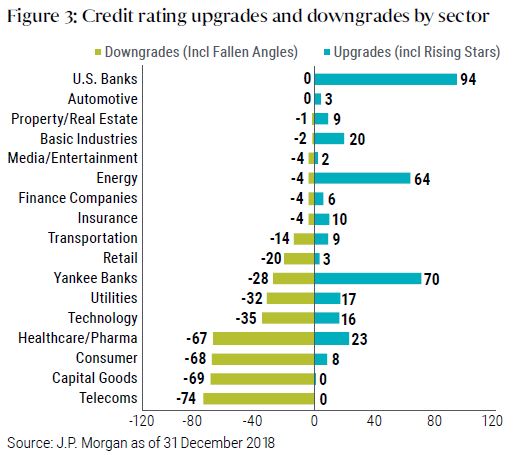
Other defensive industries are undergoing fundamental shifts, such as the consumer staples sector where customer preferences and shopping habits are changing. The result has also been a deterioration in credit quality, with a poor upgrade–to–downgrade ratio of 8 to 68 – close to the worst among nonfinancial sectors, as shown in Figure 3.
That said, many companies in defensive sectors like consumer noncyclicals, healthcare and telecoms generally have the capacity and ability to delever during periods of slowing or no economic growth by selling assets at relatively favorable multiples. By contrast, issuers in more cyclical industries like autos and energy may become more constrained in such times. Defensive companies also have the ability to reduce their generally high stream of dividends, utilizing their relatively steady free cash flow streams to reduce debt.
Yet, even as credit quality has declined in some defensive sectors, we see some traditional cyclical companies with improving fundamentals. One important example would be the energy sector, where net leverage has dropped from 3.07x to 2.37x (3Q 2017 versus 3Q 2018) based on J.P. Morgan data. Notably, the majority of energy M&A in the last 12 months was funded with equity rather than debt. Not only that, the amount of M&A was relatively modest, and some of the large integrated oil companies acted more conservatively than many expected. The improvement in credit quality in the energy sector has led to a favorable upgrade–to–downgrade ratio of 64 to 4 – the best among nonfinancial sectors, according to J.P. Morgan data.
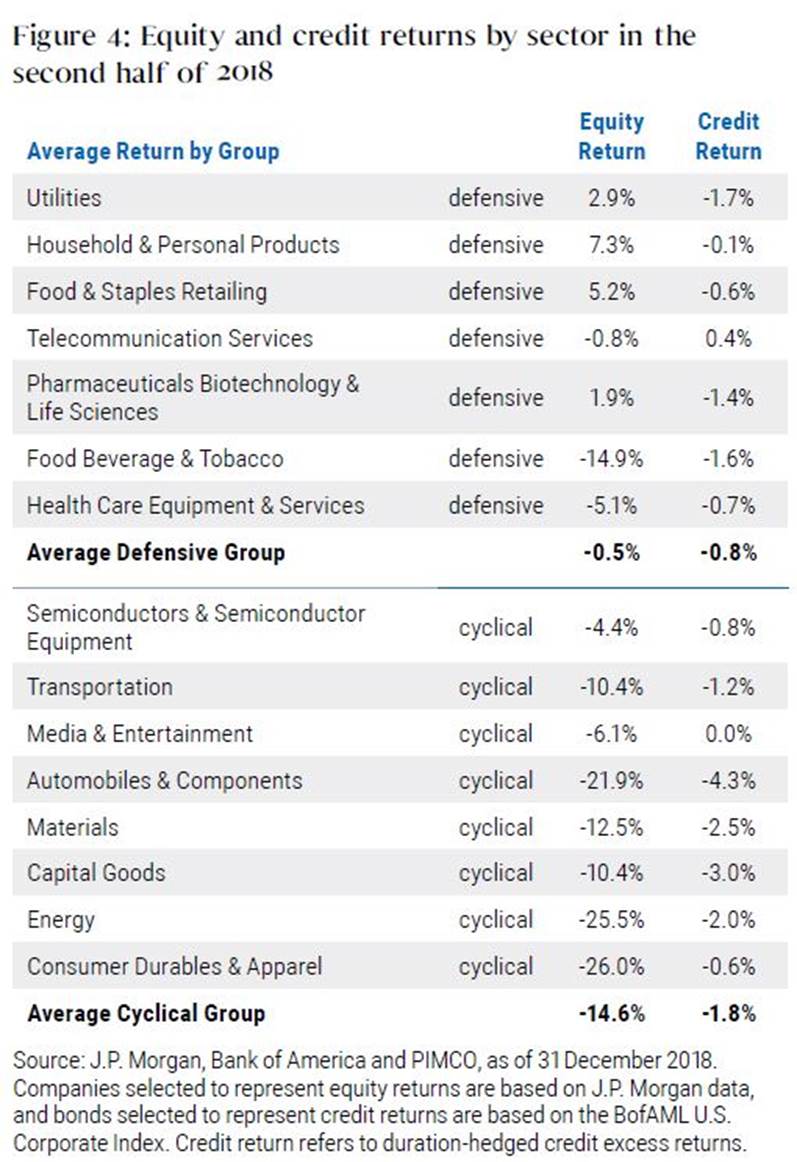
While cyclicals in general have underperformed noncyclicals in the equity market recently, the performance difference is much less in the credit market as Figure 4 shows, in part because of positive changes in credit quality.
Also of note in last year’s second-half returns, consumer durables and apparel, a cyclical sector that experienced poor equity returns, had only modestly negative credit returns. But in our view, these issuers are not necessarily going to be creditor-friendly in the future (given their equity performance); the weakness in equity performance may simply not be reflected yet in the credit market. Conversely, some companies that have levered up in years past, such as in the beverage and telecom sectors, will likely focus on debt reduction in the years ahead, while also remaining somewhat insulated from economic shocks due to their lower profit variability and their ability to be proactive in protecting their balance sheets.
What it all means for credit investors
The lines between defensive and cyclical sectors are increasingly blurred for credit investors due to recent changes in credit quality. It is therefore of the utmost importance for credit investors to do rigorous research and thoughtful credit selection, focusing on the competitive position of individual companies and barriers to entry for the underlying businesses.
As recession risk rises, we think relying on traditional classifications of companies as defensive or cyclical will not work as well in credit as it has in the past. Taking broad exposure to defensive sectors may still help equity investors in the year ahead, but in credit, careful selection will be crucial.
DISCLOSURES
Past performance is not a guarantee or a reliable indicator of future results.
Investing in the bond market is subject to risks, including market, interest rate, issuer, credit, inflation risk, and liquidity risk. The value of most bonds and bond strategies are impacted by changes in interest rates. Bonds and bond strategies with longer durations tend to be more sensitive and volatile than those with shorter durations; bond prices generally fall as interest rates rise, and the current low interest rate environment increases this risk. Current reductions in bond counterparty capacity may contribute to decreased market liquidity and increased price volatility. Bond investments may be worth more or less than the original cost when redeemed. Equities may decline in value due to both real and perceived general market, economic and industry conditions. The credit quality of a particular security or group of securities does not ensure the stability or safety of the overall portfolio.
There is no guarantee that these investment strategies will work under all market conditions or are suitable for all investors and each investor should evaluate their ability to invest long-term, especially during periods of downturn in the market. Investors should consult their investment professional prior to making an investment decision.
The S&P 500 Index is an unmanaged market index generally considered representative of the stock market as a whole. The index focuses on the Large-Cap segment of the U.S. equities market. It is not possible to invest directly in an unmanaged index.
This material contains the opinions of the manager and such opinions are subject to change without notice. This material has been distributed for informational purposes only. Forecasts, estimates and certain information contained herein are based upon proprietary research and should not be considered as investment advice or a recommendation of any particular security, strategy or investment product. Information contained herein has been obtained from sources believed to be reliable, but not guaranteed. No part of this material may be reproduced in any form, or referred to in any other publication, without express written permission. PIMCO is a trademark of Allianz Asset Management of America L.P. in the United States and throughout the world.
©2019, PIMCO.
© PIMCO
Read more commentaries by PIMCO