SUMMARY
- Variations across the U.S. credit market continue to offer high-conviction opportunities for active investment approaches, versus relying on generic beta exposure. We see opportunities in financials, high-quality taxable municipal bonds, agency mortgage-backed securities, and securitized products, which in our view offer better risk/reward profiles than most single-A corporates with relatively less downgrade risk.
- Releveraging risk may often be higher with single-A companies than BBB companies, and we also note that rating agencies have a negative outlook on a significant number of U.S. single-A nonfinancial issuers. The high dispersion in risk profiles across single-A corporate names reiterates the importance of thorough bottom-up credit research.
U.S. corporate bond markets have transformed in the past few years as the proportion of BBB rated credit has swollen. There’s little room for error, as we noted back in January 2018. Where do we stand now? Many investors express justifiable concerns about the sheer size of the BBB market, but we believe the spotlight on BBBs has diverted attention from the risks in the smaller single-A market.
These trends highlight the importance of thoughtful credit research, risk assessment, and active portfolio management across all credit markets, versus relying on generic beta exposure. We’re seeing select opportunities in several sectors both within and beyond corporate credit.
Credit market deterioration and spread widening
Deterioration in the U.S. credit market’s overall ratings has continued – for example, $180 billion in single-A corporate bonds were downgraded to BBB in 2018, according to Credit Suisse.
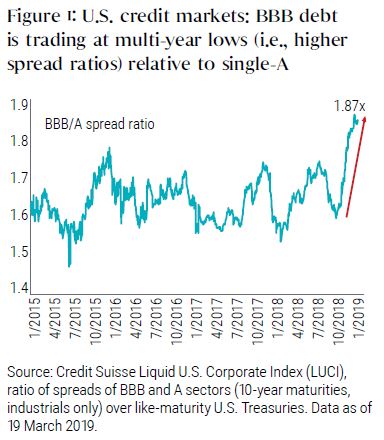
These downgrades from A to BBB were accompanied by a large widening of credit spreads over like-maturity U.S. Treasuries, in part because a significant part of the investor base sold the downgraded debt due to guideline constraints or risk aversion. Moreover, on a spread ratio basis, U.S. BBB debt has underperformed single-A (see Figure 1): Over the past year, the BBB/A spread ratio rose from 1.58x to 1.87x, with the higher ratio indicating that average BBB bond prices (quoted as spreads over Treasuries) became lower, or cheaper, relative to single-A bond prices.

Some market observers might argue that BBB debt is meant to trade at a consistently wider level versus single-A, given too much supply of BBB and a relative dearth of single-A (as well as the difference in credit quality). However, we don’t necessarily agree. Our view is that releveraging risk may often be higher with single-A companies than BBB companies. (This is the risk an issuer makes decisions, such as engaging in mergers and acquisitions (M&A) that increase the net leverage on its books, which may in turn raise concerns at rating agencies.) Aside from the relatively high risk of releveraging, we have also witnessed a relatively poor track record of deleveraging by A rated companies that were downgraded to BBB following a releveraging M&A transaction. In our opinion, single-A debt may be more risky relative to BBB debt than it has tended to be historically – precisely the opposite of what the spread ratio seems to indicate.
A recent Goldman Sachs study1 of capital management commentaries in issuers’ earnings reports noted that many higher-rated investment grade (IG) companies suggested they are using their excess debt capacity (such as existing financial flexibility and balance sheet strength) to return money to shareholders as well as to engage in M&A activities, hinting at further releveraging to come.
Negative ratings outlooks
We also note that rating agencies have a negative outlook on a significant number of U.S. single-A nonfinancial issuers (source: Credit Suisse):
- 19% of nonfinancials rated A−/A/A+ have a negative outlook on at least one of their agency ratings. However, none are on negative watch (“negative watch” would mean the issuers or issues are formally under review for a downgrade).
- 20% of nonfinancials rated A−/A/A+ and higher have a negative outlook on at least one of their agency ratings.
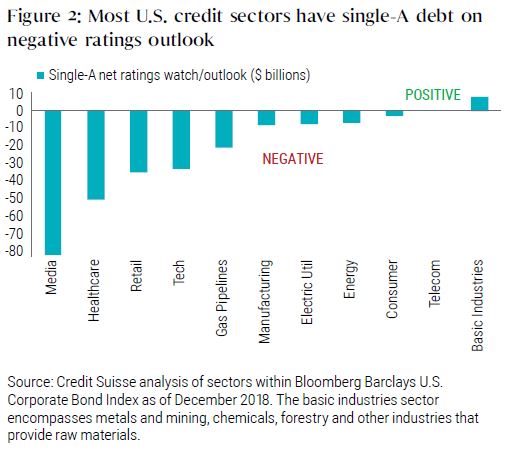
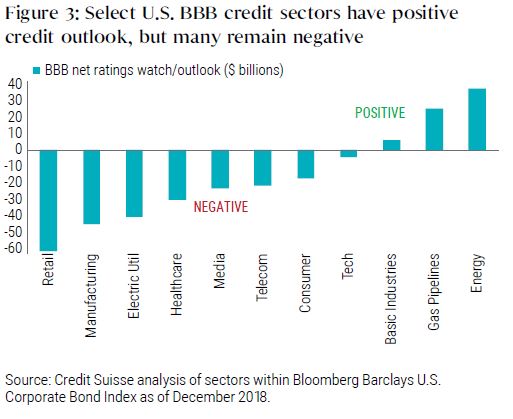
In fact, nearly all U.S. credit sectors (except for basic industries) have more single-A debt with negative ratings outlooks than with positive outlooks (see Figure 2). Media and healthcare have the most assets at potential risk of downgrade. Among BBBs, the picture is more balanced (see Figure 3), with the most positive momentum in energy and pipelines, and retail more likely to struggle.
Compelling alternatives to A rated corporate bonds
For investors seeking the yield potential and risk profile of high quality (A to AA) debt, within U.S. corporate credit we generally favor financials (both banks and REITs, or real estate investment trusts), where the upgrade-to-downgrade ratio remains favorable. Among banks, capital ratios are significantly better (higher and more stable) than before the global financial crisis, and we do not see much chance of relaxed regulation that could jeopardize the current enhanced credit quality.
Outside corporate credit, we see attractive opportunities in high quality taxable municipal bonds, agency MBS (mortgage-backed securities), and securitized products, which in our view offer better risk/reward profiles than single-A corporates with relatively less downgrade risk.
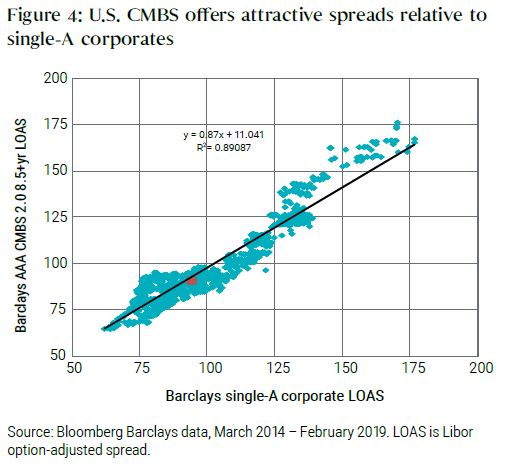
One example of a high quality U.S. securitized sector is non-agency CMBS (commercial mortgage-backed securities). Within this U.S. CMBS sector is a subset of bonds colloquially known as “dupers” or “super-dupers,” a term that refers to the bonds’ high levels of credit enhancement. Even the 2005–2008 vintages of these bonds never took a loss during the financial crisis due to their structural seniority. Today, these “dupers,” which are all rated AAA, trade at 65 bps – 90 bps Libor OAS, with a range of five to 10 years in weighted average life (maturity), according to Bloomberg.
We believe that these types of senior securitized bonds provide a compelling alternative to single-A corporates while trading at competitive levels (see Figure 4). For investors with the flexibility to tactically allocate to senior securitized products, senior CMBS provide a similar spread, beta, duration, and convexity to single-A corporates, while the seniority and credit enhancement of CMBS provide a rating pickup and help mitigate potential future idiosyncratic downgrade and default risk. Of note, select non-U.S. commercial and residential MBS may offer attractive risk-adjusted opportunities as well.
Seeking stability and high-conviction ideas
We believe the variations across the credit market will continue to offer excellent high-conviction opportunities for active investment approaches. The market’s tremendous recent growth, crowded positioning, and liquidity concerns mean that we believe portfolios shouldn’t be overly exposed to generic corporate credit, as a downturn could be costly. There are more attractive alternatives available across the changing credit spectrum. PIMCO’s long-held emphasis on rigorous research and thoughtful selection, aided by our top-down macroeconomic views, can help investors navigate today’s credit markets.
1 Goldman Sachs Credit Notes: “IG takeaways from earnings: Shareholders and M&A remain in focus” (21 February 2019)
DISCLOSURES
Past performance is not a guarantee or a reliable indicator of future results.
All investments contain risk and may lose value. Investing in the bond market is subject to risks, including market, interest rate, issuer, credit, inflation risk, and liquidity risk. The value of most bonds and bond strategies are impacted by changes in interest rates. Bonds and bond strategies with longer durations tend to be more sensitive and volatile than those with shorter durations; bond prices generally fall as interest rates rise, and low interest rate environments increase this risk. Reductions in bond counterparty capacity may contribute to decreased market liquidity and increased price volatility. Bond investments may be worth more or less than the original cost when redeemed. Corporate debt securities are subject to the risk of the issuer’s inability to meet principal and interest payments on the obligation and may also be subject to price volatility due to factors such as interest rate sensitivity, market perception of the creditworthiness of the issuer and general market liquidity. High yield, lower-rated securities involve greater risk than higher-rated securities; portfolios that invest in them may be subject to greater levels of credit and liquidity risk than portfolios that do not.
There is no guarantee that these investment strategies will work under all market conditions or are suitable for all investors and each investor should evaluate their ability to invest long-term, especially during periods of downturn in the market. Investors should consult their investment professional prior to making an investment decision.
The credit quality of a particular security or group of securities does not ensure the stability or safety of an overall portfolio. The quality ratings of individual issues/issuers are provided to indicate the credit-worthiness of such issues/issuer and generally range from AAA, Aaa, or AAA (highest) to D, C, or D (lowest) for S&P, Moody’s, and Fitch respectively.
This material contains the opinions of the manager and such opinions are subject to change without notice. This material has been distributed for informational purposes only and should not be considered as investment advice or a recommendation of any particular security, strategy or investment product. It is not possible to invest directly in an unmanaged index. Information contained herein has been obtained from sources believed to be reliable, but not guaranteed. No part of this material may be reproduced in any form, or referred to in any other publication, without express written permission. PIMCO is a trademark of Allianz Asset Management of America L.P. in the United States and throughout the world.
©2019, PIMCO.
© PIMCO
Read more commentaries by PIMCO