The hope in an arranged marriage is that people marry, and then fall in love. Sometimes that works, other times it doesn’t. Two decades after inception, the eurozone countries’ arranged marriage-type of union looks shaky at best, and now it is even more challenged by ongoing, global disruptive forces.
PIMCO’s Secular Forum recently highlighted that these disruptive forces, including Populism, Technology, Demographics and a slowdown in China, could challenge our view that over the next three to five years the global economy will stay on a New Normal path, characterized by low growth, low inflation and low interest rates.
Unfortunately, a New Normal baseline is probably the best that the eurozone can hope for. With public and private debt levels elevated, a rapidly aging population and evidence that inflation expectations are being anchored at depressed levels, we believe that Europe could be prone to a Japanification effect, essentially a state of long-term stagnation. What’s more, the eurozone’s fragile economy and half-hearted unity suggest that the monetary union could be more vulnerable to disruptions than other economic areas. Let’s see how each of the five disruptive forces identified by PIMCO could threaten the eurozone and whether investors can still find opportunity in the region:
-
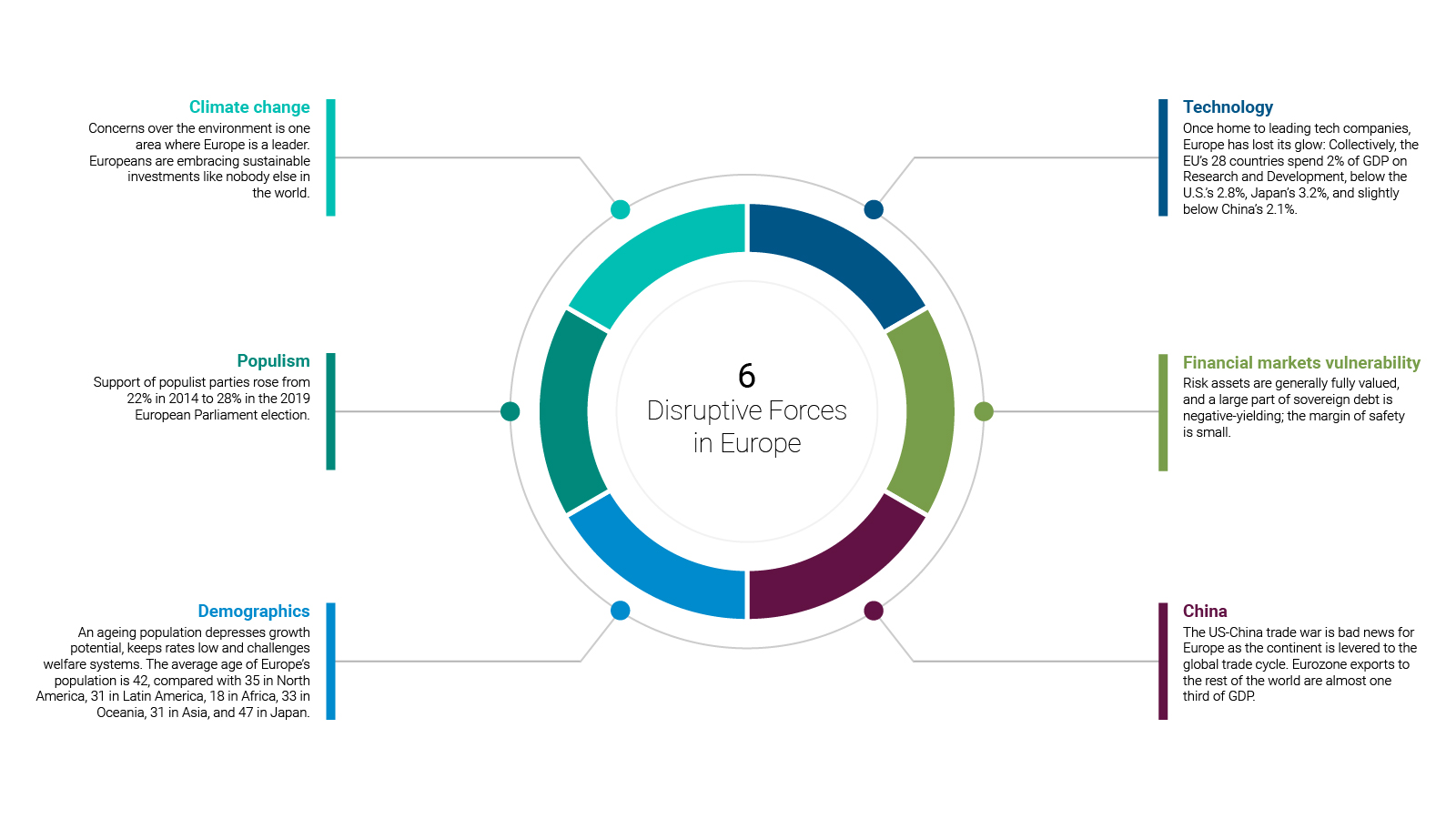
China: The economic slowdown in China and rising global trade tensions are particularly damaging for the eurozone. Its current account surplus of about 3% of gross domestic product (GDP) makes it highly exposed to the global trade cycle. This is especially true in Germany, Europe’s largest economy, which runs a current account surplus of over 7% of GDP, among the world’s highest. Extra-eurozone exports constitute about 28% of the eurozone’s total GDP, far exceeding the 12% and 20% figures for the U.S. and China, respectively. In 2018, China was the eurozone’s third-largest goods export destination, and the largest source of goods imports in Europe, according to the European Union’s (EU) data agency Eurostat. China and the eurozone trade on average over €1 billion a day – mostly machinery and equipment, motor vehicles, aircraft, and chemicals.
-
Populism: The rise in populism is of particular significance in the eurozone, as it often contains elements of EU and euro skepticism. Granted, most populist parties have scaled down their anti-European rhetoric recently, but contempt towards EU institutions is part of most of these parties’ DNA. These parties might resurrect a more antagonistic attitude towards the EU and the currency union if the region is hit by an economic crisis. Already, the proliferation of more extreme parties has increased political fragmentation in countries such as Spain and Italy, leading to difficulties in government formation, political instability, and the challenge of squaring competing populist policies.
-
Demographics: The eurozone’s working-age population, now stagnant, looks set to contract over the next decade, according to the UN. The old-age dependency ratio (the number of those above 65 as a share of the working-age population aged 15 to 64), stands at just over 30%, and looks set to move to above 40%, according to European Commission projections. Amongst major regions, the eurozone is second only to Japan in terms of how rapidly the population is ageing.
This presents many challenges: First, fewer working age people may find it harder to finance an increasing number of retirees; and secondly, aging populations tend to save more and consume less, fueling the already large savings glut in the region. More savings, among other factors, have helped push down bond yields, a drag for many pension plans as they are not earning enough interest to meet future obligations. In Germany, for instance, highly regulated insurance companies are suffering as yields on all of the country’s sovereign debt are now negative. Arguably, excess savings have also contributed to a mispricing of capital, disrupting an efficient allocation of resources.
-
Technology: Once home of leading technology companies, Europe has lost significant ground to the U.S. and China, where tech giants have grown exponentially. Investment growth has lagged in the eurozone and productivity growth, at just under 1% a year over the past decade, has remained subdued. According to Organisation for Economic Co-operation and Development (OECD) data, the 28 European Union countries spent 2% of GDP on research and development, below the U.S.’s 2.8%, Japan’s 3.2%, and marginally below China’s 2.1%.
-
Financial market valuations: The European Central Bank (ECB) policy rate, 10-year German yields, and now even 30-year Bund yields are negative, well below the level of their equivalents in the U.S., the U.K., and even below Japan’s. Negative yields have pushed investors to reach for yield, but have failed to lift growth or inflation in a sustained fashion. With nominal growth remaining stubbornly low, asset valuations look increasingly expensive, which poses the risk of sudden corrections ahead.
Challenges of an arranged marriage
In its 20th year, the monetary union remains a work in progress and is still inherently unstable, as we argued last year, due to structurally low inflation in core countries, a lack of commitment to macro convergence among countries, and a lack of willingness to commit to further fiscal and political integration.
The ECB has been the glue that has held the region together but, with policy rates at negative levels, and unconventional measures such as forward guidance, long term refinancing operations (LTROs, or the provision of long-term cheap loans to banks) and quantitative easing having already been implemented in a significant way, the bullets in the monetary arsenal are starting to look scarce.
The effect of monetary easing has been diminishing, suggesting that other policies – first and foremost fiscal policy – would be needed to lift growth. However, the likelihood that the eurozone will engage in meaningful fiscal easing looks relatively low, as the countries which are most able to do so (Germany and the Netherlands) tend to be the least willing, while the most willing (like Italy) are the least able. As a whole, with a budget deficit of -0.5% of GDP and government debt of 87% of GDP, the fiscal parameters of the eurozone look relatively healthy compared with other major economies. But eurozone public finances remain anchored at the national level, and the surge of populism and nationalism dim prospects for further fiscal and political integration.
Overall, the lack of effective countercyclical policy tools and political cohesion make the monetary union vulnerable in the next economic downturn.
Investment implications
This fragile backdrop warrants caution when investing in eurozone peripheral and risk assets. The ECB can support the region for some time ahead, but we would warn investors to be mindful when making trades that are excessively reliant on central bank action, which is becoming less and less effective as interest rates fall further into negative territory. Political risk should also be factored in.
Still, we see pockets of opportunity in high quality sectors in Europe. These include financial institutions, which have been repairing their balance sheets since the 2007-08 financial crisis, and securitized assets that offer decent returns relative to their risk profile. In terms of core assets, we see potential for a further flattening of the Bund curve in light of the region’s Japanification.
Just as the hope in an arranged marriage is that people will fall in love, the hope 20 years ago was that the currency union would foster fiscal and political integration. So far, the European project hasn’t delivered what many had hoped, although the marriage is still holding. As we wrote in August, many view the recent appointments of Christine Lagarde and Ursula von der Leyen to lead the ECB and the European Commission, respectively, as a nod towards completing the eurozone’s unfinished institutional architecture. Maybe they will again do whatever it takes to resurface the path towards a real union, perhaps turning this arranged marriage into a more cohesive blend. However, this is far from guaranteed.
Disruptive Forces in Europe
 Learn more about PIMCO’s long-term outlook for Europe and the global economy in our Secular Outlook, “Dealing With Disruption.”
DISCLOSURES
All investments contain risk and may lose value. Investing in the bond market is subject to risks, including market, interest rate, issuer, credit, inflation risk, and liquidity risk. The value of most bonds and bond strategies are impacted by changes in interest rates. Bonds and bond strategies with longer durations tend to be more sensitive and volatile than those with shorter durations; bond prices generally fall as interest rates rise, and low interest rate environments increase this risk. Reductions in bond counterparty capacity may contribute to decreased market liquidity and increased price volatility. Bond investments may be worth more or less than the original cost when redeemed.
There is no guarantee that these investment strategies will work under all market conditions or are suitable for all investors and each investor should evaluate their ability to invest for the long term, especially during periods of downturn in the market. Investors should consult their investment professional prior to making an investment decision.
This material contains the opinions of the manager and such opinions are subject to change without notice. This material has been distributed for informational purposes only and should not be considered as investment advice or a recommendation of any particular security, strategy or investment product. Information contained herein has been obtained from sources believed to be reliable, but not guaranteed. No part of this material may be reproduced in any form, or referred to in any other publication, without express written permission. PIMCO is a trademark of Allianz Asset Management of America L.P. in the United States and throughout the world.
©2019, PIMCO.
CMR2019-0815-410583
© PIMCO
More Alternative Investments Topics >
 Learn more about PIMCO’s long-term outlook for Europe and the global economy in our Secular Outlook, “Dealing With Disruption.”