SUMMARY
- With major stock markets in an elevated late-cycle environment, growing numbers of institutional investors are buying long U.S. Treasuries to hedge equity risk. But this comes at a cost: 10-year Treasuries are yielding less than 2%.
- Fortunately, a more nuanced approach may provide a less costly way to blunt the damage from an equity drawdown, while also potentially improving the risk/return trade-off.
- Our research finds that on average long Treasuries near the “belly” of the curve – around five years – maximize the diversification benefit relative to a standard 60/40 stock/bond benchmark portfolio.
- Moreover, a dynamic swap overlay – positioned along the yield curve to account for carry and the stage of the business cycle – has the potential to deliver sizable Sharpe ratio and drawdown improvements.
As major stock markets hit record highs, growing numbers of institutional investors are buying long U.S. Treasuries to hedge equity risk. But this comes at a cost: 10-year Treasuries are yielding less than 2%. Fortunately, a more nuanced approach may provide a less costly way to blunt the damage from an equity drawdown, while also potentially improving the risk/return trade-off.
We researched the optimal spot on the yield curve to hedge equity risk with long Treasuries. On average, the “belly” of the curve – around five years – maximizes the diversification benefit relative to a standard 60/40 benchmark portfolio, we found. Moreover, a dynamic swap overlay – positioned along the yield curve to account for carry and the stage of the business cycle – has the potential to deliver sizable Sharpe ratio and drawdown improvements. The details and methodology of our analysis is detailed in “Optimal Yield-Curve Positioning for Multi-Asset Portfolios.”
Finding the most effective hedge
A relatively simple way to analyze hedging effectiveness is to examine every point of the yield curve, scaled by duration, and calculate its hedging beta with respect to the equity market. The lower the beta, the better hedging properties it will provide.
We found that physical bonds with maturities between four and seven years provided the best hedge to equities in our sample period.
If investors use swaps instead, 10-year maturities were the most effective in the U.S., Europe and the U.K. (while the 30-year was the most effective in Japan).
However, this analysis is somewhat limited because it does not account for volatility. To rectify this, we calculated the potential Sharpe ratio improvement from shifting the position along the curve.
Maximizing return per unit of risk
To determine which point along the yield curve offers the best returns per unit of risk, PIMCO has long looked at two key measures: carry and roll-down. (Essentially, carry refers to the yield on the portfolio, while roll-down refers to the return earned from “rolling down” the yield curve – when a five-year bond becomes a four-year bond, etc.)
Combined, carry and roll-down refer to the estimated expected return on a bond that results simply from the passage of time. Based only on carry and roll-down, the maximum average return for the benchmark portfolio used in our research is located at the five-year portion of the curve. (We would note, however, that this can shift over time, depending on the steepness or flatness of the yield curve – which, in turn, is driven by the business cycle.) Hence the next part of our analysis takes business cycle dynamics into account.
Incorporating the business cycle
The yield curve tends to flatten late in the business cycle as it did in the U.S. in mid-August. This movement occurs in tandem with the central bank raising rates beyond expectations in order to curb inflation. But the yield curve will steepen when a recession hits, as the short end will reflect easing monetary policy.
This simple dynamic can serve as a basis for implementing a basic mean-reversion model to capture the portion of expected returns driven by a change in prices. We add this mean reversion to our analysis by moving into the portion of the curve where the expected return derived from mean reversion is highest. (Note, we used a fairly simple mean-reversion model. Investors would likely want to improve upon these results with their own more sophisticated models.)
Applications for public plans
Our analysis may be particularly relevant to public plans.
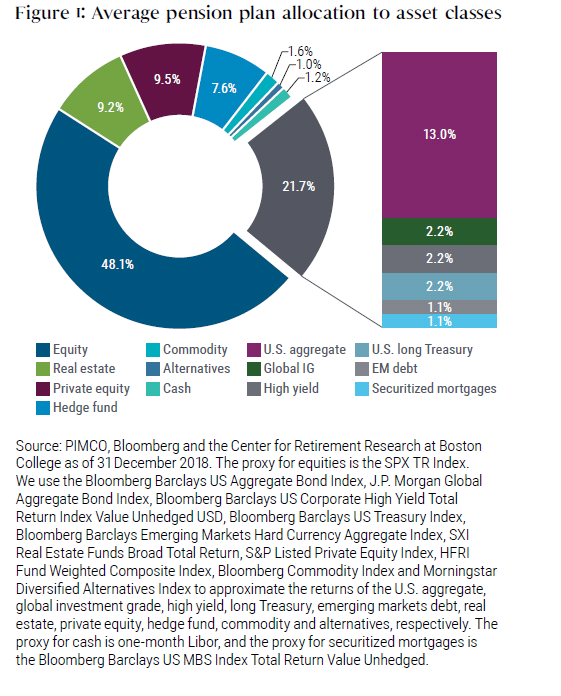
The average public plan (not only in the U.S. but across developed markets) allocates about 22% of its assets to fixed income. Within this category, about 60% of assets are allocated to the Bloomberg Barclays US Aggregate Bond Index. The balance consists of global investment grade, high yield, U.S. long Treasuries, emerging market debt and securitized mortgages (see Figure 1).

To evaluate the optimal contract used to obtain the target duration exposure, we replace the 10% U.S. long Treasury exposure within the fixed income allocation with a Libor exposure and add a swap overlay leveraged to obtain the same duration as a representative U.S. long Treasury index. Given that we aim to determine which position in the swap curve provides the maximum benefit to the portfolio, we calculate the expected Sharpe ratio to serve as a ranking criterion for different contracts across time. Each month, we select the swap tenor with the highest expected Sharpe ratio for optimal positioning along the curve. Likewise, we choose to compare the strategy with the same level of duration achieved by the benchmark Treasury portfolio so we can assess the effectiveness of each contract at reaching the same target. A separate and interesting question is the amount of duration to take to offset equity risk – a question we do not answer in this exercise.
As noted, in many states of the markets and economies, we found that the medium-tenor part of the curve was the optimal point of exposure for the dynamic model used in our research. But this can break down under some circumstances.
For instance, if we experience a structural change in the slope of the curve, either because of a repricing of inflation risk or because of an anticipated new inflation regime, the model will mean revert to the incorrect target. To derive the best benefit from this approach, the manager should use a satisfactory model of yield curve mean reversion. Different views of the target values of the yield curve will inform different optimal positioning strategies.
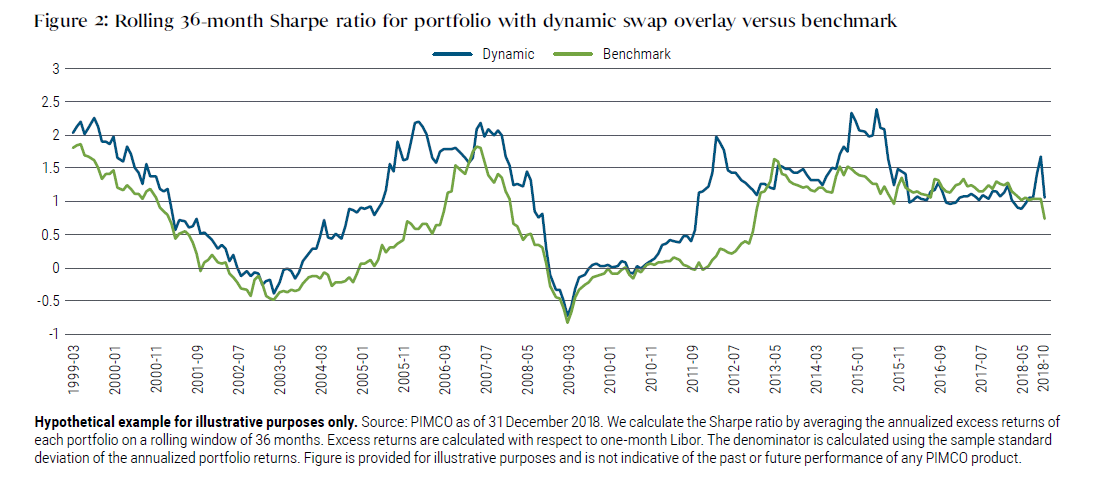
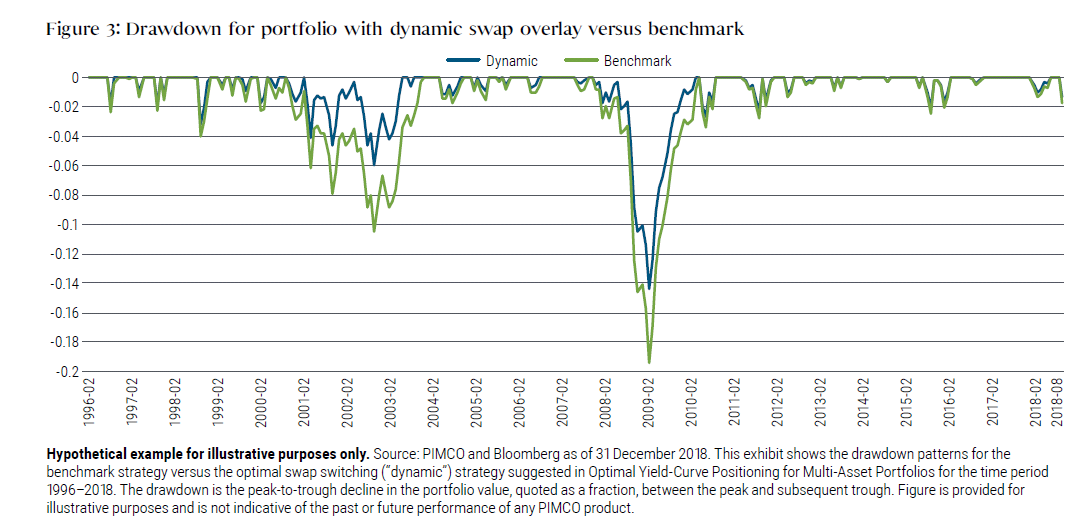
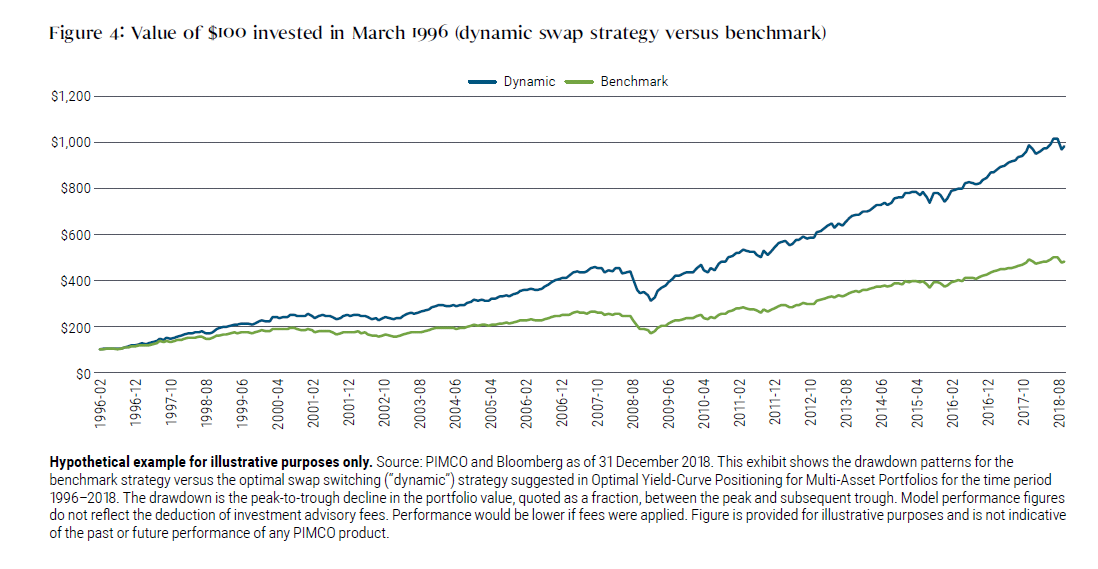
By using this dynamic swap switching strategy in our research, we were able to improve the total Sharpe ratio fairly materially compared with using long Treasury physical bonds (0.915 versus 0.621). Moreover, the 36-month rolling marginal Sharpe ratio over the benchmark, illustrated in Figure 2, is positive for 99% of the sample before 2012 and drops to 63% from 2012 onward. This strategy was also more effective than a naïve allocation to long Treasuries (physicals) in protecting against an equity drawdown. As illustrated in Figure 3, the maximum drawdown experienced in both the dot-com crash and the financial crisis is substantially lower in the portfolio with the swap overlay.
Conclusion
Investors with long Treasury allocations should consider whether the following enhancements may be beneficial to their portfolio.
1. Switch out physical Treasury bonds for swaps or futures to better pinpoint individual points on the yield curve (and consider leverage if needed).
2. Use swaps to target the area of the yield curve with the best hedging properties and highest Sharpe ratio, generally the belly of the curve (about five years), while making adjustments based on carry, roll-down, and the phase of the business cycle.
DISCLOSURES
This paper contains hypothetical analysis. Results shown may not be attained and should not be construed as the only possibilities that exist. The analysis reflected in this information is based upon data at time of analysis. Forecasts, estimates, and certain information contained herein are based upon proprietary research and should not be considered as investment advice or a recommendation of any particular security, strategy or investment product.
Hypothetical and simulated examples have many inherent limitations and are generally prepared with the benefit of hindsight. There are frequently sharp differences between simulated results and the actual results. There are numerous factors related to the markets in general or the implementation of any specific investment strategy, which cannot be fully accounted for in the preparation of simulated results and all of which can adversely affect actual results. No guarantee is being made that the stated results will be achieved.
Target and expected returns are for illustrative purposes only and are not a prediction or a projection of return. Return targets and expectations are an estimate of what investments may earn on average over the long term. Actual returns may be higher or lower than those shown and may vary substantially over shorter time periods.
Figures are provided for illustrative purposes and are not indicative of the past or future performance of any PIMCO product. It is not possible to invest directly in an unmanaged index.
Past performance is not a guarantee or a reliable indicator of future results. All investments contain risk and may lose value. Investing in the bond market is subject to risks, including market, interest rate, issuer, credit, inflation risk, and liquidity risk. The value of most bonds and bond strategies are impacted by changes in interest rates. Bonds and bond strategies with longer durations tend to be more sensitive and volatile than those with shorter durations; bond prices generally fall as interest rates rise, and low interest rate environments increase this risk. Reductions in bond counterparty capacity may contribute to decreased market liquidity and increased price volatility. Bond investments may be worth more or less than the original cost when redeemed. Certain U.S. government securities are backed by the full faith of the government. Obligations of U.S. government agencies and authorities are supported by varying degrees but are generally not backed by the full faith of the U.S. government. Portfolios that invest in such securities are not guaranteed and will fluctuate in value. Swaps are a type of derivative; swaps are increasingly subject to central clearing and exchange-trading. Swaps that are not centrally cleared and exchange-traded may be less liquid than exchange-traded instruments. Derivatives may involve certain costs and risks, such as liquidity, interest rate, market, credit, management and the risk that a position could not be closed when most advantageous. Investing in derivatives could lose more than the amount invested.
There is no guarantee that these investment strategies will work under all market conditions or are suitable for all investors and each investor should evaluate their ability to invest long-term, especially during periods of downturn in the market. Investors should consult their investment professional prior to making an investment decision.
The Sharpe Ratio measures the risk-adjusted performance. The risk-free rate is subtracted from the rate of return for a portfolio and the result is divided by the standard deviation of the portfolio returns. The correlation of various indexes or securities against one another or against inflation is based upon data over a certain time period. These correlations may vary substantially in the future or over different time periods that can result in greater volatility.
This material contains the current opinions of the manager and such opinions are subject to change without notice. This material is distributed for informational purposes only and should not be considered as investment advice or a recommendation of any particular security, strategy or investment product. It is not possible to invest directly in an unmanaged index. Information contained herein has been obtained from sources believed to be reliable, but not guaranteed. No part of this material may be reproduced in any form, or referred to in any other publication, without express written permission. PIMCO is a trademark of Allianz Asset Management of America L.P. in the United States and throughout the world.
©2019, PIMCO.
© PIMCO
More Factor-Based Investing Topics >